Abstract
LibreLinkUp has a real, recent reliability backlash: caregivers describe missed high/low notifications, forced login loops, tutorial lockups, slow loading, and lost graph usability after the May 2026 redesign. The user pain is urgent, but this is still a weak solo-builder opportunity because the product sits inside Abbott’s prescription medical-device ecosystem, depends on LibreView sharing, and is already free.
Background
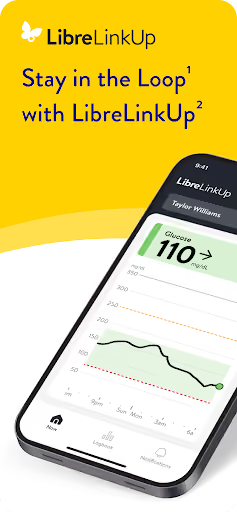
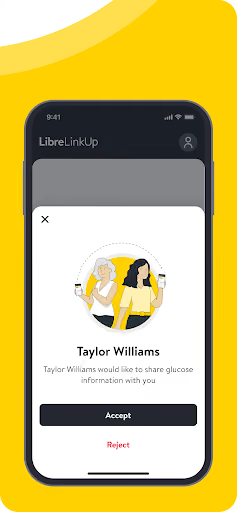
LibreLinkUp is Abbott’s companion app for family, friends, and caregivers monitoring people using compatible FreeStyle Libre systems. It is free, has a 4.1★ lifetime rating, and had 2,175,164 installs listed on 2026-09-05.
What it does
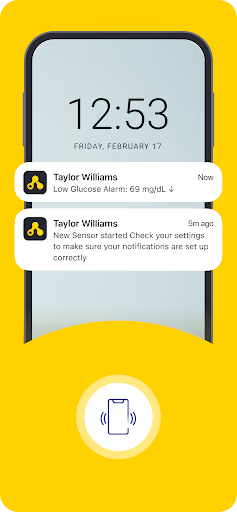
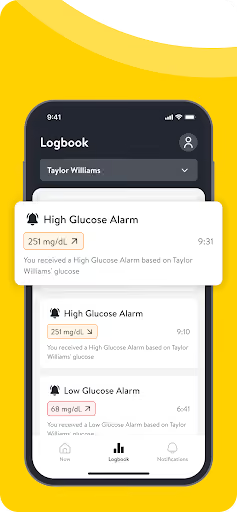
Shows recent glucose history, a graph, a logbook, and caregiver alarms after the sensor user invites you through the FreeStyle Libre family of apps.
What changed
The May 2026 version 5 update triggered complaints about no alerts, lost sessions, forced tutorials, slow startup, freezes, and graph/logbook regressions.
Why it is soft
Users are not asking for a new diabetes platform; they want the old caregiver workflow back: reliable alerts, fast readings, and usable history.
Strengths
The incumbent is not a strawman. Even angry reviewers describe the core idea as comforting, useful, or a “life saver” when it works. LibreLinkUp also benefits from Abbott’s device ecosystem, invitations from the primary Libre app, caregiver habit, a large install base, and the trust that comes with being the official companion to a prescription product.
Official integration
The app is part of the FreeStyle Libre workflow and uses LibreView registration and data transfer, which a solo competitor does not automatically inherit.
Caregiver habit
Parents, partners, and adult children already know the value proposition: remote visibility and alarms for someone they worry about.
Free price
Because LibreLinkUp is free, a paid competitor has to win on trust and reliability, not just on feature parity.
Market gap
The complaints cluster around safety-critical reliability first, then login/tutorial failures, then usability regressions from the redesign. The opportunity is a caregiver-first app that treats stale data and missed alarms as the primary product, not as edge cases.
Alerts and data reliability
The most serious complaint: caregivers say high/low alerts stopped, data is delayed, readings show “No data,” or the app disconnects when they need overnight monitoring.
Login and tutorial loops
Many reviews describe being logged out repeatedly, forced through terms and tutorials, or stuck behind an unresponsive “Start Tutorial” screen.
Graph and logbook regressions
Reviewers miss the old sticky graph cursor, clearer line, multi-day logbook, easier screenshots, and overview of multiple monitored people.
Alarm controls
A smaller but repeated ask: snooze, custom alarm tones, different sounds for different events, and more precise glucose thresholds.
Going to downgrade to 1*. Was once a very useful app till the Devs ruined it with an 'update'. Read the many reviews we're all saying similar things. We're not getting any low or high sugar alerts since the update. Please keep working on the app so family members can support our families like before the app updated to the new version. Just revert to the old app until you figure it out. Stop sending generic responses on here Newyu. It's been 3 months already!
Since the last update the quality dropped significantly. Very slow, often gives errors, always shows "No data" before finally loading the graph. Also, the vertical bar on the graph now won't stay where you put it, but will immediately return to the end of the graph (pretty useless). Waiting for all this mess to be fixed before updating my review. Also, it would be very useful if graphs from past days/weeks could be visualized.
- Build stale-data visibility before charts. The highest-value gap is not prettier glucose history; it is making caregivers instantly aware when readings are delayed, disconnected, or not safe to trust.
- Copy the pre-update caregiver workflow. Persistent login, no forced tutorial, a fast opening screen, multi-person overview, sticky graph cursor, and multi-day logbook directly answer the redesign complaints.
- Differentiate on alarm control, not medical advice. Snooze, custom tones, event-specific sounds, and precise thresholds are concrete caregiver requests and avoid pretending to replace clinical judgment.
Build complexity
Estimated, not derived: one developer, part-time, no funding, and no paid acquisition. This assumes a narrow caregiver dashboard, not a regulated sensor system; the biggest unknown is proving a reliable, user-authorized path around the LibreView-dependent sharing workflow described by the app.
| Workstream | Weeks |
|---|---|
| Android app shell, onboarding, permissions, privacy copy | 2.0 |
| Data-access proof around LibreView-dependent sharing | 5.0 |
| Stale-data detection, notification channels, alarm snooze | 3.0 |
| Graph, logbook, multi-person caregiver views | 2.5 |
| Background reliability QA across Android devices | 2.0 |
| Store listing, billing, support docs | 1.5 |
| Total | 16.0 |
Expected revenue
Estimated, not derived: because the official app is free and tied to a prescription device ecosystem, assume only anxious caregivers pay. Model a $4.99/month subscription with no paid acquisition and modest organic discovery from people searching for LibreLinkUp problems.
| Month 12, monthly | Count | Assumption |
|---|---|---|
| Installs | 1,200 | Organic only |
| Activated | 500 | Able to connect data |
| Retained | 250 | Still using after 30 days |
| Paid | 160 | $4.99/month |
| Revenue | $800 | Month-12 MRR |
Biggest challenges
The hard part is not drawing a better chart. It is earning trust in a caregiver safety workflow while depending on an ecosystem the solo builder does not own. The Play listing says LibreLinkUp requires LibreView registration, compatible devices, internet upload, invitations, prescription-product safety information, and Abbott-owned marks; those facts create a moat a small app cannot ignore.
Data dependency
If the app cannot reliably receive user-authorized Libre data, every alarm and graph feature collapses before launch.
Medical trust
Caregivers are reporting dangerous missed lows and highs; a one-person app with no support team has little room for notification bugs.
Store and wording risk
The product must avoid implying it replaces LibreLinkUp, Abbott, or clinical monitoring, while still explaining why someone should trust it.
AI angle
There is no strong AI wedge here. AI could help summarize glucose logs or draft caregiver support replies, but the reviews are not asking for prediction or coaching; they are asking for alarms, persistent login, fast loading, and reliable data transfer. AI does not solve the core dependency on LibreView sharing or the safety burden of missed notifications.
Useful but secondary
Natural-language summaries of logbook trends could be a later convenience feature for caregivers.
Not a moat
The incumbent’s failure is reliability and UX regression, not a missing model. Do not pitch this as an AI diabetes app.
Conclusion
Skip it. The complaint is real and emotionally intense, but the commercially attractive fix is “make the official LibreLinkUp work again,” not “pay an unknown solo developer for a medical-adjacent workaround.” Build only if you already have a safe, sanctioned way to access the data.
Time to v1
Caregiver subscription
Month-12 revenue
Decisive dependency