Abstract
The recent review set shows a real Android trust break around freezing, login failures, battery/data drain, permissions, ads, and weak support, but a solo builder would still be competing with a free Google app with a 4.8★ lifetime rating and 32,641,044 installs.
Background
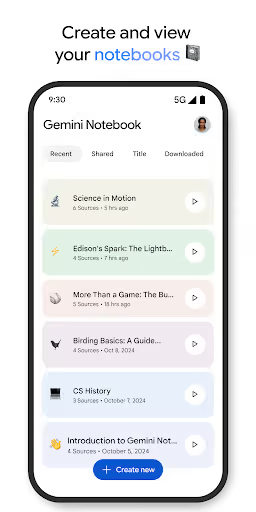
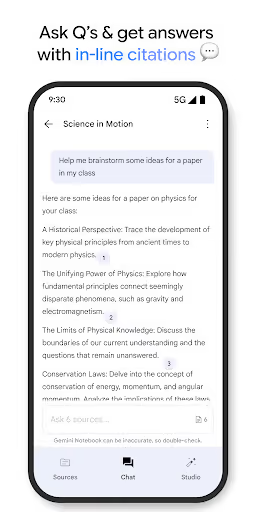
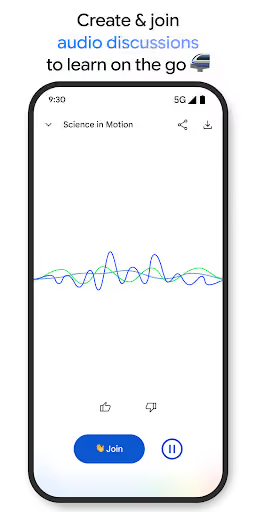
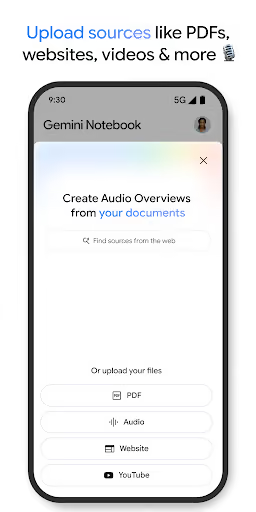
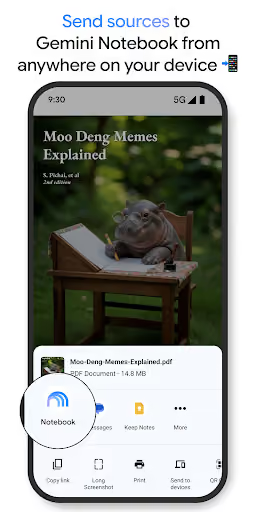
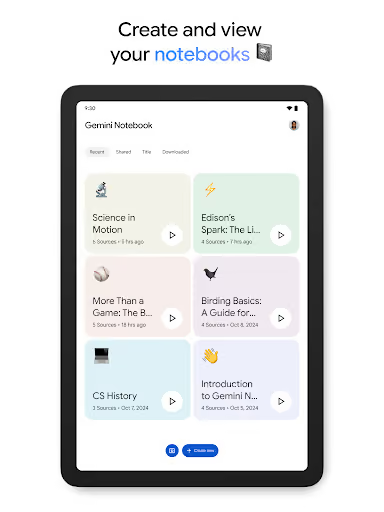
Gemini Notebook is Google’s AI notebook for uploading PDFs, websites, YouTube videos, and text, then asking cited questions or listening to podcast-style Audio Overviews. It is free, has a 4.8★ current lifetime average, and had 32,641,044 installs on 2026-08-07.
What it does
Turns uploaded sources into summaries, cited answers, connections, and audio-style learning experiences on mobile.
What changed
The listed Aug 12–14 reviews repeatedly say the Android experience became unstable after recent updates: freezing, endless loading, crashes, logout loops, and slower workflows.
Why it is soft
The soft spot is not lack of demand; it is reliability and trust on-device. A small app can target users who prefer fewer permissions, no ads, and predictable local behavior.
Strengths
This is not a weak incumbent. Gemini Notebook has Google distribution, a huge installed base, a free price point, a high lifetime rating, and a compelling core promise: source-grounded answers with citations plus Audio Overviews. A solo competitor would not be replacing the full product; it would be carving out a smaller reliability-and-privacy wedge.
Demand is proven
Millions of installs show that students, researchers, and professionals already want AI over their own sources.
Core feature is sticky
Uploaded notebooks, cited answers, and audio summaries create habit and stored context that a switcher may not want to rebuild.
Free is hard to beat
A paid indie app has to justify itself against a free Google app, not merely against a buggy small incumbent.
Market gap
The complaint clusters point to a narrow but real opening: users are not asking for a more magical AI model; they are asking for an Android app that opens, stays logged in, respects resources, and gives them a way to report problems.
Reliability failure
The most common pattern in the listed reviews is basic app failure: freezes, endless spinners, loading-screen hangs, crashes, and features that do not work.
Trust and device cost
Reviewers repeatedly mention battery drain, background data use, and permissions they believe the app does not need.
Account and support pain
Several reviews describe being logged out and unable to get back in, with no reply from support or no in-app bug reporting.
Ads and broken promise
Some users allege too many ads, slow output, half-working features, or that the app does not do the one thing it promises.
Tried everything, reinstall included, but it freezes after a few seconds and never recovers. It eats the battery like crazy. Do not waste your time.
Downloaded it after reading the good reviews, it logged me out and now it will not let me back in. No reply from support. Save yourself the trouble.
Downloaded it after reading the good reviews, it is slower than doing the same thing by hand. The last three updates changed nothing. Nothing but frustration.
- Build the boring reliable core first. Ship PDF/text/web source upload, cited Q&A, and saved notes before attempting podcast-style audio or interactive voice features.
- Make trust the product. No ads, minimal permissions, visible data controls, and an in-app bug report button directly answer the trust complaints.
- Avoid account lock-in for v1. Let users create local notebooks without mandatory login, then add optional sync later so logout failures cannot block the core workflow.
Build complexity
Estimated, not derived: one developer, part-time, no funding, and no paid acquisition. This is a narrow v1 competitor, not a full Gemini Notebook clone; Audio Overviews and live show participation are out of scope.
| Workstream | Weeks |
|---|---|
| Android app shell, notebook library, local storage | 2.0 |
| PDF, text, and basic web source ingestion | 3.0 |
| Embeddings, retrieval, citations, and answer UI | 3.0 |
| No-account mode, permissions audit, privacy controls | 2.0 |
| Billing, usage limits, model-cost guardrails | 2.0 |
| Battery/data QA, crash reporting, Play listing | 2.0 |
| Total | 14.0 |
Expected revenue
Estimated, not derived: assume no paid acquisition, a free local tier, and a $4.99/month Pro plan that funds AI calls, larger notebooks, and optional cloud sync. The free Google alternative keeps conversion modest.
| Month 12 funnel | Users | Assumption |
|---|---|---|
| Installs | 2,400 | Organic search, review-driven switching |
| Activated | 900 | Uploaded at least one source |
| Retained | 500 | Still using after 30 days |
| Paid | 240 | $4.99/month Pro |
| Revenue | $1,200 | Monthly recurring revenue |
Biggest challenges
The hard part is not making a demo chat-with-your-PDF app; it is shipping a dependable Android product around private documents while competing against Google’s free distribution and model access.
Cold-start trust
A new listing with few reviews must ask users to upload sensitive sources while the incumbent carries Google’s brand and a 4.8★ lifetime average.
Model-cost exposure
A free tier can become expensive quickly if users upload long PDFs or ask many questions; limits have to be strict from day one.
Mobile reliability bar
The wedge is reliability, so crashes, background data use, battery drain, or suspicious permissions would destroy the only reason to switch.
AI angle
There is a real AI build enabler, but not a durable AI moat. Off-the-shelf LLM, embedding, and speech APIs make cited source Q&A feasible for one developer; they do not solve distribution, trust, pricing against free, or Google’s ability to fix its Android release.
Where AI helps
Source chunking, semantic retrieval, citation-backed answers, and bug-report triage are much faster to integrate with existing APIs than to build from scratch.
Where AI does not help
It does not make the app cheaper to operate, guarantee answer quality, or create a feature Google cannot also ship.
Conclusion
Skip it. There is a clear reliability gap, but the commercially rational version is a small privacy-first niche app, not a head-on Gemini Notebook competitor. At an estimated 14 weeks for $1,200/month by month 12, the upside is too capped for a part-time solo builder unless they already have an audience in research, education, or privacy tools.
14 weeks
Time to v1
$4.99/mo
Pro subscription
$1,200
Month-12 revenue
4.8★ free
Moat that decided it