Abstract
Talabat’s recent reviews show a real trust gap around refunds, support, pricing, Pro prompts, and failed deliveries, but a solo builder should not try to clone the full food-and-grocery marketplace; the realistic wedge is a small restaurant-direct ordering app with transparent receipts and human escalation.

Background
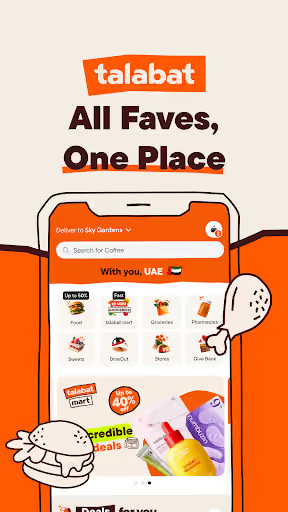
talabat: Food, grocery & more is a free food, grocery, pharmacy, flowers, pet supplies, pickup, Dine Out, rewards, and Pro delivery app operating across multiple Middle East markets. The Play listing still shows a 4.3★ lifetime rating and over 51 million installs in the supplied install snapshots, so the complaint set is serious but not evidence that the incumbent is collapsing.
What it does
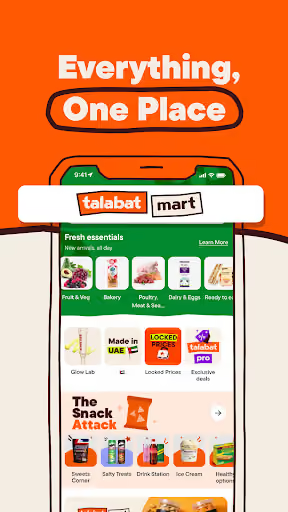
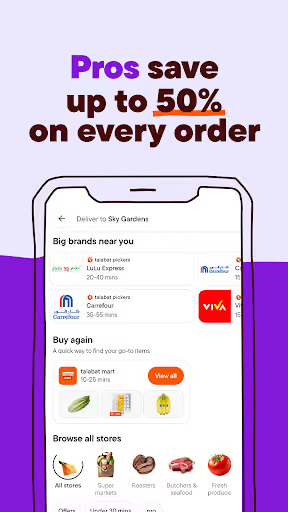
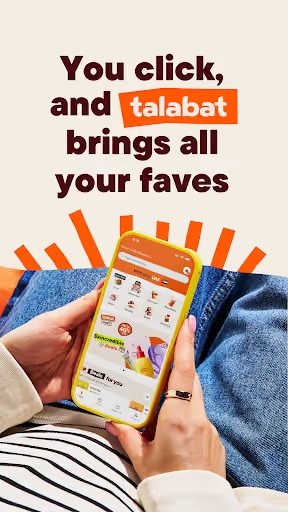
Aggregates restaurants, groceries, Talabat Mart, delivery tracking, payments, rewards, Pro perks, cashback-card promotion, pickup, and help-center flows.
What changed
Reviewers describe support becoming harder to reach, tickets closing without resolution, refunds being delayed or denied, and checkout nudging Pro, postpaid, promos, or fees in ways users call misleading.
Why it is soft
The soft spot is trust after something goes wrong, not restaurant coverage or consumer demand. That creates a wedge, but not an easy full-marketplace replacement.
Strengths
Talabat is not a strawman: it has massive retained habit, broad category coverage, multi-country availability, payments, tracking, rewards, and a visible install base a new entrant would have to earn from zero. A few positive reviews still praise fast delivery, many stores, easy ordering, and even strong customer service, which means the pain is uneven rather than universal.
Installed habit
The supplied install snapshots pass 51 million installs, giving Talabat default-app status in many user routines.
Supply density
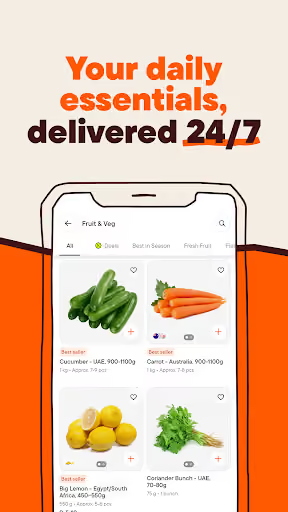
Food, groceries, mart, pharmacies, pet supplies, pickup, and deals make it useful even when users dislike a specific order experience.
Some service still works
Positive reviews mention fast deliveries, correct orders, simple flows, and helpful agents, so a competitor must beat the bad edge cases without assuming everything is broken.
Market gap
The complaint clusters are clear: support and refunds dominate the anger, followed by opaque pricing and Pro prompts, then wrong or late deliveries, with smaller but damaging app-trust issues around accounts, cards, search, favorites, and address handling.
Refunds and support dead ends
The most common complaint is paying for missing, wrong, cancelled, or undelivered orders and then hitting bots, closed cases, repeated apologies, voucher offers, or long refund waits.
Opaque fees, promos, and Pro
Reviewers describe higher menu prices, service and delivery fees, small-order fees, Pro perks that feel conditional, misleading discount codes, and subscription cancellation or card-removal anxiety.
Fulfillment failures
Wrong items, missing groceries, unavailable stock after payment, late deliveries, orders marked delivered but not received, and rider/customer-safety incidents recur across the sample.
App and account trust
A smaller cluster flags broken order placement, crashes, account freezes, missing favorites, website/app mismatch, deleted cards still charged, and awkward search or checkout flows.
Sadly, the app has changed from allowing quick support ticket chats to requiring a 24-hour wait if something goes wrong with an order. The absence of a proper support team makes things even more frustrating. It’s unfortunate to see this app decline, but there are better alternatives now. fun update, the app doesn't have support incase anything goes wrong in your order! unless you pay to be pro! wow
The pricing on Talabat is very misleading. The same food items are often 2–3 times more expensive than the prices at the restaurant if you dine in or order directly. On top of these inflated menu prices, customers are also charged delivery and service fees. The discounts don't feel like real savings because the menu prices appear to be increased first, and then a discount is applied to make it look like a great deal. In reality, you're still paying much more than the restaurant's actual prices.
1-The App makes you press on the search bar twice, which is on the top, just to open the search! (before it was better, as having the search icon on the bottom rather than needing to click on the top bar twice just to do the same thing) -2-Also the evaluation of the restaurants is a mess.. can't trust them..you evaluate the restaurant, and they take it on all the dishes. the high fluctuations seems fake . - 3-Plus can't find my favorite list. 4-No connection between talabat app and website.etc.
- Do not clone the rider marketplace. A solo builder should start with pickup and restaurant-direct delivery in one dense area, because the reviews punish trust failures, not the absence of another logistics network.
- Make every receipt and refund auditable. Show item-level prices, substitutions, photos, timestamps, refund status, and a visible escalation path so the user never feels trapped in a closed ticket.
- Keep checkout boring. No surprise Pro prompts, postpaid interstitials, disappearing discounts, hidden fees, or unclear card/subscription controls; the gap is transparency more than feature breadth.
Build complexity
Estimated, not derived: one developer, part-time, no funding, no paid acquisition. This is for a restaurant-direct ordering app in one city with pickup/direct-delivery handoff, not a Talabat-scale fleet, mart, pharmacy, rewards, credit-card, and multi-country marketplace.
| Workstream | Weeks |
|---|---|
| Consumer app: browse, cart, checkout, order status | 3.0 |
| Restaurant admin: menus, availability, incoming orders | 3.0 |
| Transparent receipts, substitutions, refund ledger | 2.5 |
| Payments, subscriptions, basic dispute workflows | 2.0 |
| Restaurant onboarding tools and QR/share links | 1.5 |
| QA, Play listing, analytics, launch operations | 2.0 |
| Total | 14.0 |
Expected revenue
Estimated, not derived: consumers use the app free; revenue comes from local restaurants paying $50/month for the order inbox, listing, transparent receipt flow, and direct customer relationship. The month-12 funnel assumes organic restaurant QR codes, neighborhood sharing, and founder-led onboarding, not paid ads.
| Month 12 funnel | Volume | Assumption |
|---|---|---|
| Installs | 2,400 | Local organic installs |
| Activated diners | 900 | Browse or place first order |
| Retained diners | 350 | Repeat monthly users |
| Paid | 24 restaurants | $50/month each |
| Revenue | $1,200 | Month-12 MRR |
Biggest challenges
The hard part is not the app screens; it is earning two-sided trust without Talabat’s restaurant coverage, riders, brand, support staff, and payment/refund machinery. A single part-time builder will feel every operational edge case personally.
Cold-start supply
Consumers will not open a food app with only a few restaurants, and restaurants will not pay until they see real orders.
Operational burden
Every wrong item, refund dispute, unsafe delivery, or angry diner becomes founder support unless the scope stays narrow.
Trust and compliance
Handling payments, stored cards, refunds, subscriptions, food complaints, and potentially multiple languages creates review and legal risk even before scaling.
AI angle
There is a genuine but limited AI angle: AI can speed up menu ingestion and triage complaint evidence, but it does not solve the marketplace moat, restaurant acquisition, delivery reliability, or refund accountability that decide this opportunity.
Useful AI shortcut
Use vision/OCR to convert restaurant menus and receipts into structured items, and classify refund tickets by missing item, wrong item, late order, duplicate charge, or safety issue.
Not a moat
AI cannot replace human escalation when money, food safety, or driver behavior is disputed; the trust gap needs policy and operations, not just chat automation.
Conclusion
Skip it. Do not build a full Talabat competitor as a solo part-time project. The user pain is real and loud, but the incumbent’s install base, merchant network, logistics, payments, and support surface are too large. If you build anything, make it the narrower restaurant-direct wedge estimated here: 14 weeks to v1 and about $1,200/month by month 12.
14 weeks
Time to v1
$50/mo
Restaurant subscription
$1,200
Month-12 revenue
51.3M
Incumbent install base