Abstract
USAA DriveSafe has a real product gap: recent reviewers repeatedly describe battery drain, excessive background tracking, missed drives, false phone-use events, harsh-braking penalties, and no useful dispute path. The commercial problem is that the app’s main value is tied to USAA insurance discounts, so a solo builder cannot simply ship a replacement and give users the same benefit. Build only a narrow companion or proof-of-concept; skip a direct consumer competitor unless you already have an insurer distribution partner.
Background
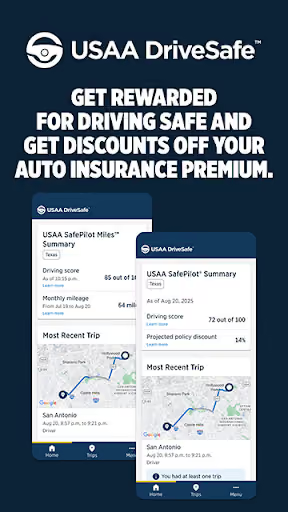
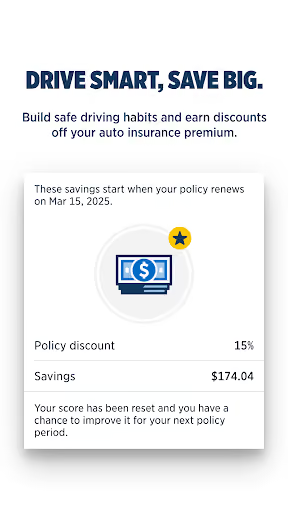
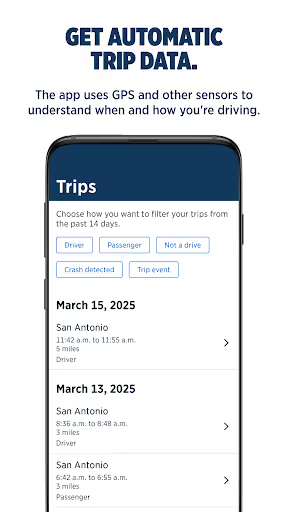
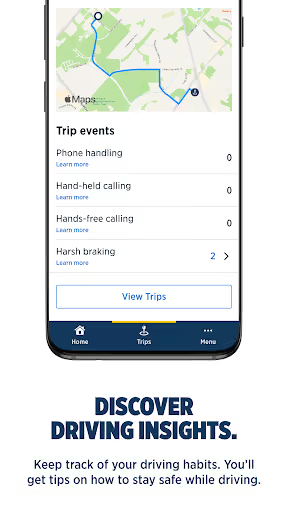
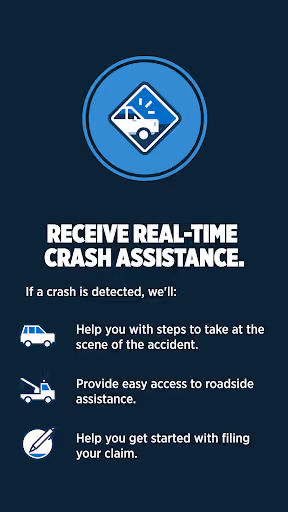
USAA DriveSafe is a free Android app for USAA members with an active auto insurance policy in select states who are enrolled in USAA SafePilot or SafePilot Miles. It records trips automatically using GPS and sensors, scores driving behavior, supports crash assistance, and can help users earn auto-insurance discounts.
What it does
Tracks trips, maps driving, measures habits such as phone use and harsh braking, and connects the result to an insurance program.
What changed
Reviewers describe a recent update/outage period after which the app drained battery, stopped recording drives, produced login errors, or came back with more false events.
Why it is soft
The opening is product trust, not basic demand: the app has 1,200,738 installs and a 3.9★ lifetime rating, but recent users are spelling out exactly what a fairer, lower-drain telematics app should do.
Strengths
Clear user motivation
Even angry reviewers often say they keep the app only for the potential discount, which means the habit is financially motivated and hard to dislodge.
Broad feature surface
Trip capture, driving insights, crash assistance, and claims support make the incumbent more than a simple GPS logger.
Some users still like the idea
A few reviews still praise the chance to save money or say the concept made them more mindful while driving, so the category itself is not rejected.
Market gap
The gap is not “make another driving app.” It is “make a driving app people can trust while it runs in the background and affects money.” The recurring complaints cluster into four practical asks.
Battery and background tracking
The most common complaint is that the app runs constantly, drains battery, heats phones, uses data, or fights battery-saver settings even when the user is not driving.
False scoring events
Reviewers repeatedly say the app marks phone handling while parked, hands-free calls, passenger phone use, potholes, sudden evasive braking, or traffic events as unsafe driving.
No appeal or explanation
A recurring ask is for dispute tools, comments, weightings, and clearer score logic, especially because a wrong event can affect an insurance discount.
Reliability after the outage
A smaller but serious cluster describes login errors, missed trips, technical-difficulty banners, and uncertainty about whether unrecorded drives will count.
This app needs to be fixed! First off, it recorded 3 calls as hand-held, when, in fact, I was sitting still, parked, at a gas station, with no way to edit!! Why did I get dinged? Second, this app KILLS the battery in my new S25 Ultra, requiring far more charge cycles. In turn, those repeated charge-ups reduce over-all battery life, and that, frankly, will cost me $$ in down-the-line phone repair. Please support Battery-Saving mode. You don't need to measure while I sleep!
Would be nice to see how each action is weighted towards the score(does hands free calling count as much as phone handling). The app usually works ok, but other times will say I handled my phone for an entire drive while it was on the mount. The app will kill your battery in a matter of hours if you don't Force Stop it right after every drive. You then need to open the app for every drive. I automated that part, I just have to remember to force stop when I get out of my car.
- Make battery behavior the headline feature. Use explicit trip start/stop detection, visible background-state controls, and battery-saver compatibility because users are not just asking for lower drain; they are saying the current app makes the phone unreliable.
- Build a review-and-dispute workflow first, not last. Let users mark parked calls, passenger phone use, work vehicles, other insured vehicles, potholes, and evasive braking, with comments attached to each trip event.
- Explain the score like money depends on it. Show event weight, confidence, and before/after score impact because reviewers are not merely annoyed by low scores; they do not understand why the score changed.
Build complexity
Estimated, not derived: one developer, part-time, no funding, no paid acquisition. This is for a consumer-grade v1 or insurer demo, not a full USAA replacement with underwriting, claims, crash-response operations, or guaranteed insurance discounts.
| Workstream | Weeks |
|---|---|
| Low-drain trip detection and background permissions | 4.0 |
| Trip timeline, event capture, and local storage | 3.0 |
| Event review, reclassification, and dispute notes | 2.0 |
| Transparent scoring dashboard | 2.0 |
| Billing, listing, onboarding, and support docs | 1.0 |
| Device QA, battery testing, and error recovery | 2.0 |
| Total | 14.0 |
Expected revenue
Estimated, not derived: because a solo builder cannot grant USAA discounts, the revenue model assumes a $4.99/month Pro plan for exportable trip records, score explanations, and dispute packs, aimed at users who want evidence and transparency rather than a formal insurance replacement.
| Month 12, monthly | ||
|---|---|---|
| Installs | 3,200 | |
| Activated | 1,600 | 50% |
| Retained | 800 | 25% |
| Paid | 480 | 15% |
| Revenue | $2,400 | $4.99/month Pro, rounded |
Biggest challenges
No insurance lever
The hardest blocker is distribution: angry users still keep USAA DriveSafe because it is tied to an insurance discount, and a solo Play Store app cannot grant that benefit without an insurer partnership.
Permission and privacy trust
A new entrant has to ask for the same sensitive background location and sensor access that reviewers already describe as creepy, battery-draining, and financially consequential, but with no USAA brand trust behind it.
Device-level telematics QA
The product promise depends on low-drain trip detection and fair event classification across many Android phones, vehicles, mounts, passengers, Bluetooth setups, potholes, and stop-and-go scenarios — exactly the kind of long-tail QA a part-time solo builder is worst equipped to prove.
So the solo-friendly version is a companion evidence log or insurer demo, not a true replacement for the enrolled discount app.
AI angle
The event-scoring complaints — parked calls, passenger phone use, potholes read as hard braking — are a sensor-classification problem, and a model reading accelerometer, gyroscope and phone-state together can cut false positives far better than a simple motion-threshold heuristic.
Without AI
Hand-tuned thresholds on speed and motion sensors misread parked calls, mounted phones and potholes as unsafe events — the same complaint driving reviewers away from USAA's app now.
With AI
A classifier trained on labeled trip data separates handheld-while-driving from parked/passenger/road-noise events with a confidence score the dispute workflow can show — it doesn't change the verdict below, which turns on insurer-only distribution, not detection accuracy.
Conclusion
Skip it. The product gap is real, but the business gap is not solo-builder friendly: users tolerate the pain because the app is connected to a USAA insurance discount, and you cannot ship that relationship from the Play Store. Build a narrow telematics proof or dispute-log companion if you want the learning, but do not build a direct consumer competitor as the main bet.
14 weeks
Time to v1
$4.99/mo
Pro plan for evidence and exports
$2,400
Revenue at month 12
USAA-only
Discount access decides the market