Abstract
Driversnote automatically tracks driving for tax deductions and reimbursement, and reviewers confirm the tracking itself is accurate. The recurring complaint is severe battery drain and a price reviewers repeatedly compare unfavorably to named, cheaper competitors.

Background
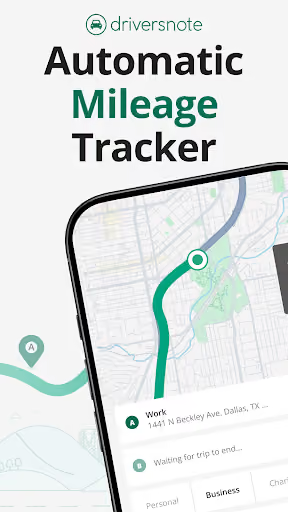
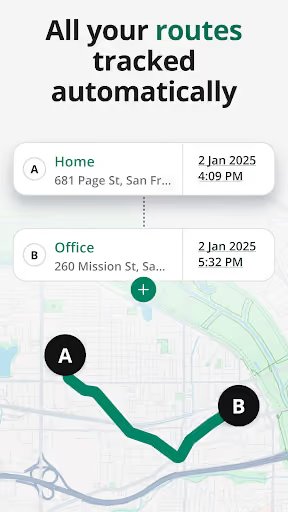
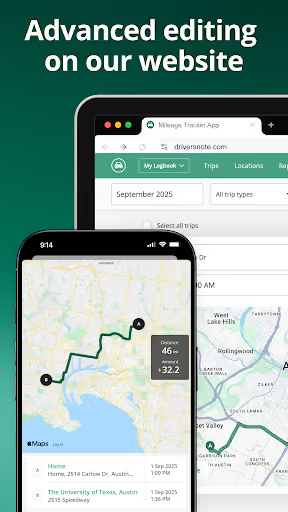
With nearly 3.8 million installs, Mileage Tracker by Driversnote automatically logs driving trips and generates IRS-compliant mileage reports. Reviewers confirm the tracking accuracy but describe battery usage as high as 20%+ of total daily battery, and pricing (up to ~$17-20/month) well above what they say they'd pay.
What it does
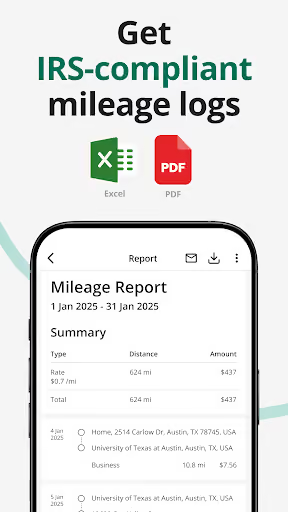
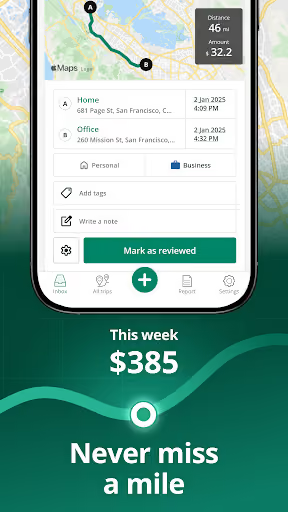
Auto-detects driving trips via GPS/motion, categorizes them as business or personal, and generates IRS-compliant mileage logbooks for tax deductions or reimbursement.
What changed
Nothing recent — this is a persistent complaint: continuous background GPS tracking drains the battery, and the free tier caps at just 15 trips/month before a paid subscription is required.
Why it is soft
The tracking accuracy itself is praised as near-perfect by many long-time users — the complaint is entirely about battery cost and price, not whether it works.
Strengths
Long-time users trust the accuracy enough to rely on it for actual IRS audits, and several explicitly credit it with real tax savings — the core tracking problem is solved, just not efficiently or cheaply.
Trusted accuracy
"99% accuracy" and "audit-ready" come up repeatedly from multi-year users who rely on it for real tax filings.
Proven willingness to pay
Users are already paying $10-20/month for this category — the opportunity isn't creating demand, it's serving it more cheaply and efficiently.
Market gap
The recurring complaints, most-common first:
Severe battery drain
The most common complaint by a wide margin: 15-20%+ of daily battery use, phones getting hot, attributed to continuous background GPS tracking.
Price vs named alternatives
Reviewers name specific cheaper competitors (TripLog free/$5, MileIQ, Gofar) and say Driversnote's $10-20/month is simply too high for the same job.
Free tier too small
15 trips/month free is described as a hidden limit that surprises users mid-use, forcing an unplanned subscription decision.
Tracks phenomenally... also drains my battery just as well. System wake ups above 250 times and it has used twice as much battery in the background throughout the day than the two hour teams call I had with my screen and camera on.
way too expensive. $10 per month subscription for this type of app is absurd. There are cheaper alternatives that work. I am using TripLog. For mileage tracking it's free. for $5 per month you get the premium subscription
- Use motion/activity recognition, not continuous GPS polling. Android's activity-recognition + geofencing APIs detect driving without keeping GPS hot in the background the whole day.
- Price at the $20-30/year point reviewers name as fair. Several reviewers explicitly say this is what they'd be willing to pay, well below the incumbent's $130-200+/year.
- Make the free-tier trip limit visible upfront. A limit that surprises users mid-month is what turns them into 1-star reviews.
Build complexity
Estimated, not derived: one developer, part-time, no funding and no paid acquisition. The core fix (battery-efficient detection) is a known Android pattern, not novel research.
| Workstream | Weeks |
|---|---|
| Motion/activity-recognition + geofenced trip detection | 2.0 |
| Trip categorization UI | 1.0 |
| IRS-style PDF/Excel report export | 1.0 |
| Billing | 1.0 |
| Total | 5.0 |
Expected revenue
Assumes $2.50/month (~$25-30/year), the price point reviewers themselves suggest as fair for this category.
| Month 12, monthly | ||
|---|---|---|
| Installs | 5,000 | |
| Activated | 2,600 | 52% |
| Still on at 30d | 1,400 | 28% |
| Paid | 500 | 10% |
| Revenue | $1,250 |
Biggest challenges
Not the detection algorithm — matching Driversnote's tracking accuracy without the battery cost, since the two are in real engineering tension (more frequent polling improves accuracy but burns more battery).
Accuracy vs. battery tradeoff
Getting trip detection accurate enough to be audit-ready while staying battery-light is the actual hard problem, not a quick fix.
IRS-compliance credibility
Users are trusting this app with real tax filings — the report format and reliability need to hold up to genuine scrutiny from day one.
AI angle
No genuine AI angle — this is a battery-efficient sensor/geofencing engineering problem, not one AI makes meaningfully easier or cheaper to solve.
Conclusion
Build it. Users already pay for this category and name their own fair price point — the fix is a known battery-efficiency pattern, not a novel product idea.
Time to v1
Well below incumbent's $10-20/mo
Revenue at month 12
Helpful votes naming a cheaper alternative