Abstract
BuzzKill sits at 4.6★ and is press-praised (Android Authority, Lifehacker) — and it's already a small, indie-built app filling a genuine Android gap (fine-grained notification control the OS doesn't natively offer). Its remaining complaints are mostly OEM-specific reliability issues — aggressive battery optimization on Xiaomi, Samsung, and Pixel devices silently killing its background service — a platform-level problem every competitor in this category would inherit identically. There's little room to out-build an already-good solo product on a bug class nobody outside Google can actually fix.
Background
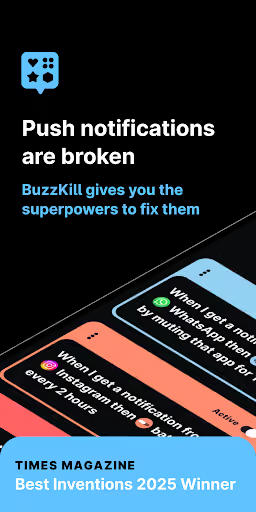
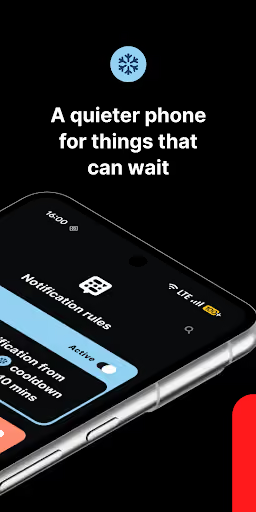
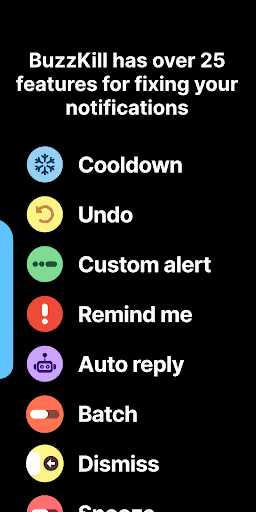
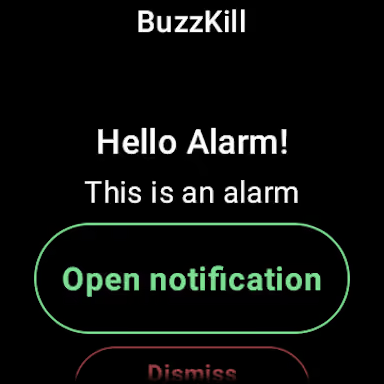
BuzzKill is an independently-built (Play Store listing) $3.99 notification manager: cooldowns, custom alerts, auto-dismiss, auto-reply, and snoozing, built entirely offline with no ads or trackers.
What it does
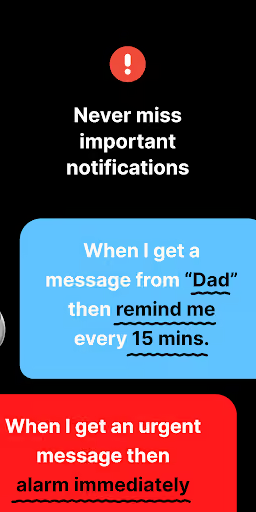
Rule-based notification filtering/automation — batch, mute, escalate, or auto-dismiss notifications per app, contact, or keyword.
What changed
Nothing structural. Complaints are scattered device-specific reliability bugs (rules not firing on certain OEM skins), not a broken promise.
Why it is not very soft
The underlying cause — Android OEM battery/background restrictions — affects every app in this category, so a competitor inherits the same failure mode.
Strengths
This is already the success story a solo builder would want to be: a small team (one developer, by the tone of support replies) built a beloved, press-covered, no-tracking utility that Android itself is missing. That's a hard act to follow, not a gap to fill.
Market gap
The recurring complaints, grouped into clusters.
OEM reliability
Rules silently fail to fire on specific devices/OS versions (Galaxy S21 Ultra, Pixel 8 Pro on Android 17, Xiaomi phones unsupported) due to aggressive background restrictions.
No widget / limited quick-toggle
A vocal minority wants a home-screen widget to toggle rules without opening the app.
Doesn't actually dismiss notifications most the time. I have a rule set that when an app shows any notification that BuzzKill will automatically dismiss it. BuzzKill will show me that it sees the notification and the filters that are set should trigger the rule, yet it never does.
- Don't compete head-on. The incumbent is a well-executed indie app in a niche that rewards being first and trusted, not a fumbled product.
- If entering, focus entirely on OEM reliability engineering. Aggressive testing/workarounds across Samsung, Xiaomi, and stock Android would be the only real differentiator — and it's still an uphill platform fight.
- Add the widget the incumbent lacks. A small, concrete, buildable feature gap, though not enough alone to justify a full competitor.
Build complexity
Estimated for one developer, part-time, no funding. The rules engine itself is a moderate, well-scoped build; OEM-specific reliability workarounds are where time actually goes.
| Workstream | Weeks |
|---|---|
| Notification listener + rules engine | 3 |
| Cooldown/dismiss/reply/snooze actions | 2 |
| OEM battery-optimization workarounds | 2 |
| Listing + billing | 1 |
| Total | 8.0 |
Expected revenue
Assumes a $3.99 one-time price matching the incumbent, into a niche with proven demand but an already-loved leader, so growth depends on the widget differentiator and generic discovery.
| Month 12, monthly | ||
|---|---|---|
| Installs | 11,000 | |
| Paid | 225 | 2.0% |
| Revenue | $900 |
Biggest challenges
The dominant complaint (rules not firing) traces back to Android's own OEM battery-optimization behavior, which every notification-automation app fights and none can fully solve — a solo builder inherits this exact platform limitation, not a fixable code bug.
AI angle
A modest angle: an LLM could help auto-suggest rules from a user's notification history ("you always dismiss X, want a rule for that?"), a nice-to-have that doesn't address the core OEM reliability complaint.
Conclusion
Skip it. An already-successful solo-built app whose remaining bugs are an Android platform limitation every competitor would inherit unchanged.
8 weeks
Time to parity
$3.99
One-time, estimate
$900
Revenue at month 12
4.6★
Lifetime rating