Abstract
Learn Fast & Speak Fluently has huge proven demand and a clear self-inflicted wound: users say the product is buried under ads before they can evaluate the lessons, while some also complain about language selection, weak audio, and inaccurate content. A solo builder should not try to out-Duolingo the market, but a narrow, ad-free, beginner-focused app could win frustrated search traffic if it ships with better onboarding and trustworthy lesson quality.
Background
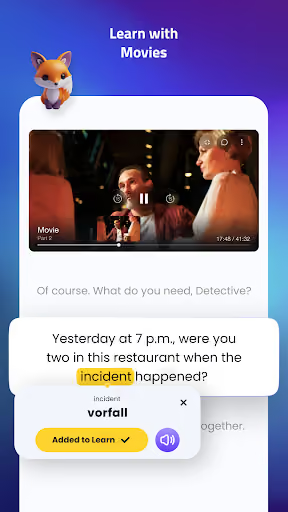
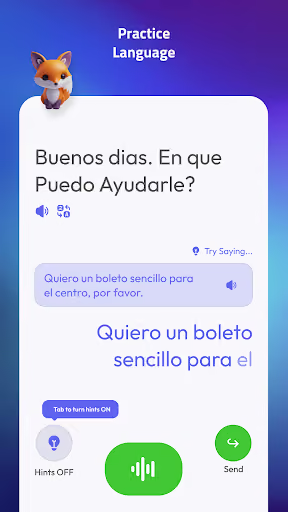
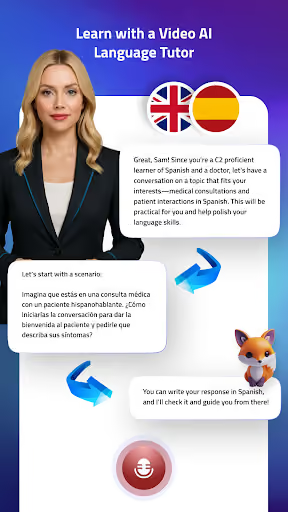
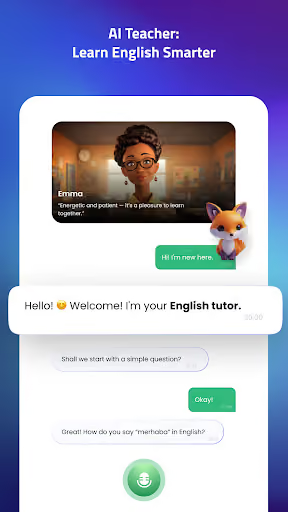
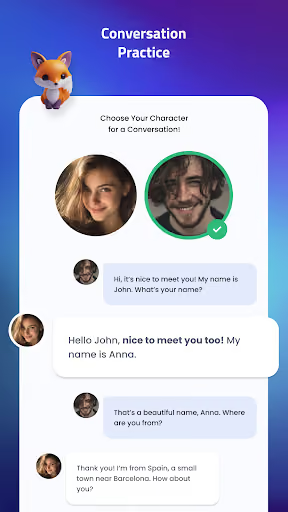
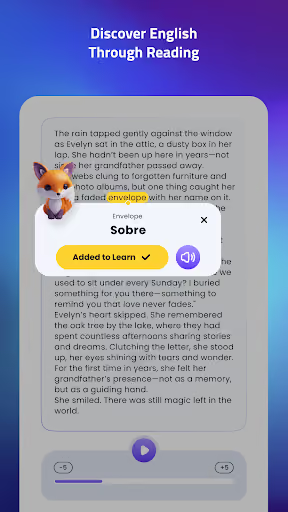
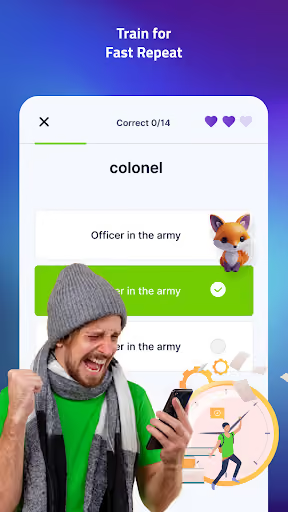
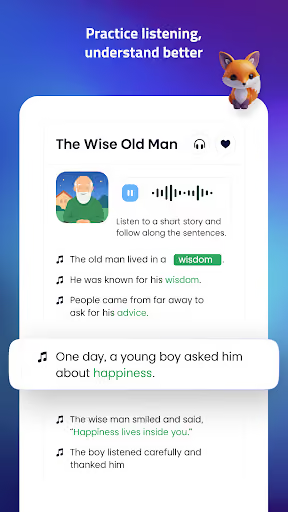
Learn Fast & Speak Fluently is a free language-learning app with a 3.7★ lifetime rating and 7,482,473 installs as of 2026-08-04. Its listing promises multi-language lessons, reading-based learning, word practice, pronunciation audio, and an AI video teacher.
What it does
Beginner language practice across categories, reading, vocabulary, audio pronunciation, and AI-teacher-style interaction.
What changed
Recent reviewers describe the experience less as a learning app and more as an ad funnel, sometimes before the first usable lesson.
Why it is soft
The demand is real, but trust is damaged: users are objecting to ads, misleading free positioning, forced upgrades, glitches, and content accuracy.
Strengths
This is not a dead category or a completely broken concept. Positive reviewers still say it helps them learn English, German, pronunciation, and practical language basics; the free positioning also clearly attracts a large audience. A competitor has to respect that the incumbent already has scale, broad language coverage, and a simple promise people understand.
Proven demand
7,482,473 installs show that beginner language practice still pulls meaningful Play Store interest.
Simple value proposition
The promise is easy to grasp: choose a language, learn vocabulary, hear pronunciation, and practice through lessons.
Some users still like it
Several five-star reviews praise it as useful, practical, fun, and friendly for learning.
Market gap
The gap is clear but not effortless: users want the same beginner-learning promise without the hostile ad load, confusing language setup, and shaky content quality.
Ads block the lesson
The most common complaint is that ads appear immediately, repeatedly, or so aggressively that users uninstall before testing the product.
Free feels misleading
Some reviewers say they cannot judge the free version, are pushed toward premium too early, or still see ads after purchase.
Language setup fails
A smaller but important cluster mentions missing native-language options, being forced into Spanish, or lessons opening in the wrong language.
Audio and content quality
Reviewers call out crackly voices, wrong pronunciation, inaccurate Japanese, robotic reading, and missing transliteration support.
I don't normally leave reviews, but this app's level of suckage inspired me. It looks like it has potential to be a cool app, but who would know for sure when you spend more time stuck on ads than being able to explore content. It feels like you are stuck in one bad stream of malware hell. Not saying it has malware, but you get the idea. Not even my free apps are this bad. Google Play really should give the option of zero stars. This app only got a 1 because zero wasn't an option. 🤷♀️
waaayyy too many ads to be able to do anything at all in this app, it doesn't allow you to repeat it back so you know your saying it right, doesn't ask what language you want to learn and starts with Spanish which yes I want to learn Spanish but what if I wanted to learn something else
I tried to practice Japanese but most of the lessons are in English and there are some mistakes. Also you end up watching more advertisements than the lessons you want to practice.
- Make the free tier usable before asking for money. Let users complete a real first lesson with no interstitial ads, then offer an ad-free subscription only after value is proven.
- Start narrow and accurate. Do not promise every language on day one; ship a few well-tested language paths with correct target/native selection.
- Compete on trust, not feature breadth. Clear pricing, no adult or sketchy ad inventory, repeat-after-me practice, readable transliteration, and content QA matter more than an AI-teacher headline.
Build complexity
Estimated, not derived: one developer, part-time, no funding, and no paid acquisition. This assumes a focused v1, not a full clone of every language and AI video feature in the listing.
| Workstream | Weeks |
|---|---|
| Onboarding, native language, and target language picker | 1.0 |
| Lesson shell, vocabulary practice, progress, and spaced review | 2.0 |
| Initial lesson content and language QA | 2.5 |
| Audio, repeat-after-me flow, and transliteration support | 1.5 |
| Reading stories, tap-to-translate, and dictionary flow | 1.5 |
| Subscription, free trial limits, Play listing, privacy, and polish | 1.5 |
| Total | 10.0 |
Expected revenue
Estimated, not derived: the model is a usable free tier plus a $4.99/month ad-free subscription with extra review, pronunciation practice, and reading content. With no paid acquisition in a crowded language category, month-12 revenue should be treated as modest unless organic search and review quality compound.
| Month 12 funnel | Assumption | Notes |
|---|---|---|
| Installs | 2,400/month | Organic Play Store and complaint-led positioning |
| Activated | 1,000 | Complete first real lesson |
| Retained | 420 | Return for practice or reading |
| Paid | 360 subscribers | Active paid base by month 12 |
| Revenue | $1,800/month | $4.99/month rounded |
Biggest challenges
The hard part for a solo builder is not making flashcards; it is earning trust in a brutally competitive language-learning category while avoiding the same quality trap. A broad multi-language clone will collapse under content QA, audio issues, and support demands.
Cold-start store trust
A new app has no reviews while the incumbent has millions of installs, even if many recent users are angry.
Language QA burden
Wrong Japanese, wrong pronunciation, and missing native-language support are exactly the kinds of mistakes a solo builder can accidentally repeat.
Monetization discipline
The opportunity exists because ads feel abusive; copying that revenue pattern would destroy the differentiator.
AI angle
There is a real AI angle, but it is not “add an AI teacher” as a marketing badge. AI can reduce the cost of drafting graded stories, generating example sentences, checking translations, and providing pronunciation feedback, all of which directly address the content and audio complaints above. It is still not a moat: the incumbent already claims AI, and a solo builder must QA outputs carefully.
Useful AI
Generate beginner texts, distractors, transliterations, and speech-feedback hints faster than hand-writing every exercise.
Dangerous AI
Unreviewed AI content is how you get robotic voices, inaccurate lessons, and the same “AI Slop” perception one reviewer already called out.
Conclusion
Build a focused version, not a full clone. The market gap is real because users are explicitly asking for fewer ads, clearer language choice, and better lesson quality. But language learning is crowded and content-heavy, so the honest solo-builder play is a narrow ad-light app with a trustworthy first lesson, not a giant AI language platform.
10 weeks
Time to v1
$4.99/mo
Ad-free subscription
$1,800
Month-12 revenue
7,482,473
Installs prove demand