Abstract
Learna has real demand and users praise its AI speaking practice, but recent reviews repeatedly attack the same breach of trust: ads implying the app is free, followed by a short trial, card requirement, paid subscription, and occasional billing or support frustration. A solo builder can compete on transparency and a gentler freemium model, but the category is crowded and voice-AI costs make this a modest, not explosive, opportunity.
Background
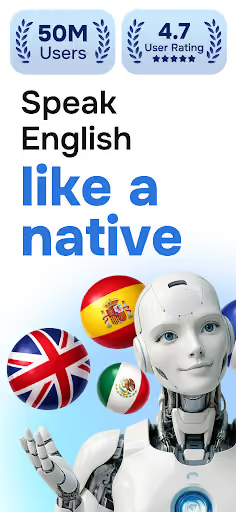
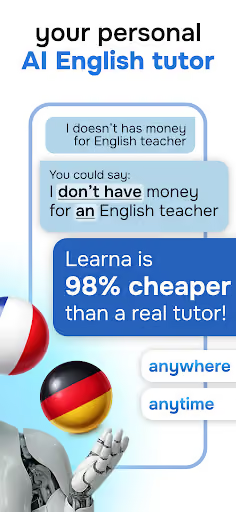
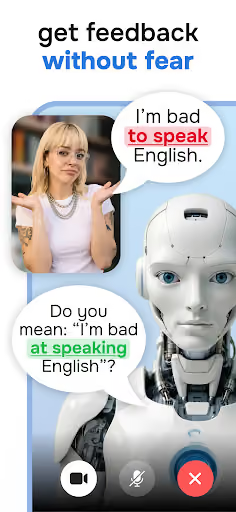
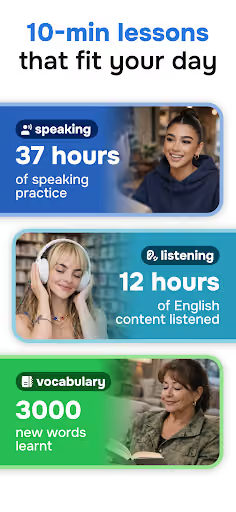
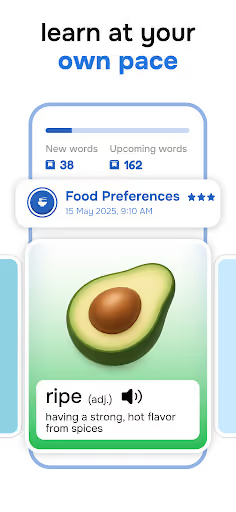
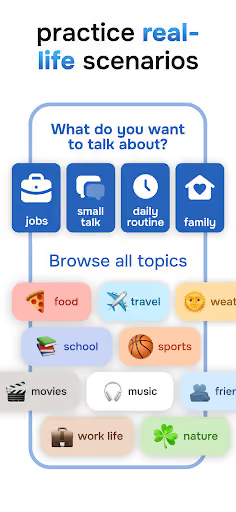
Learn English, Spanish: Learna is a free-to-install AI language tutor for English and Spanish with conversation practice, grammar, vocabulary, pronunciation exercises, progress tracking, and an AI virtual chat character. The listing shows a 4.6★ lifetime rating and 45,516,850 installs as of 2026-08-05, so this is not an unknown product — it is a large app with visible acquisition and an active user funnel.
What it does
AI-led English and Spanish practice: conversation, grammar, vocabulary, pronunciation, reading, goals, and progress.
What changed
Reviewers say the ads promise free learning, but the app quickly asks for a trial, card, subscription, or paid plan.
Why it is soft
The complaint is less “AI tutors do not work” and more “I do not trust this paywall.” That creates room for a smaller app with clearer terms.
Strengths
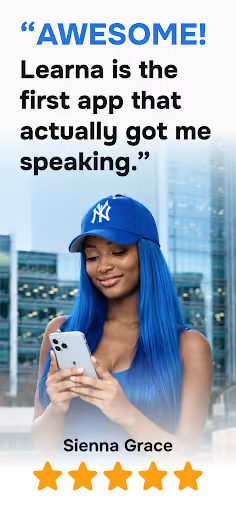
Learna still has meaningful strengths: some reviewers say the app is educational, interesting, confidence-building, and useful for speaking practice. The product idea is validated by its large install base, and even some critical users say they like the layout, the “real conversation” flow, or the basic concept before objecting to price or access.
Validated use case
People want low-pressure speaking practice with AI, especially for English and Spanish.
Positive habit signal
Several high-star reviews describe confidence, learning progress, and enthusiasm after early lessons.
Clear incumbent playbook
The listing itself specifies the core feature set a competitor must cover: chat, feedback, grammar, vocabulary, pronunciation, and progress.
Market gap
The gap is not that Learna lacks demand; it is that the acquisition promise and the monetization experience feel mismatched. The most common complaint is misleading “free” advertising, followed by price shock, billing/support distrust, and product-quality issues around speech recognition or lesson flow.
Misleading free claim
Reviewers repeatedly say ads present the app as free, but usage quickly turns into a free trial, card entry, or paid subscription.
Price shock
Users cite $12.99 monthly, $12.99 weekly, $12 per week, and other confusing amounts; the consistent issue is that the charge feels high or unclear.
Billing and support trust
A smaller but serious cluster mentions unwanted charges, refund frustration, restore-purchase failure, and unresolved support.
AI feedback quality
A few reviewers say the app accepts wrong pronunciation, ignores answers, changes languages unexpectedly, or has mic/connectivity bugs.
i saw an ad while using another app. In that ad it was claimed that the app is totally free but after downloading and getting all the information the app gave me 7 days free trial and after that payment needed to be done. i m not against u charging for ur services but please don't make misleading advertisement.
I love the layout and the flow of having a "real conversation". The APP is good so far, but it is too expensive @12.99 a WEEK!! 😕
this app is a scam. I meant to read some words wrong the pronunciation but the app keeps saying excellent and never correct me. haha Really scam.
- Make the free tier genuinely usable. Offer a daily speaking allowance without a card, then clearly cap heavy AI usage. This directly answers the dominant “free means free” complaint.
- Price simply and visibly. Show the paid plan before onboarding, avoid weekly ambiguity, and make cancellation/refund instructions prominent.
- Win on speech feedback honesty. If pronunciation confidence is low, say so; do not mark every near-answer as correct. Trust is the product.
Build complexity
Estimated, not derived: one developer, part-time, no funding, and no paid acquisition. A narrow v1 should not try to clone all language-learning content; it should focus on English/Spanish AI speaking drills, a small lesson library, transparent limits, and reliable subscription handling.
| Workstream | Weeks |
|---|---|
| Android app shell, onboarding, account-light setup | 1.5 |
| AI conversation flow and correction prompts | 2.5 |
| Speech recording, STT/TTS, pronunciation scoring UX | 2.0 |
| Starter grammar, vocabulary, and scenario content | 2.0 |
| Progress, usage limits, billing, cancellation copy | 1.5 |
| QA, Play listing, privacy policy, support workflows | 2.5 |
| Total | 12.0 |
Expected revenue
Estimated, not derived: with no paid acquisition, assume slow organic discovery from store search, complaint-led positioning, and word of mouth. The model is a real free tier plus a clearly disclosed $4.99/month plan for heavier speaking practice; at month 12, a realistic solo-builder outcome is about $900 MRR before platform fees, AI costs, and taxes.
| Month 12, monthly | ||
|---|---|---|
| Installs | 2,000 | organic estimate |
| Activated | 700 | 35% |
| Retained at 30d | 260 | 13% |
| Paid subscribers | 180 | $4.99/mo |
| Revenue | $900 | MRR |
Biggest challenges
The hardest part is not shipping a chat screen; it is earning store trust in a category full of aggressive ads, keeping AI voice costs below subscription revenue, and making pronunciation feedback feel credible enough that users do not accuse the app of praising wrong answers.
Cold-start trust
Learna has a 4.6★ lifetime rating and tens of millions of installs; a new app starts with no reviews and no proof.
AI unit economics
Free speaking practice consumes speech and language-model calls, so abuse controls and short daily limits are necessary.
Pronunciation credibility
If the app says “excellent” after bad speech, the trust advantage disappears immediately.
AI angle
There is a genuine AI angle, but not a secret one: modern speech-to-text, text-to-speech, and language-model APIs make an AI speaking tutor feasible for one developer. The differentiator is not “uses AI” — Learna already does — but using AI more honestly: calibrated correction, confidence-based pronunciation feedback, and explanations when an answer is only partially right.
Cheaper with AI
A solo builder can generate scenario variations, grammar explanations, and conversation turns without hand-writing a full course.
Still not free
Voice AI has per-use cost, so the free tier must be transparently limited rather than pretending unlimited tutoring is free.
Best wedge
Explain “why your answer passed or failed” instead of simply marking vague matches correct.
Conclusion
Build a narrow version. Do not try to out-Duolingo the market or outspend Learna on ads. The viable solo-builder wedge is a transparent AI speaking tutor with a real free tier, clear $4.99/month upgrade, and better pronunciation honesty. The upside is capped by crowded acquisition and AI costs, but the trust gap is real enough to justify a careful v1.
12 weeks
Time to v1
$4.99/mo
Transparent freemium
$900
MRR at month 12
45,516,850
Installs prove demand