Abstract
The user pain is real: recent reviews repeatedly say the Hungry Howies app moved ordering into a clunky webview, broke login, lost saved cards, confused store selection, and removed or stranded rewards. The problem is that a solo builder cannot actually replace Hungry Howies’ branded ordering, payments, rewards, delivery, or store POS rails without cooperation, so the realistic product is only a thin helper app with low revenue ceiling.
Background
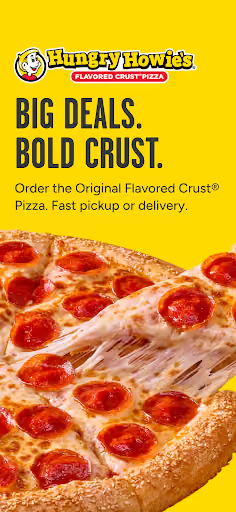
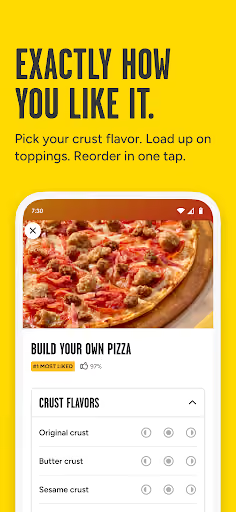
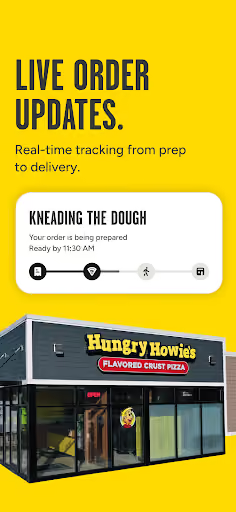
Hungry Howies is a free Android app for delivery and pickup ordering, with a current lifetime Play rating of 4.5★ and 1,707,699 installs as of 2026-08-04. The recent review stream is dominated by users who liked the pizza and often liked the old app, but say the new ordering flow is slower, web-based, and unreliable.
What it does
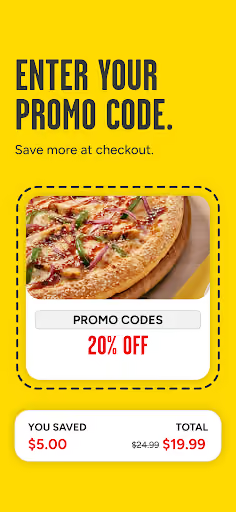
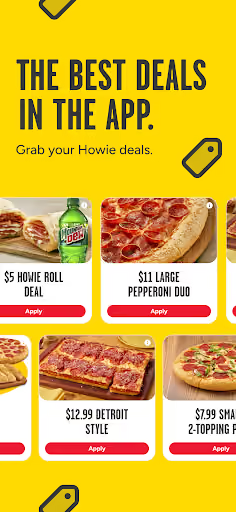
Lets Hungry Howies customers choose food, pick delivery or pickup, use deals, pay, and track orders.
What changed
Reviewers describe a new update that opens website-like ordering inside the app, forces repeated login, and removed or changed rewards.
Why it is soft
Users are angry enough to say they call stores, use the website, or stop ordering; but the ordering rails are brand-owned, so outsiders cannot fully replace them.
Strengths
This is not a dead product. The brand has a large installed base, users repeatedly praise the food, and several complaints explicitly say the old app used to be fast, simple, or even great. That means a new entrant would not be competing against indifference; it would be competing against a familiar restaurant brand whose customers still want the pizza.
Food loyalty remains
Even one-star reviews often separate the app from the product: people say the pizza is good, but ordering is a hassle.
Old habit existed
Long-time users describe years of app usage and say the previous version worked better, so the behavior is already proven.
Brand trust is huge
A solo helper app starts at zero while Hungry Howies carries the restaurant relationship, menu authority, payments, delivery, and support.
Market gap
The gap is clear but awkward: users want the old native ordering experience back, not a generic pizza app. Complaints cluster around four practical failures.
Webview + repeated login
The most common theme is that the app now feels like a website inside an app, makes users log in again, freezes, spins, or redirects in loops.
Checkout and saved payment
Reviewers mention card-entry bugs, missing Google Pay or autofill, lost saved card info, custom-tip crashes, and orders that never submit.
Store and address confusion
A recurring frustration is the app choosing or locking the wrong store, failing location lookup, or pairing an address with a store that will not deliver.
Rewards removed or lost
Users say points disappeared, rewards expired during the broken transition, emails promised rewards they could not redeem, and the loyalty program changed without enough warning.
The previous app and rewards worked fine. Whoever made this latest version should be fired. In the past everything was done inside the app, now it's just a front for the website, and your login credentials do not carry over so you have to sign in every time. Poor design. I also don't appreciate that the 50 rewards points that I earned didn't at least give me some kind of credit when you shut the old program off.
I have to keep editing & lowering the stars. I don't know how you could possibly just continuously make an app worse. The app like locks me into a store. No matter how many times I change the store, It just keeps ordering from the same one no matter how many times I change it. I have to keep driving out of my way to get my pizza because this stupid app refuses to change doors. It also asks for a certificate to like getting my phone. Also, 4 freaking dollars for some sprinkling of bacon is absurd
- Do not try to process orders yourself. Without official store, menu, payment, and delivery access, a solo app should stay a helper: saved favorites, store notes, phone-order scripts, and safe handoff to the official flow.
- Win on reliability, not features. The strongest wedge is a tiny native app that remembers preferred store, address, toppings, instructions, and last orders locally without repeated login.
- Avoid rewards replacement claims. Users are angry about rewards, but an unofficial app cannot mint or redeem Hungry Howies loyalty credit; it can only track reminders and store user-entered coupon notes.
Build complexity
Estimated, not derived: one part-time solo developer, no funding, no team, and no paid acquisition. This is the build for a limited helper app, not a full Hungry Howies ordering replacement, because the full checkout, rewards, and POS integration are not realistically available to an outsider.
| Workstream | Weeks |
|---|---|
| Native Android shell, local account-free profiles | 2.0 |
| Saved favorites, repeat-order builder, special instructions | 3.0 |
| Store/address selection, maps, phone-order fallback | 1.5 |
| Safe handoff to official web/app flow without storing cards | 2.0 |
| QA for Android devices, accessibility, error recovery | 2.0 |
| Play listing, disclaimers, support, launch polish | 1.5 |
| Total | 12.0 |
Expected revenue
Estimated, not derived: the realistic model is free with a small $2.99/month convenience upgrade for saved household orders, multiple profiles, coupon notes, and reorder shortcuts. Conversion should be weak because the official app is free and users mainly want Hungry Howies to fix its own checkout.
| Month 12, monthly | Estimate | Assumption |
|---|---|---|
| Installs | 1,000 | Organic only |
| Activated | 300 | Create a saved order |
| Retained | 130 | Use again after first order attempt |
| Paid | 100 | $2.99/month convenience upgrade |
| Revenue | $300 | Rounded month-12 MRR |
Biggest challenges
The hardest part is not the app UI; it is that the valuable parts of this market are controlled by Hungry Howies. A solo developer cannot reliably submit orders, redeem rewards, apply official deals, process payments, or track delivery without access to brand systems, and using the brand name too aggressively creates Play Store and trademark risk.
No official rails
The reviews complain about checkout, rewards, and store routing — exactly the parts an outsider cannot safely own.
Cold-start trust
Customers ordering food and entering addresses will be cautious with an unofficial app from an unknown developer.
Store policy risk
If a handoff breaks or a store refuses phone/web pricing, users blame the helper even when the official system failed.
AI angle
There is no strong AI angle for the core opportunity. AI could turn a saved favorite into a phone-order script or help parse a messy coupon email, but it does not solve the real blockers: official checkout, payment, rewards, store availability, and delivery tracking live inside Hungry Howies-controlled systems.
Helpful but minor
AI can polish UX around saved orders, instructions, and reminders, but those are convenience features.
Not a moat
The incumbent could add the same assistant later, and users are not asking for AI; they are asking for ordering to work again.
Conclusion
Skip it. The review pain is loud and specific, but it points to a brand-owned ordering failure, not an open software niche. A solo builder can ship a helpful reorder companion, yet the ceiling is low because the app cannot actually replace checkout, rewards, delivery, or store routing.
12 weeks
Time to v1
$2.99/mo
Optional convenience upgrade
$300
Month-12 MRR
Brand checkout
Deciding constraint