Abstract
Google Chat reviews show a real product gap around threads, notification reliability, confusing updates, and missing basic messenger affordances, but a solo builder should not try to replace Google Chat broadly; the only realistic wedge is a narrow, simple, email-invite group messenger for families, clubs, and small teams that hate Workspace-style complexity.
Background
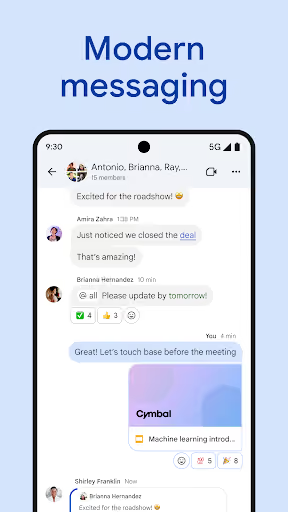
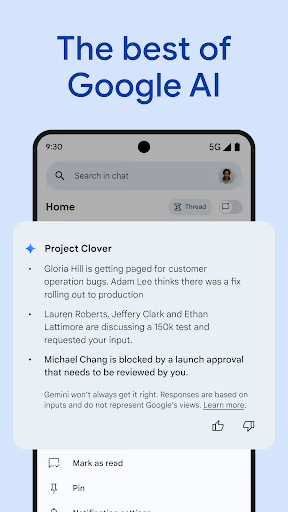
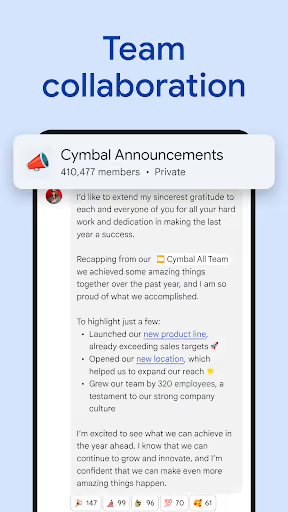
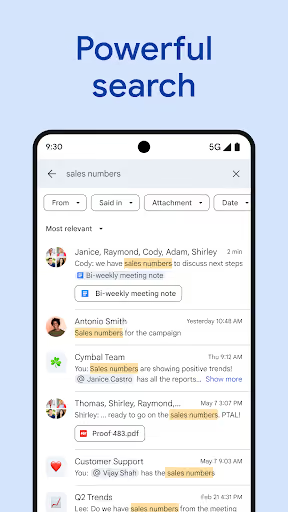
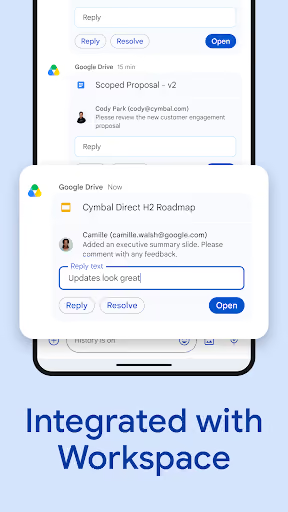
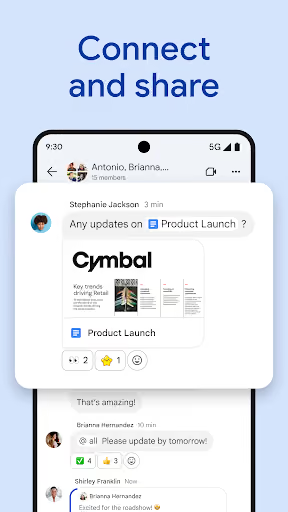
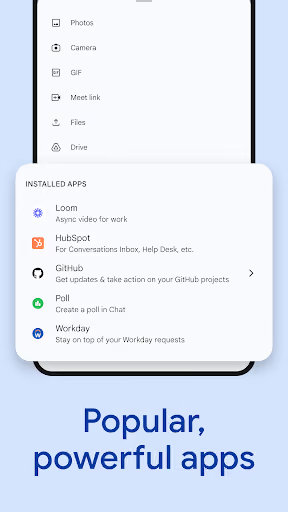
Google Chat is a free Google Workspace messaging app with a 4.4★ lifetime rating and 75,483,155 installs as of 2026-08-05. Its listing leans into Gemini, Workspace integrations, messaging, spaces, huddles, Drive, Meet, Tasks, and Chat APIs.
What it does
Chat by email or Google account, share files, use spaces, connect across phone and desktop, and plug into Google Workspace.
What changed
Recent reviewers complain about icon changes, removed swipe-edit behavior, thread-heavy navigation, smart highlights, AI clutter, delayed notifications, and loading glitches.
Why it is soft
Google is optimizing for Workspace collaboration, while some users just want a clean personal or small-group messenger that does not behave like a project-management tool.
Strengths
This is not a dead app. Positive reviewers still praise easy setup with email instead of a phone number, Google Workspace integration, cross-device use, file sharing, Meet calling, saved history, GIFs, and the ability to chat with friends, family, or coworkers. A new entrant starts with none of Google’s account graph, default trust, or Workspace distribution.
Distribution moat
The listed install base is massive, and many users stay because their family, partner, school, or organization already uses it.
Real utility
Email-based identity, desktop/mobile sync, saved history, and Google account access are genuinely useful for people avoiding phone-number-only messengers.
Market gap
The gap is not “build Slack or WhatsApp again.” The complaints cluster around Google making a simple messenger feel harder, less predictable, and less respectful of user preferences.
Threads and UX churn
The loudest theme is thread confusion: users cannot find conversations, dislike side threads, ask to disable threads, and object to useful gestures being removed.
Notifications and delivery
Several reviewers say notifications arrive late, never arrive, or messages get stuck sending or fail to load after recent updates.
Missing basics
Read receipts in groups, nicknames, multi-delete, selective copy, contact naming, local photo picker defaults, and faster voice-message playback all appear as basic unmet expectations.
Too smart, not controllable
Smart highlighting, AI clutter, accidental UI elements, and call behavior create a strong “please let me turn this off” signal.
Threads is dumb- at least give me the option to disable it. Seems like every update makes this app a little- or a lot- worse. Aug 2026 edit- stupid app is getting worse. downgraded score. trying to find a replacement chat app, it's getting so painful to use on Android.
Notifications rarely work. Google has been actively making their chat apps worse for 15 years now. They constantly change, remove functionality, and generally suck compared to the competition. "Chat" is no exception. I only use it because I can't convince everyone I know to switch to one of the many, many better alternatives out there.
Google Chat was released on February 28, 2018. Over 8 years ago. You STILL can't see who read messages in group chats. Google still can't get this app right.
- Make threads optional, not the model. Default to one chronological chat per person or group, with no nested conversations unless a group owner explicitly enables them.
- Treat delivery and invites as the product. Show sent, delivered, read, invite pending, and invite accepted states clearly; the replacement only matters if users trust that messages arrive.
- Ship boring messenger basics first. Nicknames, selective copy, real delete controls, a local-first photo picker, group read receipts, and off switches for smart features should beat Gemini-style flourishes.
Build complexity
Estimated, not derived: one part-time solo developer, no funding, no team, and no paid acquisition. This v1 is not a full Google Chat clone; it is a narrow Android-first, email-invite, threadless group messenger with reliable push and basic media.
| Workstream | Weeks |
|---|---|
| Email auth, profiles, contacts, and invites | 2.5 |
| Realtime 1:1/group chat, delivery states, and push notifications | 3.5 |
| Threadless inbox UX, search, read receipts, and group admin | 2.0 |
| Media picker, uploads, previews, and quality controls | 2.0 |
| Block, report, abuse handling, privacy, and account deletion | 1.5 |
| Billing, Play listing, QA, crash handling, and onboarding polish | 2.5 |
| Total | 14.0 |
Expected revenue
Estimated, not derived: a free app with a $4/month Plus plan for group organizers who want larger groups, longer history, and admin controls. With no paid acquisition and a network-effect product, month-12 revenue is likely modest even if the product is good.
| Month 12 funnel | ||
|---|---|---|
| Installs | 2,000 | organic estimate |
| Activated | 900 | 45% |
| Retained | 420 | 21% |
| Paid | 150 | $4/month |
| Revenue | $600 MRR |
Biggest challenges
The hard part is not drawing a cleaner chat screen; it is persuading whole groups to move, earning trust with private conversations, and delivering push notifications more reliably than users expect from Google. A solo builder also has to handle abuse reports, scams, account deletion, media storage costs, and Play policy review without a support team.
Network cold start
Reviewers often say they stay because friends, family, partners, or organizations are already there; one person cannot switch alone.
Reliability burden
If the wedge is “notifications work,” every missed push becomes a brand-breaking event, especially across Android battery settings and OEM quirks.
Trust and safety
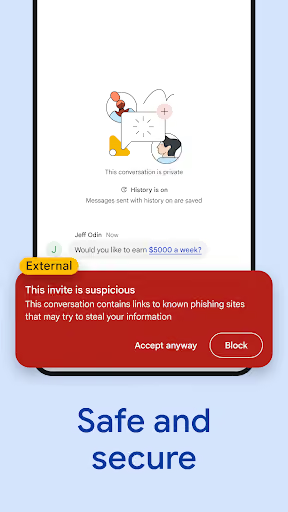
Scam and harassment complaints mean the app needs blocking, reporting, moderation flows, and clear safety defaults from v1.
AI angle
There is no strong AI wedge here. Google Chat already advertises Gemini summaries, translation, AI-powered search, action items, and DLP; meanwhile several complaints are about unwanted smart features or AI clutter. AI can help a solo builder write tests, triage abuse reports, or draft support replies, but it is not the reason this product wins.
Do not lead with AI
The market gap is control, predictability, and simplicity, not another assistant inside the inbox.
Useful behind the scenes
Use AI cautiously for moderation triage, spam pattern detection, and QA automation, while keeping the user-facing messenger intentionally boring.
Conclusion
Skip it. Build only if you want a small, opinionated, threadless messenger business, not a Google Chat competitor. The reviews expose a real usability gap, but Google’s account graph, Workspace lock-in, and 75,483,155-install distribution make this a weak solo-builder opportunity.
14 weeks
Time to v1
$4/mo
Plus plan for organizers
$600
MRR at month 12
75,483,155
Incumbent installs decided it