Abstract
Moon+ Reader Pro still has a loyal base and deep feature moat, but recent reviews expose a focused opening: readers want reliable offline access, folder-scoped storage, simpler library management, and sync that does not strand Google Drive users.
Background
Moon+ Reader Pro is a paid Android ebook reader with a 4.2★ lifetime rating, a listed price of 6 USD, and 1,506,644 installs as of 2026-08-08. Its listing emphasizes broad format support, PDF annotation, TTS, cloud backup, WebDAV, Dropbox, Google Drive-style workflows, and heavy customization.
What it does
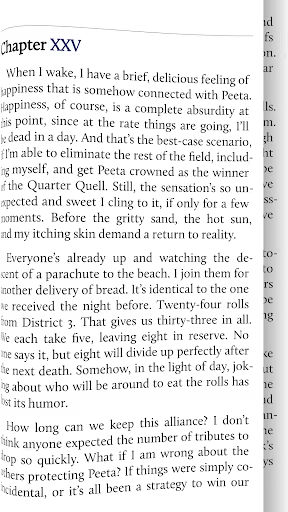
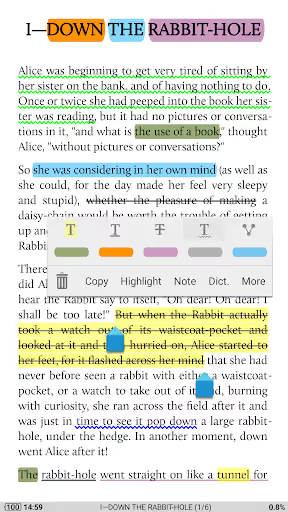
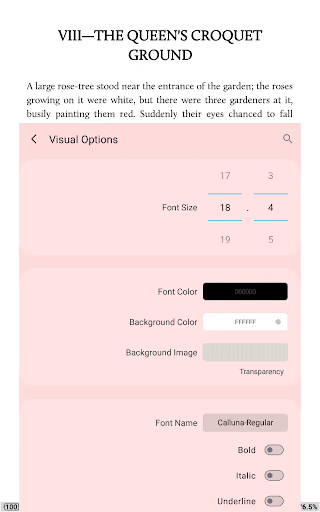
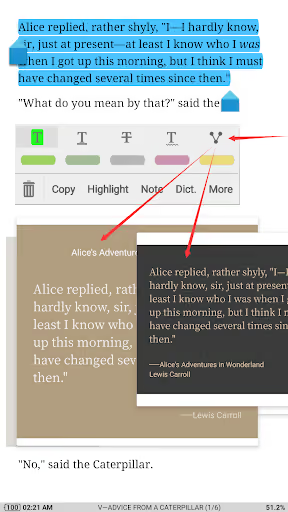
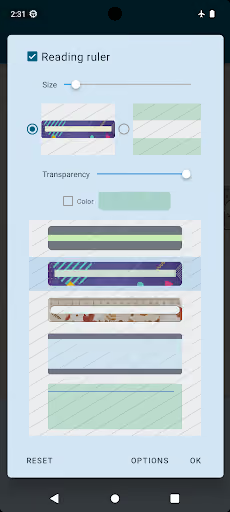
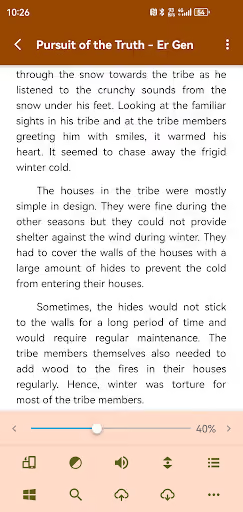
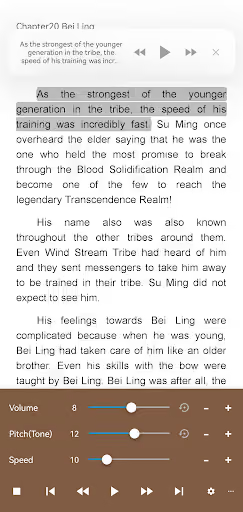
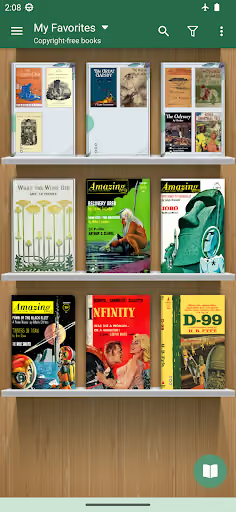
Reads EPUB, PDF, comics, documents and many archive formats; adds TTS, annotations, shelves, themes, gestures, stats, cloud backup and sync.
What changed
Recent reviews complain about broken Google Drive access, unreliable sync, offline license checks, force closes, removed PDF annotation tools, and requests for broad “All files” access.
Why it is soft
The gap is not “make every Moon+ feature again.” It is a narrower trust gap: safe storage, offline-first reading, predictable sync, and better library organization.
Strengths
This is not a weak incumbent. Positive reviewers still call Moon+ the best Android reader, praise its customization, TTS, annotations, statistics, shelves, exportable notes, e-ink mode, tablet/foldable support, and years of one-time-purchase goodwill.
Feature depth
A solo builder should not try to match its full format list, PDF tools, gestures, themes, widgets, cloud options and reading modes in v1.
Retained habit
Several angry reviewers still say they used it for years or over a decade; that habit is hard to displace unless switching solves a specific pain immediately.
Brand proof
The app has more than a million installs and a 4.2★ lifetime rating, so a new entrant starts with a trust deficit even if its wedge is cleaner.
Market gap
The complaints cluster around trust and reliability more than raw reading features: cloud sync breaks, storage permissions feel excessive, offline reading is not always dependable, and large personal libraries are hard to manage.
Google Drive and sync reliability
The most common pain in the sample is broken or confusing sync: Drive cannot connect, auto-sync loops, reading history differs across devices, favorites do not sync, and users ask for OneDrive or Proton Cloud alternatives.
Privacy and offline ownership
Reviewers object to mandatory-looking “All files” access and to paid reading being interrupted by Google Play checks or internet requirements on offline tablets and e-ink readers.
Library management
Users ask for collections, to-read and finished states, multi-tag filtering, series numbers, synced groups, better favorites, global highlights and searchable notes across books.
Regression and UI sprawl
A smaller but important group reports crashes, TTS bugs, PDF feature removals, image layout problems, and settings hidden across too many menus.
Recent updates have trashed a great app; google Drive will not connect no matter how many times you delete and re-connect, and themes keep reseting every time you open the book. But the loss of google drive library access is a deal breaker. Sadly, after 8 happy years of using Moon+Reader Pro, I'm moving to PocketBook.
The reading functionality is great. The customization allows me to get a book's text to look exactly the way I want, but... Why does this still not work with folder-specific access? I don't want any app to have permission to do anything outside of the relevant data location/s. This doesn't need access to anything on my device besides a books/ dir and it's own app data. I use it on a tablet with nothing else, but I can't use it on my phone because I won't give it "read all" access.
This is an excellent reading app, but I have become more and more frustrated with the lack of library management. I would like to be able to add books to user defined collections (e.g. sci-fi, historical fiction, self-help, history), a to-read list, and a way to mark that you've finished an ebook. As it is, it's too easy for ebooks to get lost in your collection.
- Ship a narrow offline reader first. Support EPUB and basic PDF well, cache the entitlement for offline use, and make folder-scoped access the default instead of asking for all files.
- Make sync boring, not broad. Start with a standards-based backup path and clear export; do not promise every cloud provider until account verification and conflict handling are stable.
- Differentiate on library control. Collections, multi-tags, series, finished/to-read status, searchable highlights and clean metadata are the clearest non-incumbent wedge.
Build complexity
Estimated, not derived: one part-time solo developer, no funding, no team, and no paid acquisition. This is for a focused competitor, not a full Moon+ clone with every listed format and PDF feature.
| Workstream | Weeks |
|---|---|
| EPUB reader, basic PDF viewing and TTS handoff | 4.0 |
| Library metadata: collections, tags, series, read states | 2.5 |
| Folder-scoped Android storage and offline entitlement behavior | 2.0 |
| Backup/sync v1 with conflict handling and export | 2.5 |
| Bookmarks, highlights and searchable notes | 1.5 |
| Polish, testing, Play listing and launch support | 1.5 |
| Total | 14.0 |
Expected revenue
Estimated, not derived: assume a free reader with a 5.99 USD one-time Pro unlock. The $900/month figure is month-12 monthly gross revenue from new unlocks, not true subscription MRR.
| Month 12 funnel | Monthly volume | Assumption |
|---|---|---|
| Installs | 1,200 | Organic only |
| Activated readers | 480 | 40% open and import a book |
| Retained readers | 300 | 25% of installs still reading |
| Paid unlocks | 150 | 5.99 USD one-time |
| Revenue | $900/month | Rounded gross |
Biggest challenges
The hard part is not proving demand; it is earning enough trust to be installed beside a long-lived paid app, while avoiding the same storage, sync and cloud-account pitfalls users are already angry about.
Cold-start store trust
A new paid reader has no review base, while Moon+ has years of loyal users and 1,506,644 installs in the supplied data.
Cloud verification risk
Google Drive complaints include unverified-developer warnings and limited-access confusion; a solo builder can easily get stuck in the same review and permission maze.
Compatibility expectations
Moon+ advertises many formats and device modes. Even a focused alternative will be judged on e-ink devices, tablets, foldables, PDFs, TTS engines and Android storage changes.
AI angle
There is a modest real AI angle, but it should not be the core wedge. Reviews explicitly ask for text-to-podcast, AI support, and reading text in pictures aloud; AI can also make settings search less painful for an app that would otherwise grow Moon+-style menu sprawl.
Useful AI add-on
OCR-to-TTS for images and a natural-language “find this setting” helper would address actual review requests without needing to replace the reader engine.
Do not overclaim
AI does not solve Google Drive permissions, offline licensing, EPUB rendering, PDF annotation, or store trust; those remain the build and adoption bottlenecks.
Conclusion
Build it. But only as a focused privacy-first offline reader, not as a feature-for-feature Moon+ clone. The gap is clear; the moat is also real, so keep the first version narrow and opinionated.
14 weeks
Time to v1
$5.99
One-time Pro unlock
$900/month
Month-12 gross revenue
Sync + storage
Deciding complaint