Abstract
The reviews do not show a normal UX annoyance; they show users repeatedly reaching redemption, losing points, waiting days, and calling the payout promise fake. There is demand — the app lists 111,242 installs and a 4.5★ lifetime average — but the solo-builder opportunity is weak because the gap is trust and payout economics, not just a better captcha UI.
Background
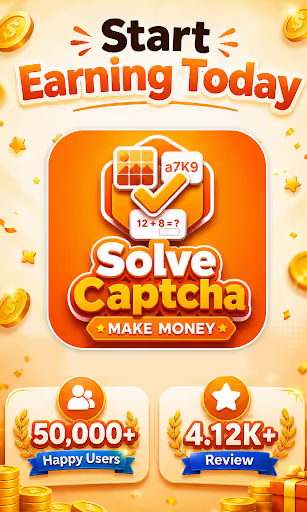
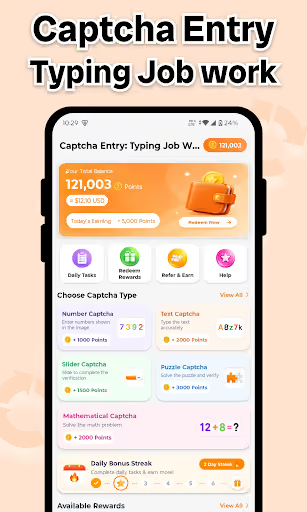
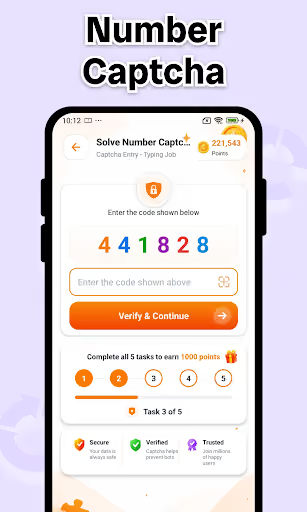
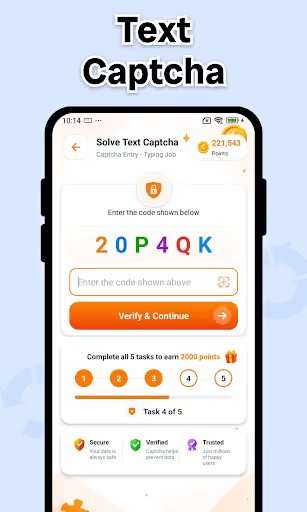
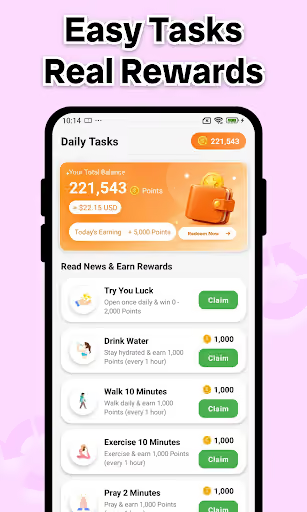
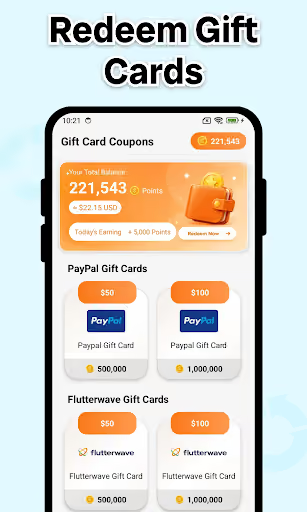
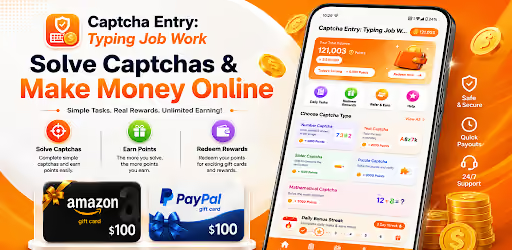
Captcha Entry - Typing Job is a free Android app where users solve number, text, slider, puzzle, and math captchas to collect points and redeem eligible rewards. The store copy also says reward availability, point values, redemption limits, and processing requirements may vary, and that the app is for entertainment and engagement rather than professional employment.
What it does
A simple points loop: choose a captcha type, solve it, submit, build a balance, then try to redeem once eligible.
What changed
For many reviewers, the experience breaks at redemption: points are deducted, PayPal or gift-card rewards do not arrive, and the app may not collect enough payout information.
Why it is soft
The trust gap is public and specific, but it is also expensive to fix: a real competitor must either fund verified rewards or stop marketing itself as a money app.
Strengths
The incumbent is not failing because captchas are impossible to build. Reviewers who are still hopeful describe the tasks as easy, simple, user-friendly, and sometimes fun; several are only waiting to see whether cashout works. The app also has 111,242 listed installs, so a new entrant is not inventing the desire from scratch.
Simple loop
Typing, math, slider, and puzzle tasks are understandable without onboarding, which is why users tolerate the grind until redemption.
Hope keeps usage alive
Many positive or neutral reviews are conditional: users like the app so far, but say they will update only after a successful payout.
Visible demand
The install count proves people search for this kind of earning or captcha-task app, even if the current reviews show distrust.
Market gap
The market gap is clear but dangerous: users are not asking for prettier captchas first; they are asking for proof that rewards are real. The complaint clusters point to a trust-and-operations product, not merely a game clone.
Payouts not received
The most common complaint is reaching a stated redemption level, requesting PayPal or gift-card payout, then receiving nothing after the waiting period.
Broken redemption flow
Reviewers repeatedly mention points disappearing, no confirmation email, no payout record, or no place to enter PayPal details.
No support trail
A couple of reviewers say emails or support attempts got no response, which turns a delayed payment into a scam accusation.
Ads and task friction
A smaller but real cluster complains that ads block the screen, ads are excessive, or puzzle pieces do not behave as expected.
Fake. I spent 3 days finishing the points needed just so I can withdraw the said 50$. It said to wait for 4-6 days, so I waited last June 17 but til now I haven't even received it yet. I knew this game was too good to be true but I just risked it since I had nothing to lose. If the game wasn't really gonna reward you any money then don't advertise it like it does. Fake money making apps just spread like crazy these days.
100% SCAM! Please do not waste ANY of your time doing these captcha tasks because you will not receive any kind of payout that you are promised. I reached 1,000,000 points and I requested a $50 paypal giftcard and a $50 Amazon giftcard on the redemption page but it took my points and I didn't receive any giftcards and that was a big bummer :(
- Do not promise cash unless you can prove cash. The wedge is radical honesty: publish payout rules, limits, timing, and proof, or position the product as practice and entertainment instead.
- Build redemption before growth. A v1 must include payout email capture, transaction IDs, status history, receipts, and a support contact before any serious acquisition push.
- Make the task loop ad-light and functional. If the app cannot reliably move puzzle pieces or keep ads off the start button, users will not stay long enough to trust the rewards.
Build complexity
Estimated, not derived: one developer, part-time, no funding, and no paid acquisition. This assumes a cautious v1: an honest captcha-practice app with optional rewards or ad-free support, not a fully funded cash-job marketplace.
| Workstream | Weeks |
|---|---|
| Captcha task engine and categories | 1.5 |
| Points ledger, redemption status, and support trail | 2.0 |
| Ads, optional subscription, and basic fraud controls | 1.0 |
| Polish, testing, Play listing, and compliance copy | 1.5 |
| Total | 6.0 |
Expected revenue
Estimated, not derived: the realistic model is free with ads plus a $2.99/month ad-free or supporter unlock. Users looking for payouts are weak subscription buyers, so month-12 revenue is intentionally modest.
| Month 12, monthly | ||
|---|---|---|
| Installs | 2,500 | organic estimate |
| Activated | 1,000 | 40% assumption |
| Still on at 30d | 400 | 16% assumption |
| Paid | 100 | $2.99/month |
| Revenue | $300 | rounded MRR |
Biggest challenges
The hard part is not rendering captchas; it is operating a category users already distrust. A solo builder would need to earn store trust from zero while avoiding misleading “typing job” claims, funding any real rewards, and answering payout disputes without a support team.
Payout economics
If users expect $50 rewards, ad or subscription revenue will not naturally cover that without a real paid task buyer behind the scenes.
Policy and review risk
A money-earning captcha app attracts scrutiny; vague reward language or delayed redemptions can quickly create the same review spiral.
Cold-start credibility
The incumbent has installs and a 4.5★ lifetime average; a new app has to prove legitimacy before users invest hours.
AI angle
There is no strong AI angle here. AI could generate puzzle images or help triage support messages, but it does not solve the core gap: verified payouts, transparent rules, and trustworthy operations. In fact, one reviewer explicitly complains the app looks like “AI slop,” so leaning into AI-generated content could make trust worse.
Useful but minor
AI can create task variations, rewrite help copy, and summarize payout tickets, but those are implementation conveniences.
Not a moat
The differentiator users want is proof of payment or honest non-payment positioning; AI does not replace that operational burden.
Conclusion
Skip it. There is a real complaint to exploit, but not a clean solo-builder business. A six-week clone can be built, yet the honest version is likely only a small ad-supported practice app, while the version users actually want requires reliable reward funding and support.
6 weeks
Time to v1
Free + $2.99/mo
Ad-free/supporter model
$300
Month-12 revenue estimate
Payout trust
Fact that decided it