Abstract
Testerup has a real audience and many users say it pays, but the recent complaint pattern is severe: missed credits, unclear deadlines, high cash-out thresholds, support disputes, and account blocks near payout. The market gap is obvious, but a solo competitor is not a simple app clone — it is a payments, attribution, fraud, and support business.



Background
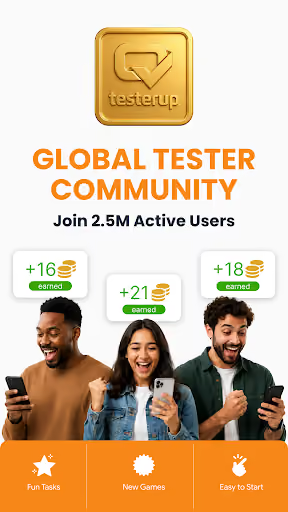
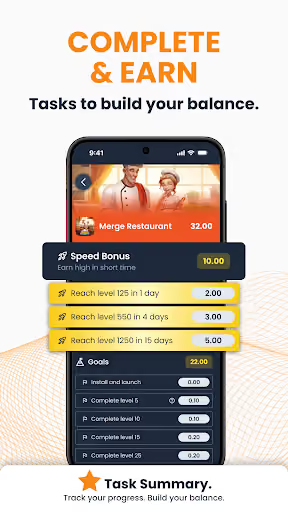
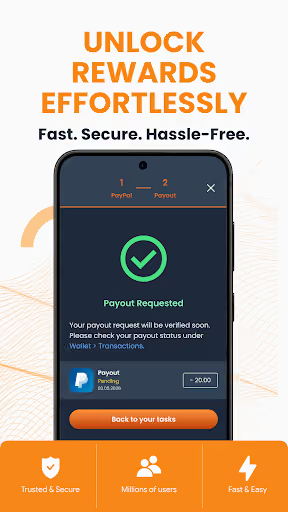
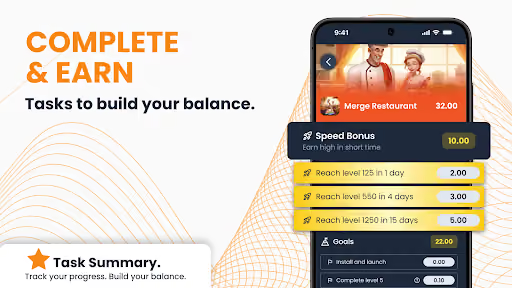
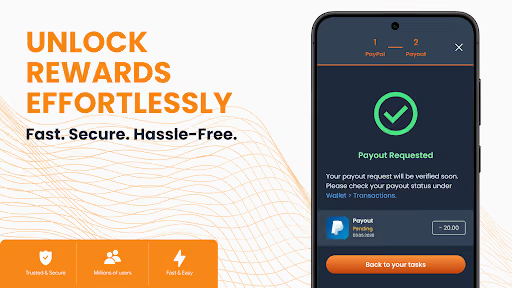
Testerup: Test & Earn Rewards is a free rewards app with a 4.1★ lifetime rating and 16,236,241 installs as of 2026-08-05. It lets users earn by playing games, completing offers, taking surveys, and requesting payout, but recent long reviews show a trust problem around whether progress, deadlines, and larger rewards are being credited fairly.
What it does
Aggregates games, surveys, app tests, and other tasks, then pays rewards after users reach stated milestones.
What changed
Several reviewers say they were paid early on, then later stopped receiving credit, hit confusing deadlines, or faced higher cash-out friction.
Why it is soft
The weakness is trust and transparency, not lack of demand: users still want paid game offers, but they want proof that milestones and payout rules are visible.
Strengths
This is not a dead product. Positive reviewers say payouts can arrive through PayPal within a few days, the game selection can be enjoyable, and some long-term users report multiple payouts. Its 16,236,241 installs also mean the incumbent has store trust, habit, and a large review base a new entrant would start without.
Proven demand
People are willing to grind mobile games and surveys for cash-like rewards, even when they know it takes time.
Some payouts work
Several favorable reviews say the app really paid them, usually after reaching a relatively high threshold.
Clear core loop
The user behavior is simple: pick an offer, hit milestones, see balance update, cash out.
Market gap
The complaints cluster around trust at the exact moment the app must be most credible: when a user has already spent hours and is nearing a meaningful reward.
Milestones not credited
The loudest complaint is progress tracking that works for small rewards but allegedly fails around larger goals, speed bonuses, or later-stage milestones.
Threshold feels unreachable
Reviewers cite cash-out floors such as $35, $55, $70, £55, £70, and £75, often while saying the remaining offers pay pennies or require excessive play.
Hidden deadlines and rules
Users repeatedly complain that offer expiry dates, speed-bonus windows, VPN accusations, or terms-of-use decisions are unclear until after a reward is denied.
Support cannot restore trust
Screenshots, recordings, and emails are described as slow, rejected, or unanswered, so every disputed milestone becomes a credibility event.
Stopped paying once I reached bigger value goals. I have been playing for about 6 weeks. have reached and low paying goals with no problems credited quickly. but once I reach a goal with a significantly higher value, nothing the tracker wont acknowledge I have reached that level and have in fact passed that goal level. NO credit added. have contacted them, NO response. Starting to think its a SCAM with fake account reviews.
Update: still haven't cashed out as minimum is £70 (I have half of that as goals are unachievable). One of the games would have required playing over 170 levels a day for 30 days to get the highest reward, it took me around 49 days to get there so they don't pay out. A waste of precious time...
scammed by an imaginary deadline. my goals were still showing and not crossed out or removed. I was getting close to the highest payout and then all of a sudden it was not completing the task. upon reaching out to support, they said the goals ended a few days ago. however, there's no indication on the page that says when it was ending. how convenient for Testerup. they'll pay the smaller bonuses but not the higher ones. gg, uninstalled. customer no: 22362922 ticket no: 1790863
- Make every deadline visible before install. Each offer needs a countdown, final eligible date, speed-bonus window, and expired-state UI that cannot be missed.
- Show an audit trail for every reward. Users should see installed, tracked, pending, credited, rejected, and evidence-needed states instead of discovering problems only after grinding.
- Compete on payout trust, not giant rewards. A smaller but clearer reward promise is more defensible than high headline payouts that trigger support disputes.
Build complexity
Estimated, not derived: one developer, part-time, no funding, and no paid acquisition. A basic app UI is easy; the hard work is offer tracking, wallet state, payout operations, fraud handling, and support evidence.
| Workstream | Weeks |
|---|---|
| Android app: offer list, account, wallet, task detail | 3.0 |
| Game/survey offer integrations and tracking events | 4.0 |
| Deadline, audit trail, and reward-state transparency | 2.0 |
| Payout queue, user evidence flow, and support tools | 2.5 |
| Fraud rules, QA, privacy, Play listing, launch polish | 2.5 |
| Total | 14.0 |
Expected revenue
Estimated, not derived: the app stays free and earns repeat monthly revenue from completed offers after user rewards and support cost. Because there is no funding or paid acquisition, this is modeled as a small organic app, not a 16-million-install challenger.
| Month 12 funnel | Estimate | Assumption |
|---|---|---|
| Installs | 3,000 | Organic store search, review replies, and word of mouth only |
| Activated | 900 | Users who start at least one offer |
| Retained | 300 | Users still checking offers and balances after the first month |
| Paid | 120 | Users completing revenue-generating offers that survive disputes |
| Revenue | $1,200 | Month-12 net monthly revenue estimate |
Biggest challenges
The main risk is operational, not UI. A solo builder must convince users to trust a brand-new rewards app while also handling disputed credits, payout timing, fraud accusations, app-store policy scrutiny, and support volume without a team.
Cold-start trust
A new app has no payout history, while users in this category are already primed to suspect scams.
Attribution disputes
If an install or level is not tracked, the user blames the app even when the failure is inside a game, survey, or partner flow.
Payout float
Even small cash-outs create timing and cash-flow pressure before the product has predictable revenue.
AI angle
There is a real but limited AI angle: AI can reduce support workload by reading screenshots or screen recordings, extracting claimed level/date evidence, grouping duplicate complaints, and drafting transparent responses. It does not solve the core attribution or payout-liability problem, so it should not change the build-time or revenue estimate.
Useful AI
Evidence triage: summarize a user’s proof, compare it to the offer deadline, and flag obvious support cases faster.
Not solved by AI
Whether a partner actually credited the install, whether a payout should be released, and whether fraud rules are fair.
Conclusion
Skip it. The gap is real and painful, but this is a tough solo-builder business: the product users want is not just a cleaner app, it is a trustworthy payment operation with reliable tracking and responsive dispute handling.
14 weeks
Time to v1
Free + offer margin
Price and model
$1,200/mo
Revenue at month 12
16,236,241
Installs prove demand, not ease