Abstract
ChargePoint has a real user-trust problem after a mid-2026 redesign: reviewers complain about login loops, broken payments, stale availability, removed notifications, confusing holds, and lost features. But a solo builder cannot realistically replace the charging network, station authorization, RFID/NFC, workplace waitlists, or Home Flex control, so the practical opportunity is a small companion app, not a true ChargePoint competitor.
Background
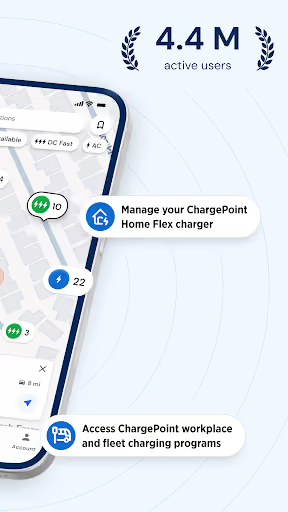
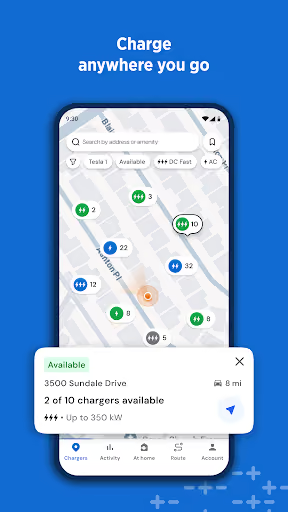
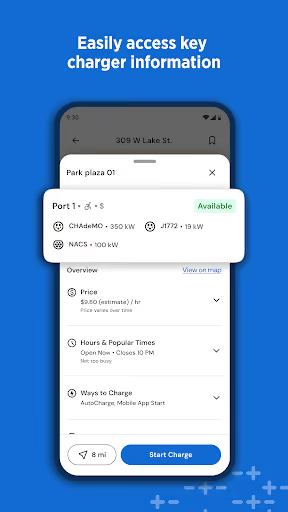
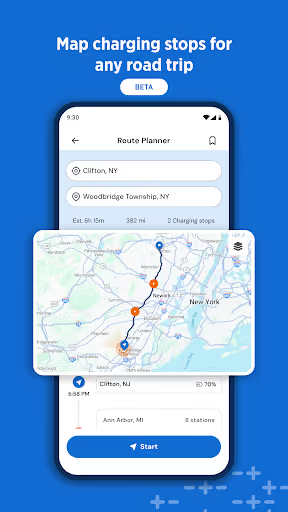
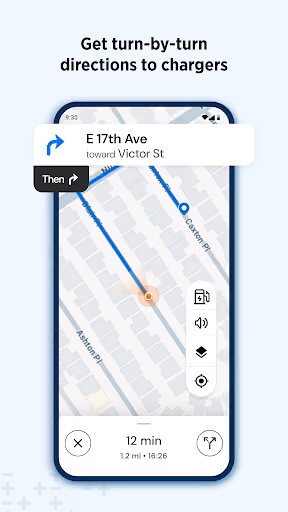
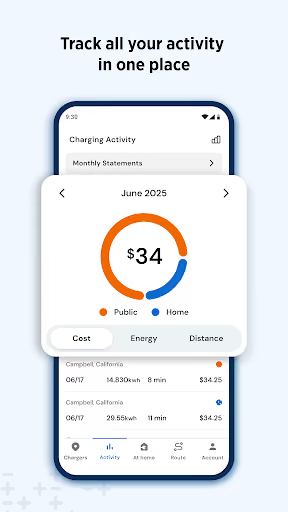
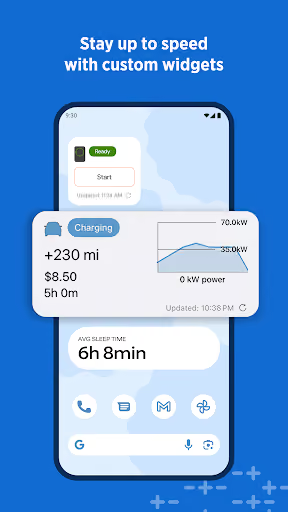
ChargePoint is a free EV charging app with a 3.9★ lifetime rating and 2,655,871 installs on 2026-09-20. It promises charger discovery, filters, reviews, pricing, turn-by-turn navigation, payment, ChargePoint Home Flex management, workplace charging, waitlists, and charging history.
What it does
Find public chargers, start and pay for sessions, manage home charging, and handle workplace charging programs from one app.
What changed
Reviewers describe a major redesign that removed or buried useful features while introducing login, payment, map, waitlist, and notification failures.
Why it is soft
The gap is emotional and urgent: people are standing at chargers, sometimes low on battery, and the app is the gatekeeper to charging.
Strengths
This is not a weak incumbent. ChargePoint controls the charging relationship, supports home and workplace flows, lists partner providers, and has a large installed base. Some reviewers still say the map view usually works, charging can be easy when the app cooperates, home scheduling can work well, support people can be helpful, and pricing can be competitive in some places.
Network control
The key actions users need — authorize, pay, stop, waitlist, and manage a Home Flex — sit inside ChargePoint’s own system.
Existing habit
Many negative reviews come from long-time users, workplace users, and home charger owners who already built routines around the app.
Distribution moat
A new app starts with no charger contracts, no payment authorization path, no station hardware, and no trusted history in the store.
Market gap
The complaint pattern is loud and consistent, but only part of it is addressable by an independent app. The most valuable pain is not “find chargers”; it is “make charging dependable when the official app is unreliable.”
Login and payment failures
The strongest cluster is users being logged out, unable to add cards, stuck in verification, declined at chargers, or forced through repeated payment setup.
Lost reliability features
Reviewers miss availability notifications, user tips, dark mode, color-coded availability, station history, and simple access to favorites.
Confusing holds and fees
A recurring payment-trust complaint is pre-authorization holds, auto-reload behavior, surcharges, and difficulty getting held money released.
Workplace and home pain
Waitlist bugs, stale charger status, missing workplace chargers, unreliable notifications, and Home Flex control issues show up repeatedly.
Chargepoint is the #1 service to choose if you like being stranded at a charging station with no way to charge. Seriously, what are you thinking with this new app? This service has quickly gone from my favorite, daily, reliable one to avoid at all costs. You guys are starting making EA look good, something I thought was impossible. I've had to update my payment information several times in one day because the app thinks it doesn't have it, even though it shows it correctly in the app.
Awful redesign. Tapping the bookmarks button does nothing, so I have to pan the map each time to find my usual charger. The option to notify when available is gone. And worst of all, it takes an extremely long time (10+ minutes) for the availability to update in the app. I've pulled up to a charging station so many times and had to leave because someone else was already charging there, even though the app still shows the station as available. Awful, unusable.
- Do not try to start or pay for charging. That is the moat. A solo app should position as a fallback companion: favorites, reminders, notes, fee tracking, and manual recovery steps.
- Bring back the removed convenience layer. Station notes, personal tips, charger history, favorite clusters, availability-check reminders, and dark-mode usability directly map to the feature-loss complaints.
- Make money-trust the wedge. A hold and fee log, receipt capture, dispute checklist, and “what did this session actually cost?” screen addresses a complaint ChargePoint cannot solve with UI polish alone.
Build complexity
Estimated, not derived: one developer, part-time, no funding, and no paid acquisition. This is for a companion app that avoids station authorization and payment control; a real ChargePoint replacement is not a solo part-time build.
| Workstream | Weeks |
|---|---|
| Favorites, charger records, and map/deep-link shell | 2.0 |
| Account-free onboarding, vehicle/home/work profiles | 1.0 |
| Reminders, timers, availability-check prompts, widgets | 2.0 |
| Hold, fee, receipt, and session-cost tracker | 1.5 |
| Crowdsourced tips, station notes, reporting, moderation | 1.5 |
| Play listing, billing, privacy, support polish | 2.0 |
| Total | 10.0 |
Expected revenue
Estimated, not derived: the realistic model is freemium with a $4.99/month optional Pro tier for unlimited tracked stations, widgets, hold logs, and saved station notes. Because it cannot actually authorize charging, conversion should be assumed weak.
| Month 12 funnel | Estimate | Assumption |
|---|---|---|
| Installs | 2,000 | Organic only |
| Activated | 900 | 45% |
| Retained | 350 | 18% of installs |
| Paid | 200 | $4.99/month |
| Revenue | $800 | Estimated net MRR |
Biggest challenges
The hard part is not building screens; it is that the most painful user jobs depend on ChargePoint-controlled chargers, accounts, RFID/NFC, payments, workplace programs, and Home Flex controls. A companion can reduce frustration, but it cannot guarantee a charge.
Integration moat
Users complain about start, stop, payment, tap-to-charge, waitlists, and home settings — exactly the flows a third-party app cannot safely promise from the supplied facts.
Cold-start trust
An EV driver at low battery will not trust a new app unless it is honest, narrow, and clearly not pretending to control the charger.
Crowdsourcing quality
Tips and station notes are useful only after enough local users contribute; without paid acquisition, that network effect will grow slowly.
AI angle
There is no strong AI angle for the core opportunity. AI cannot release a payment hold, authorize a charger, fix NFC, restore a workplace waitlist, or make stale station status accurate. It could help classify receipts or summarize station notes, but that is a convenience feature, not the reason to build.
Useful but minor
Receipt parsing, complaint templates, and station-note summaries could reduce support friction for users tracking holds and fees.
Not a moat
The incumbent’s failure is operational reliability and payments, not missing generative AI.
Conclusion
Skip it. Do not build a true ChargePoint competitor as a solo part-time project; the market gap is real, but the highest-value fixes require control of chargers, payment authorization, workplace access, and home-charger integrations. A narrow fallback companion could make modest revenue, but it is a side project, not a venture-scale wedge.
10 weeks
Time to v1
$4.99/mo
Optional Pro companion
$800
Month-12 net MRR
Start/pay moat
Deciding fact