Abstract
The complaints reveal a real gap: users want a calmer bird-ID app that respects location, gives confidence instead of impossible species, and proves value before pushing payment. But for a solo part-time builder, the hard part is not the Android UI — it is building or integrating sound recognition good enough to compete with free alternatives reviewers already mention.
Background
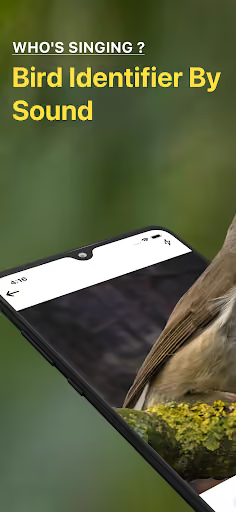
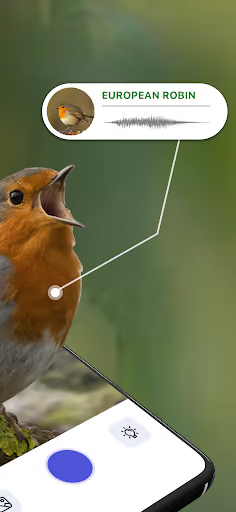
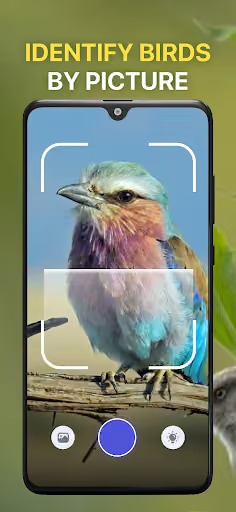
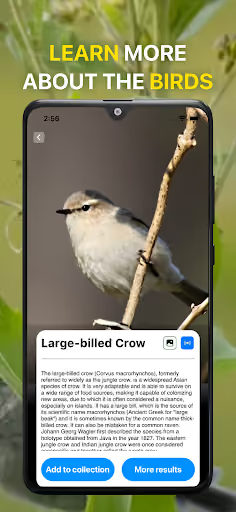
Bird Sound Identifier Bird ID is a free Play Store app with a current lifetime average of 4.4★ and 1,669,237 installs as of 2026-08-04. It promises bird identification from recorded sound or photos across 10,000+ species, but the supplied reviews repeatedly describe wrong-continent sound IDs, aggressive ads, and subscription prompts before trust is earned.
What it does
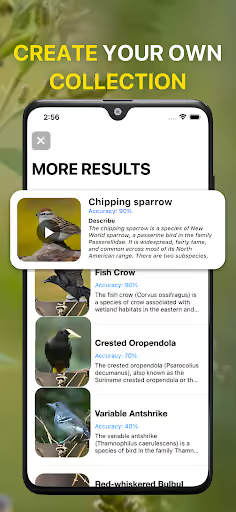
Record a bird song, upload or take a photo, then get a species result and supporting information.
What broke
Users say the app confidently identifies common local birds as species from Asia, Africa, South America, Australia, or other impossible regions.
Why it is soft
The visible gap is not exotic features; it is basic trust: location filtering, clear recording flow, fewer ads, and monetization after the first successful ID.
Strengths
This is not a dead niche. Bird ID has a large install base, a strong current lifetime rating, and at least some users still report that it helped them identify birds and that the interface is easy to use. A competitor would still need to earn store trust, handle real field audio, and persuade users away from an app they can already find.
Demand is proven
The install count shows broad curiosity around bird recognition, especially casual backyard use.
Some workflow works
A few reviewers praise the concept, the free version, or the ease of use; one notes photo identification works better than sound.
Search visibility
The app appears to capture high-intent users searching for bird ID and even users looking for Merlin, according to reviews.
Market gap
The review complaints cluster around a clear product promise failure: users are willing to record birds, but they lose trust when the answer ignores geography, changes on repeated attempts, or arrives behind ads and payment prompts.
Wrong continent IDs
The most common complaint: common local birds are identified as species from distant regions, often with high confidence.
Paywall before proof
Reviewers object to subscription screens, limited free identifications, unclear cancellation, and paying before seeing a reliable result.
Bad field recording UX
Users mention recorder delay, weak sensitivity, uploads that fail, no clear instructions, and flows that ask for a photo when they selected sound.
No uncertainty handling
Several reviews want ranges of possibilities, location filters, or better handling when multiple birds sing at once.
I used the same audio clip 3 times for birds I knew. It gave me a different bird each time that was not even close to what the bird was. A common house sparrow for the record. I was suggested Asian water fowl, south American parrots and something for Europe for the third time. Disappointed and annoyed I went for a yearly sub on this app, I definitely feel I wasted my money.
While $29 for the year seems reasonable. $3.99 a week seems outrageously expensive. The $29 is 85% off according to the app. So does that mean next year is 85% more expensive when it auto-renews if I forget to cancel? When Merlin Bird ID is free with a email address. Your competition is tough. Uninstalled.
- Make location a hard constraint. Let users set country or region, request location permission clearly, and refuse impossible species instead of returning exotic guesses.
- Earn trust before charging. Offer useful free daily IDs, no fake-warning ads, and a simple Pro plan only after the user has seen accurate results.
- Design for field audio first. Fast recording, saved clips, upload support, confidence scores, and multiple likely candidates matter more than a broad species database.
Build complexity
Estimated, not derived: one part-time solo developer, no funding, no team, and no paid acquisition. A UI clone is easy; a credible bird sound identifier is not, because the app lives or dies on real-world audio accuracy.
| Workstream | Weeks |
|---|---|
| Android recording, upload, photo, and saved-clips flow | 2.0 |
| Country/region species filter and bird browser | 2.0 |
| Sound/photo identification pipeline | 6.0 |
| Confidence, fallback, and multiple-candidate UX | 2.0 |
| Free quota, Pro billing, and privacy-safe onboarding | 1.5 |
| Device QA, Play listing, and field-test polish | 2.5 |
| Total | 16.0 |
Expected revenue
Estimated, not derived: assume no paid acquisition, a free daily allowance, no aggressive ads, and a $3.99/month Pro plan for unlimited IDs and saved history. The free Merlin alternative mentioned by reviewers keeps conversion low.
| Month 12, monthly estimate | ||
|---|---|---|
| Installs | 3,000 | Organic only |
| Activated | 1,200 | 40% |
| Retained | 600 | 20% |
| Paid | 300 | $3.99/month |
| Revenue | $1,200 | Rounded MRR |
Biggest challenges
The solo-builder problem is credibility. Users are angry because results are wrong, not because the app lacks polish. You need enough audio quality, regional filtering, and test coverage to avoid becoming the same app with a nicer paywall.
Sound accuracy
Common birds, noisy yards, overlapping songs, and distant calls are exactly the use cases reviewers are testing.
Free competition
Reviewers repeatedly compare against Merlin, including comments that it is free and works better for them.
Store trust cold start
A new app starts with no review base against an incumbent with 1,669,237 installs and a 4.4★ lifetime average.
Device quirks
Reviews mention Pixel upload issues, recording bugs, and weak sensitivity, so Android QA cannot be skipped.
AI angle
There is a genuine AI angle, but it is not a shortcut to an easy business. AI is the product: sound recognition plus a guardrail layer that uses location, confidence, and candidate ranking to avoid impossible answers. That can directly address the biggest complaint, but the solo builder still has to validate the model in real outdoor audio.
Useful AI differentiation
Return “not confident” or a ranked shortlist instead of a single confident wrong-continent species.
What AI cannot hide
If the underlying audio classifier is weak, an AI explanation layer only makes the same failure more verbose.
Conclusion
Skip it. The market gap is real, but a solo part-time builder should not chase a full bird-recognition clone unless they already have a credible audio-identification path. A narrower regional tool could be worth testing, but the base competitor is a hard ML product with free alternatives pressuring revenue.
16 weeks
Time to v1
$3.99/mo
Pro after free daily IDs
$1,200
Month-12 revenue
Free Merlin
Fact that decided it