Abstract
Upward has a real trust problem in recent reviews: users complain about layered paywalls, ignored distance filters, scam profiles, account lockouts, and support that does not resolve paid-account issues. The market gap is clear, but a dating app is a brutally hard solo-builder category because the product only works when it has local density, active moderation, and user trust from day one.
Background
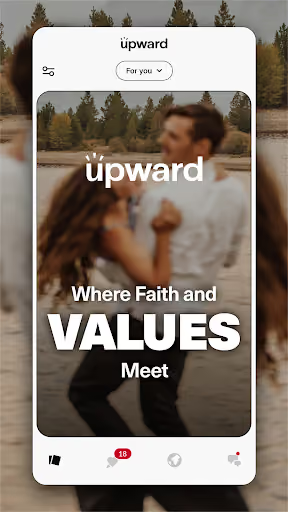
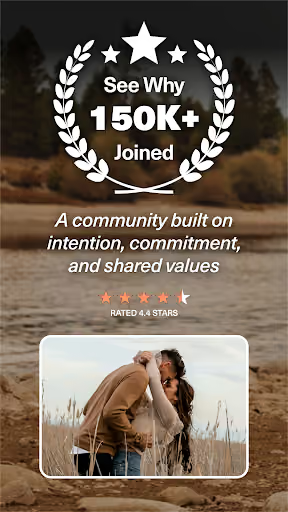
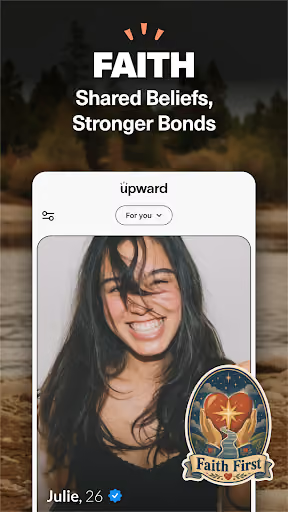
Upward Dating: Meet Singles is a free, values-driven dating app positioned around Christian and family-oriented relationships, with 2,744,222 installs as of 2026-08-03 and a 3.8★ current lifetime rating.
What it does
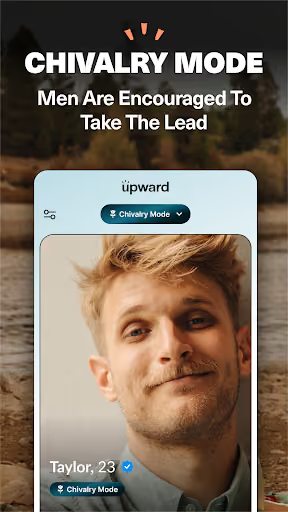
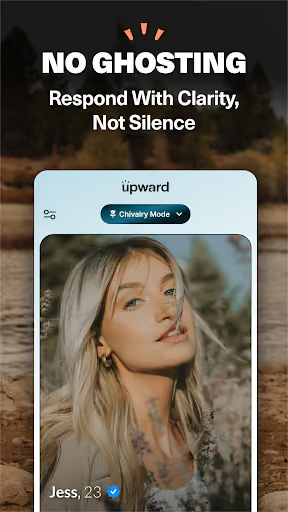
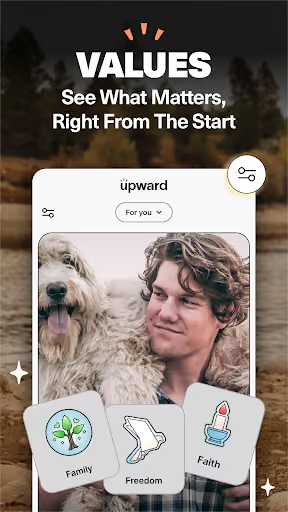
Profiles, Core Values, swiping, mutual matches, chat, Premium features, Elite access to likes, boosts, rewinds, Super Likes, and community-style interaction.
What broke
Reviews describe a trust collapse: paid tiers feel confusing, filters appear soft, local matches feel scarce, and account/payment support often fails when money is involved.
Why it is soft
The concept still has demand, but the incumbent’s users are explicitly asking for hard distance limits, transparent pricing, better safety, and fair appeals.
Strengths
Do not treat Upward as a strawman: the positioning is strong, the install base is large, and several reviewers still like the idea, the social pages, the values-oriented profiles, the no-swipe-limit feel, and the fact that some real relationships do happen.
Clear niche
Christian and values-driven singles are a sharper audience than a generic dating app, which helps messaging and app-store positioning.
Existing habit
A new entrant would have to build from zero what Upward already has: profile inventory, repeat swiping behavior, and user familiarity with the matching flow.
Proof it can work
One reviewer says they met a fiancé on the app, so the promise is not fake; the issue is trust, execution, and monetization.
Market gap
The complaints cluster around four product gaps: the most common is confusing layered monetization, followed by distance/filter failures, then trust-and-safety problems, and finally account/support reliability.
Layered paywalls
Users repeatedly say basic discovery, likes, messages, boosts, and tiers feel split into too many paid moments, with unclear expectations before purchase.
Soft local filters
Many reviewers object to seeing people far outside their stated radius or age range, especially when they paid to improve matching.
Safety and authenticity
Fake profiles, explicit accounts, scam messages, and off-platform extortion stories are a major trust blocker for a faith-branded app.
Bans and support
A smaller but serious set of reviews describes unexplained bans, login failures, refund disputes, and support loops that do not fix the account.
4 different things you would need to pay for. Says Christian, yet allows same sex dating connections. Swiping filters dont actually work. You will constantly be given the same 100ish profiles to swipe on. I've swipped no on the same profile 4 times in just 3 minutes. Yes, on a separate one three times in the same time frame. Advertising is constantly shoved in your face. Even if you pay, there is 2 more levels to pay for. Bad review -> Deleted profile.
Paywall structure is confusing. When you pay down one for $35 6/mo, it doesn't let you know prior that there's 3 tiers. The second of which is $75 EXTRA. Same thing pretty much all dating sites are guilty of including non-Christian ones. Reducing rating even more. They've been doing other deceptive practices with this app than before. Like introducing streaks and manipulating it to where you're never actually rewarded.
Upward is a bad app. There are too many fake, pornographic accounts with disgusting messages. Upward tries too hard to be like Tinder but the majority of the women look like fake accounts. The real women aren't using the app. They allow FanDuel and Tinder to advertise. They're expensive. They don't deserve your money. Their app is underdeveloped, overpriced and a scam. This was a Christian app but now they allow users to have agnostic and spiritual but not religious labels.
- Use one transparent $9.99/month tier. No stacked unlocks, no paid ambiguity around likes versus messages, and no surprise second tier after purchase.
- Make distance and age filters hard limits. If there are no nearby matches, say so plainly instead of padding the feed with people hundreds of miles away.
- Lead with verification, reporting, and appeals. A faith-branded dating app cannot feel safe if scam accounts survive while real users get banned without explanation.
Build complexity
Estimated, not derived: one developer, part-time, no funding, and no paid acquisition. This is not a full Upward clone; it is a narrow v1 with profiles, matching, chat, hard local filters, subscriptions, moderation tools, and enough safety infrastructure to avoid launching a spam magnet.
| Workstream | Weeks |
|---|---|
| Auth, onboarding, profiles, values fields | 4 |
| Swipe, match, and chat | 5 |
| Geolocation and hard filters | 3 |
| Verification, reports, admin review, appeals | 5 |
| Subscription billing and Play listing | 3 |
| QA, privacy, abuse testing, launch polish | 4 |
| Total | 24 |
Expected revenue
Estimated, not derived: with no paid acquisition, assume slow organic discovery, church/community sharing, and a single transparent $9.99/month subscription. Month-12 MRR is likely thin because local dating marketplaces need density before people pay.
| Month 12 funnel | Estimate | Assumption |
|---|---|---|
| Installs | 1,200 | Organic only |
| Activated | 600 | Completed profile |
| Retained | 240 | Still active locally |
| Paid | 80 | $9.99/month |
| Revenue | $800 | Month-12 MRR |
Biggest challenges
The hard part is not the swipe UI; it is launching a two-sided local marketplace where users trust the safety, see enough nearby people, and believe the app will not waste their money.
Local density cold start
Hard distance filters are the promise, but they also expose empty inventory unless the launch is city-by-city or church-network-led.
Trust and safety burden
Scam, explicit, and impersonation reports require fast human judgment; a part-time solo builder can easily become the moderation bottleneck.
Store and billing risk
Dating, subscriptions, user-generated content, bans, and refunds are all policy-sensitive areas where sloppy implementation can create review and support problems.
AI angle
There is a real but limited AI angle: AI can make moderation cheaper by flagging explicit images, likely scam text, duplicate-looking profiles, and suspicious off-platform money requests before a solo builder reviews them. It does not solve the core marketplace problem of getting enough local real users.
Useful AI
Pre-screen photos and messages, prioritize reports, summarize appeal context, and warn users when a conversation resembles a known scam pattern.
Not enough
AI matching copy or chat suggestions would be a distraction; users are complaining about safety, paywalls, distance, and trust, not a lack of clever recommendations.
Conclusion
Skip it. The user pain is real, but a part-time solo builder is fighting local network effects, trust-and-safety workload, and app-store subscription risk. Only build this if you can launch inside a specific local faith community first, not as a general Upward clone.
24 weeks
Time to v1
$9.99/mo
One transparent tier
$800
Month-12 revenue
Local density
Deciding constraint