Abstract
Bark is a real, funded child-safety company, not a stumbling startup, but its app draws a steady stream of one-star reviews for the same three things: it silently loses connection to the child's device, it flags harmless content as explicit, and it charges through a confusing billing flow. The complaint is calibration and reliability, not the underlying idea — parents who get a working setup describe it as genuinely valuable, which is exactly why the noisy setup and false alarms cost Bark trust it otherwise earns.
Background
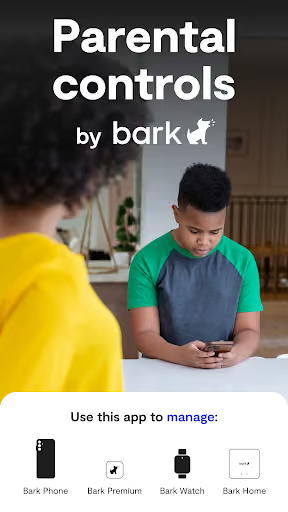
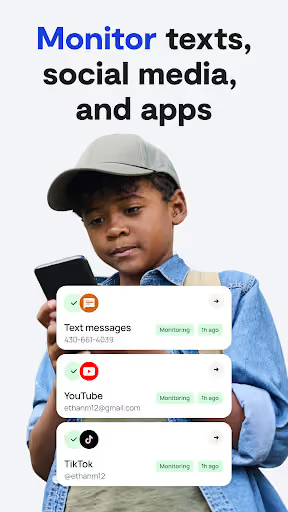
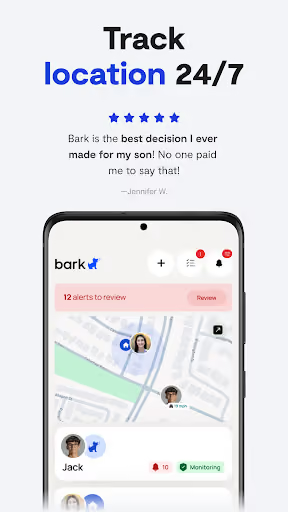
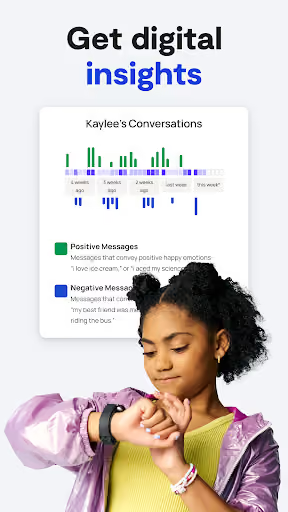
Bark — Bark - Parental Controls — monitors a child's texts, email, YouTube and 30+ apps for cyberbullying, adult content and similar risks, layered with screen-time limits and web filtering, sold at $14/month ($99/year) with a cheaper Bark Jr tier and an optional Bark Home router device and Bark-branded phones/watches.
What it does
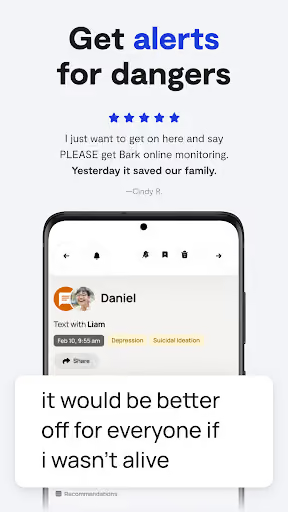
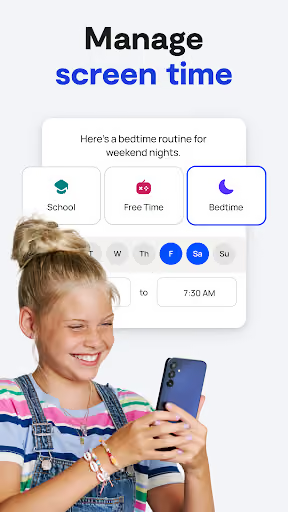
Reads a child's messages and app activity for risk keywords, lets a parent set screen-time schedules, and filters web content — either on the child's own phone or, with Bark Home, every device on the family Wi-Fi.
What changed
Recent updates replaced a one-tap free-time/school-mode toggle with a more confusing "schedule" flow, dropped the satellite map view from location tracking, and — per at least one billed customer — raised the price without notice via a new "installment plan".
Why it is soft
The complaints are about execution, not concept: the same reviewers who call the alerting "life saving" when it works also describe the VPN silently breaking a child's other apps, the location map going stale for hours, and support degrading to an unhelpful AI chatbot.
Strengths
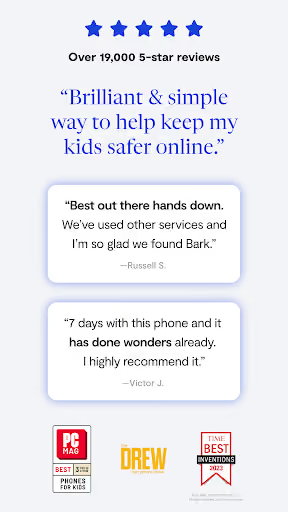
Bark's core alerting is repeatedly called out as valuable when it's actually running, and the company has real switching costs a new entrant starts without: an installed base near a million, multi-year repeat customers, and a hardware ecosystem (Bark Phone, Watch, Home) that ties a family's setup to the brand, not just the app.
Alerting works when connected
Parents describe the content and location alerts as reassuring after a scary encounter, and multiple reviewers have stuck with the service for years.
Retained habit + hardware lock-in
Families on a Bark Phone or Watch face real switching friction — one reviewer notes their device becomes "completely useless" without an active Bark subscription.
Market gap
The recurring complaints cluster into a few groups, most-common first.
Reliability over completeness
The most common complaint by a wide margin: the app loses contact with the child's device, the location map goes stale for hours, and the VPN needed for web filtering blocks unrelated apps (a guitar-tabs app, Xbox, the weather app) — often requiring the child's app to be manually re-updated to reconnect.
Calibration
A close second: content flagged as explicit that plainly isn't — a statue, a snack bag, ordinary teen slang — burying real alerts in noise, alongside a separate thread of teens describing the monitoring itself as a strain on trust with their parents.
Billing and lock-in
A smaller but pointed cluster: a price increase applied without notice, a "cancel anytime" trial that converted into a non-refundable annual charge, and Bark-branded phones that are hard to leave or uninstall from.
Interface quality
The parent app is described as feeling like a website rather than a native Android app (the system back-gesture closes it instead of navigating back), cluttered with an unremovable "Weekly Moments" widget, and a recent redesign made basic mode-switching harder, not easier.
It's an Android phone. Needs a lot of work. Disconnects from monitoring devices often and if they don't keep the app/notification open on their phone, you can't track their location. Major flaw. This is causing me to switch to Life360 for safety. Final straw, they don't monitor the Discord app on computers. Major safety issue. I'm finding something else.
7-17-26 - Still receiving warnings - garbage,SMH 3-19-26 - After our kids got new phones, we decided to stop using this app and did not install on our kids new phones (this app is terrible). We purchased those phones over a month ago and Bark is STILL warning us, even when the app isn't installed - this app is far too aggressive, way too many false positives, and can't even figure out when it is installed or not. Save your money, use nextdns dot io for free and just block social media outright.
app is not user friendly, the company charges a lot for these features that don't work very well. I tried for months to get numbers added, things like that, and it never worked. and when I inquired about options for my account, the rep took that as a license to charge me for the phone, putting my bank account into overdraft. and now the phone is paid off but I still can't use it, and rn I'm trying to get them to remove the software, and I keep being ignored. -10000/10
- Fix connection reliability first. A persistent background service that surfaces a clear "disconnected" state immediately, instead of silently going stale, answers the single most-repeated complaint above.
- Let parents retrain false positives. A visible "not sexual / not bullying" feedback control on each alert directly targets the calibration cluster and rebuilds trust in the alerts that are real.
- Price and cancel transparently. Visible pricing before signup and a genuine one-tap cancel with no forced annual lock-in directly answers the billing complaints above.
Build complexity
Estimated, not derived: one developer, part-time, no funding and no paid acquisition. Reading a child's notifications/SMS and filtering web traffic both rely on Android's Accessibility and VPN-service APIs rather than any official "parental monitoring" API, so the service has to be built and then kept working against OS permission changes — the same maintenance burden visible in Bark's own review complaints, just carried by one person instead of a team.
| Workstream | Weeks |
|---|---|
| Core monitoring service (Accessibility/notification listener) | 5 |
| Web/DNS filtering (on-device VPN) | 3 |
| Screen-time & scheduling UI | 2 |
| Play Store compliance & restricted-permission review | 2 |
| Billing + subscription management | 2 |
| Total | 14 |
Expected revenue
Estimate, not a forecast: assumes a narrower product than Bark's full suite — screen-time and web filtering only, skipping full content-monitoring and hardware — at $4.99/month freemium, sold on Bark's own reliability complaints rather than paid acquisition.
| Month 12, monthly | ||
|---|---|---|
| Installs | 40,000 | |
| Activated | 16,000 | 40% |
| Still on at 30d | 4,000 | 10% |
| Paid | 361 | 0.9% |
| Revenue | $1,800 |
Biggest challenges
Not the monitoring logic itself — earning enough trust that a parent hands a stranger's app their child's messages, and surviving Google Play's stricter, declared-use review process for apps requesting SMS/notification access, which most app categories never have to clear.
Cold-start trust
A safety-critical category where parents research heavily before installing — zero reviews and no brand recognition on day one against Bark's near-million-install base.
Store review risk
Play's restricted "Permitted Use" declaration for SMS/notification access adds an approval step and ongoing compliance burden most solo-built apps never face.
AI angle
There is a genuine angle: the calibration cluster above — a statue and a snack bag flagged as explicit — reads like a keyword/heuristic filter rather than one that understands context. A small classifier model scoring message/image risk with actual context (and a confidence score that triggers a human review instead of an auto-flag) directly targets the most common complaint after reliability, and is realistically only buildable by a solo developer with an off-the-shelf model API rather than a hand-tuned rules engine. It doesn't remove the need to handle a child's private messages carefully, which stays a trust problem no model fixes.
Without AI
A hand-maintained keyword/regex list, tuned indefinitely against new slang and false positives — the exact failure mode reviewers describe.
With AI
A context-aware classifier call per message/image, with a confidence threshold that routes unclear cases to a summary instead of an alarm — days of integration, not a research project, and it ships inside the Core monitoring service estimate above.
Conclusion
Skip it. The reliability and calibration gaps are real and clearly documented by Bark's own users, but this is a crowded, safety-critical category where Bark, Life360, Qustodio and Google's own free Family Link are already fighting for the same parents — a moat a solo builder with no funding and no paid acquisition is unlikely to crack before running out of runway.
14 weeks
Time to v1
$4.99/mo
Freemium, no lock-in
$1,800/mo
Revenue at month 12
~1M
Bark's own install base