Abstract
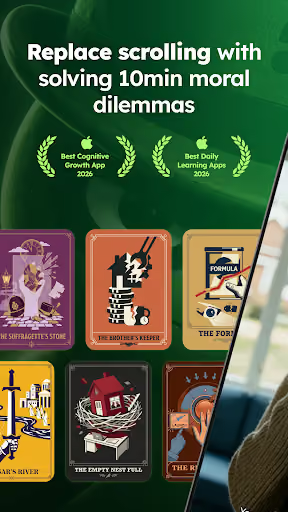
Dilemmo pitches itself as a quick daily ethical-dilemma quiz that reveals your personality through the choices you make. What reviewers actually get is a long, mandatory, low-quality AI-generated video for every scenario, binary choices that misread their real reasoning, and a subscription gating a thin content library — a mismatch between the ad and the app that shows up again and again in its reviews, alongside real enthusiasm for the underlying concept.





Background
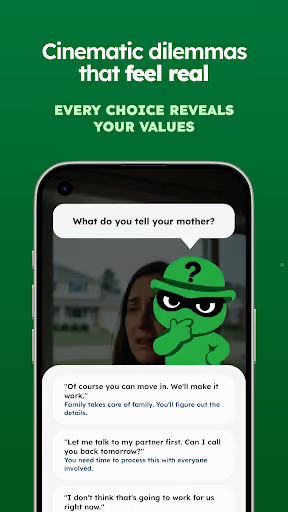
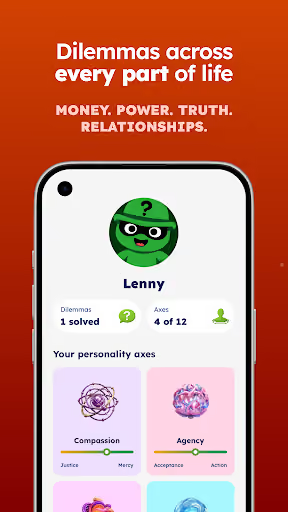
Dilemmo (Dilemmo: Make Better Decisions) sells a simple premise: face a moral dilemma, make a choice, learn something about your own personality across twelve dimensions. In practice, opening a dilemma plays a slow, AI-generated video with no way to skip to text, and the two-option choices often force an outcome the reviewer never intended.
What it does
Branching video scenarios with high-stakes moral choices, closing with a personality read across categories like Integrity, Risk, and Compassion.
What changed
Ads promise "a question a day"; the delivered app is a padded, AI-video-heavy subscription experience reviewers repeatedly call "not as advertised."
Why it is soft
The AI video layer is cheap to generate but expensive to trust — it is the single most repeated complaint, ahead of pricing or bugs.
Strengths
The complaint is about execution, not the idea — reviewers who get past the AI-slop framing consistently describe the underlying concept as "cool," "interesting," and genuinely self-revealing after enough scenarios, and the free tier's lack of ads is called out as a rare positive in a crowded personality-quiz category.
Concept pull
"Much like a Choose Your Own Adventures style book... after 25 of them I'm starting to see a trend in me" — the core loop lands for users who stick with it.
Clean free tier
No forced ads reported anywhere in the sample, unusual for the category and called out by name as a reason to keep trying the app.
Market gap
Complaints cluster into three groups, most common first. First and loudest: AI-generated video quality — glitchy renders, no captions-only option, inconsistent narration, and users explicitly saying they'd prefer a static illustration or plain text. Second: the ad-to-app gap — marketing promises a short daily question; the app delivers a long mandatory story with occasional binary choices, and several reviewers call this false advertising outright. Third: value for the subscription price — a small scenario library, some reviewers reporting they finished all available content within hours or days of paying, and isolated reports of being charged more than the quoted price.
Verdict - This is, in my opinion, a money grab that go just as easily be achieved as a free website. Do not purchase.
The advertisement said it was basically about asking you personal questions, but when I downloaded the app and got started the first thing it did was just play a gigantically long, AI driven story narrative that presents you with some pseudo-ethical question every couple of minutes, and frankly I got bored. It wasn't what I was told it would be.
- Replace mandatory AI video with a fast, skippable text-first presentation of each dilemma, keeping video strictly optional.
- Rewrite ad creative to match the real experience — a short, honest daily-question format, not a long branching story.
- Launch with a larger day-one scenario library (or a visible content-release cadence) so the paid tier doesn't feel exhausted within days.
Build complexity
Estimate assumes one part-time solo developer, no funding, and no team — the build leans on off-the-shelf branching-narrative UI patterns and text content rather than the video pipeline Dilemmo built, which is itself the thing to avoid rebuilding.
| Workstream | Weeks |
|---|---|
| Dilemma content — write 30-40 launch scenarios, 12-trait scoring model | 2 |
| App shell — swipe/choice UI, personality result screens, account/auth | 1.5 |
| Optional lightweight AI art (static images, not video) + subscription paywall | 1 |
| Polish, crash-proofing, store listing | 0.5 |
| Total | 5 |
Expected revenue
Assumes a $6/month single tier (below Dilemmo's reported $12-30/month range, priced against the complaint that content doesn't justify the cost), free tier funded by no ads, and a modest 1-3% installer-to-payer conversion typical for an unbranded solo-built quiz app at month 12.
| Stage | Month 12 |
|---|---|
| Installs (cumulative) | 15,000 |
| Activated (completes 1 scenario) | 9,000 |
| Retained (returns week 2) | 2,700 |
| Paid | 300 |
| MRR | $1,800 |
Biggest challenges
The real bottleneck is creative, not technical: Dilemmo's complaints show that writing dilemmas people find plausible and non-binary is hard, and a solo builder must keep producing new scenarios solo to avoid Dilemmo's "ran out of content in a day" complaint. A second challenge is category trust — "AI slop" is now a loaded phrase reviewers reach for fast, so any AI use at all, even restrained, invites the same backlash unless it's clearly optional. Store discovery for an unbranded personality-quiz app is also crowded and ad-spend-driven, which a no-budget solo launch can't match.
AI angle
Dilemmo's own flaw is over-applying AI to the user-facing product, so the honest angle here is not "add more AI" — that is exactly what users are rejecting. Where AI genuinely helps is on the builder's side: drafting a larger, more varied first batch of dilemma scenarios and follow-up branches far faster than writing them all by hand, while keeping the shipped experience text-first and skippable. There is no capability here an incumbent couldn't also offer — the edge is discipline about where AI stays invisible (content drafting) versus where it becomes the product (mandatory video).
Conclusion
Skip it. The market gap is real and the concept has a following, but the margin is thin: a solo builder must out-write Dilemmo's content pace indefinitely on a $6 price point, in a category primed to reject any AI use on sight. Worth a side-project bet, not a primary one.
5 weeks
Time to v1
$6/mo
Single-tier subscription
$1,800
Month-12 MRR
Thin margin
Content-authoring pace is the real constraint