Abstract
The opening is real: reviewers repeatedly complain that TV Cast for Chromecast looks free, pushes payment or trial friction, is hard to cancel, and often fails at basic connection. But a solo builder should not try to clone every promised TV protocol; the viable wedge is a narrower, honest Chromecast-first caster with simple setup, clear one-time pricing, and better failure messages.
Background
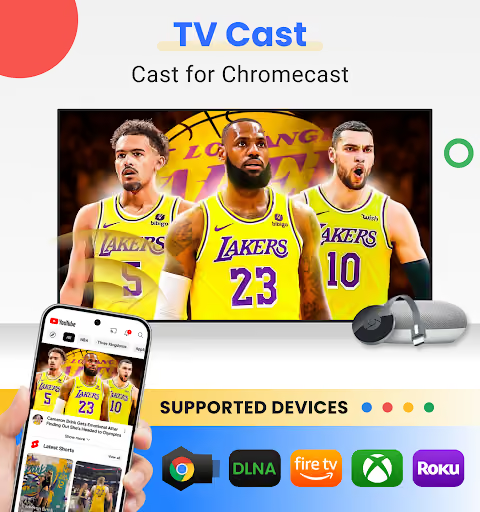
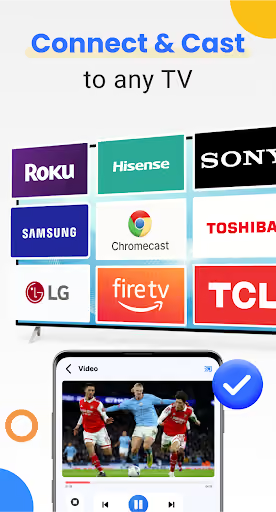
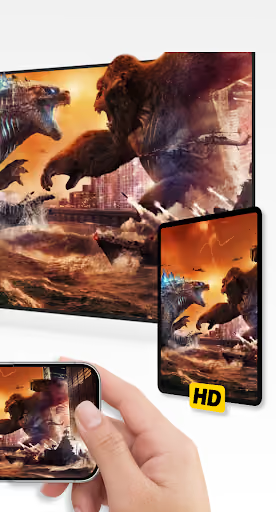
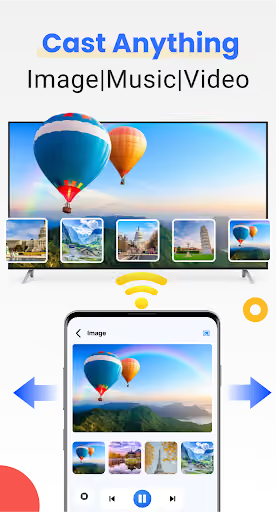
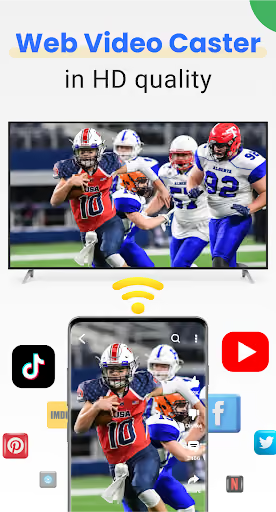
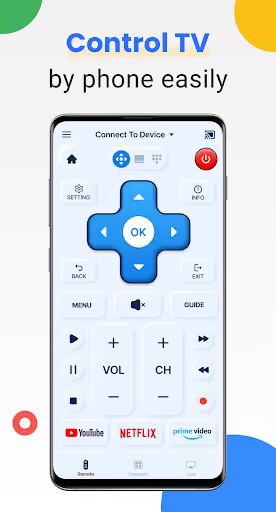
TV Cast for Chromecast is a free Play Store app with a 3.8★ lifetime average, 2,561,160 installs on 2026-08-26, and a broad promise: cast photos, videos, music, web URLs, camera, games, and full screen mirroring to Chromecast, Roku, Fire TV, Xbox, Samsung, LG, Sony, and other smart TVs.
What it does
A universal casting and mirroring utility: local media casting, web-video casting, screen mirroring, camera streaming, and multi-device discovery on the same Wi-Fi network.
What changed
Recent reviewers say the app is advertised or remembered as free, but now blocks usage behind subscriptions, trials, or repeated payment prompts.
Why it is soft
The same reviews also mention connection failures, missing PINs, poor instructions, refund confusion, and cancellation anxiety — pain a simpler product can avoid by promising less.
Strengths
This is not an empty category. The incumbent has millions of installs, shows up for broad “cast to TV” intent, and offers a feature list that covers nearly every common household use case. A competitor has to earn trust from zero while users already search for Chromecast, hotel TV, LG, Vizio, Roku, and smart-TV help.
Demand is proven
Installs rose from 2,547,358 on 2026-08-11 to 2,561,160 on 2026-08-26, so people are still actively finding this type of app.
Broad feature surface
The app’s description covers photos, videos, music, web URLs, camera streaming, screen mirroring, games, and many TV brands — breadth that users may expect from any replacement.
Some users still get value
One 5★ reviewer said it was “pretty good so far,” which matters: the complaint is not that casting apps are useless, but that this experience is unreliable and monetized poorly.
Market gap
The review pattern is clear enough to define a product wedge, without pretending to count the whole sample: the loudest complaint is billing surprise, followed by cancellation/refund anxiety, connection failure, and confusing setup.
Surprise payment wall
The most common complaint is that users expected free casting or a free trial, then hit a subscription, daily cost, or payment request before they could do the occasional cast they came for.
Cancellation and refund fear
Several reviewers say they were charged, could not find cancellation, or wanted refunds after the app did not work. A no-subscription unlock directly removes that anxiety.
Does not connect
Multiple reviews mention LG, Hilton hotel TVs, Vizio, Chromecast, missing PINs, codes that do not work, or devices being visible but not connecting.
Setup is too hard
Some users ask for written step-by-step instructions, simpler directions, and clearer troubleshooting instead of vague prompts.
what happened to free? it said free, but it wants money now...I don't think so...
When I downloaded the app I was hoping it would let me try it like it stated it would. once I downloaded it. It did not work. It was supposed to be for a 3-day free trial and now it will not let me undo it I'm only 30 minutes into it... And somehow it will not allow me to cancel the subscription. How do I get rid of this subscription!? What a mess!
Could not get app to connect to LG OLED TV. It sees my TV but will not connect even after following the troubleshoot suggestions. And then the refund issues which can't be reversed. Be careful.
- Start Chromecast-first, not universal-TV-first. The broad multi-device promise creates support pain; a solo builder should win the users who just want simple phone-to-Chromecast photo and video casting.
- Use one clear unlock, not a subscription. The reviews punish ambiguity more than payment itself, so make the listing, first screen, and checkout say exactly what is free and what costs money.
- Make failure states the product. Show same-Wi-Fi checks, supported-device checks, PIN guidance, and “this TV is not supported” messages before asking for payment.
Build complexity
Estimated, not derived: one developer, part-time, no funding, no paid acquisition. The v1 is intentionally scoped to Chromecast discovery plus local photo/video casting, transparent billing, onboarding, and diagnostics — not a full clone of every Roku, Fire TV, LG, Samsung, Xbox, web-video, and screen-mirroring promise.
| Workstream | Weeks |
|---|---|
| Chromecast discovery, connection, and session handling | 2.0 |
| Local photo and video casting flow | 2.0 |
| Setup wizard, diagnostics, and clear failure messages | 2.0 |
| One-time unlock, listing copy, and refund-safe paywall | 1.0 |
| Device testing, edge cases, and Play Store release hardening | 3.0 |
| Total | 10.0 |
Expected revenue
Estimated, not derived: month-12 revenue assumes organic Play Store discovery only, a free install with clear limited trial/use, and a $4.99 one-time unlock. This is a monthly run-rate from new unlocks, not dependable subscription MRR, because subscriptions are exactly what reviewers are rejecting.
| Month 12, monthly | Users | Assumption |
|---|---|---|
| Installs | 3,000 | Organic search and review-led switching |
| Activated | 1,200 | 40% complete device discovery |
| Still on at 30d | 600 | 20% of installs retain for repeat casting |
| Paid | 300 | 10% buy $4.99 unlock |
| Revenue | $1,500 | Rounded monthly run-rate |
Biggest challenges
The hard part is not making a pretty caster UI; it is surviving the device-support burden without a QA lab, earning Play Store trust against high-install incumbents, and avoiding over-promising the same universal compatibility that made reviewers angry.
Device matrix
Users mention LG OLED, Vizio, hotel TVs, Chromecast, and generic smart TVs. A solo builder cannot test every firmware, hotel captive network, and TV brand.
Store trust cold start
The incumbent has 2,561,160 installs and a 3.8★ lifetime average; a new app has no review base and must avoid looking like another casting scam.
Scope creep pressure
Searchers will ask for screen mirroring, web-video, Roku, Fire TV, Xbox, Samsung, LG, and hotel support. Saying “no” is strategically correct but will cap revenue.
AI angle
There is no strong AI moat here. AI can help draft troubleshooting copy, classify support emails, or generate device-specific help text, but the core job is network discovery, casting protocol reliability, Android media handling, billing transparency, and real-device testing. Do not count AI as reducing the 10-week build or lifting the $1,500/month estimate.
Useful AI support
A small in-app help assistant could ask what TV model and Wi-Fi state the user has, then guide them through the same setup checks in plain language.
Not a differentiator
AI does not make a phone connect to an unsupported hotel TV, fix a missing TV PIN, or validate every Chromecast-like device on the market.
Conclusion
Build a narrow version, not a full clone. The reviews expose a real gap around honest pricing, cancellation-free monetization, and clearer setup, but universal casting is a support-heavy category with many compatibility traps. The right solo-builder bet is a small Chromecast-first app, priced once, that refuses to over-promise.
Time to v1
One-time unlock
Revenue at month 12
Fact that decided it