Abstract
Shipt’s recent reviews show a real worker-trust gap: shoppers complain about strict deactivations, buggy Android releases, opaque ratings, poor support, low pay, and hidden tips. The pain is serious, but a solo builder would be competing against a two-sided logistics marketplace, not just a flawed app, so the opportunity is weak unless scoped to a tiny local launch.

Background
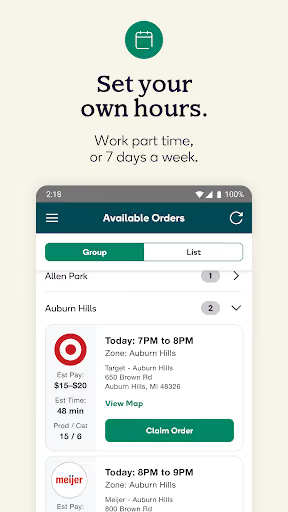
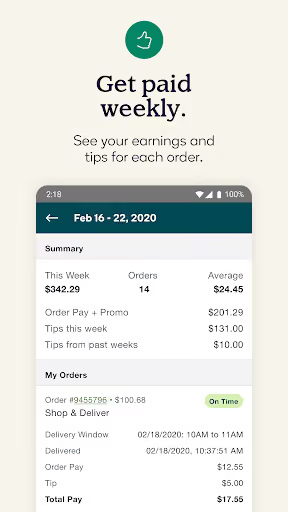
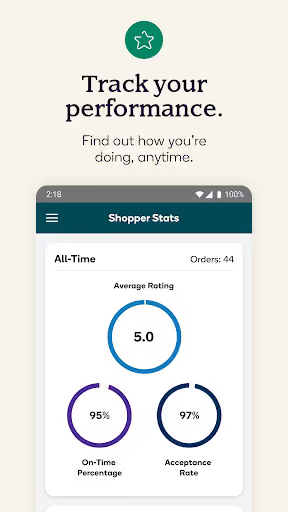
Drive and Shop with Shipt is Shipt’s shopper and delivery-driver app for grocery shopping, package routes, tips, same-day pay opportunities, and flexible gig work. The Play listing shows a 4.2★ lifetime rating, a free price, and 3,095,289 installs as of 2026-08-03.
What it does
Lets independent shoppers accept grocery orders or delivery routes, communicate with customers, track delivery windows, and get paid through Shipt.
What changed
Recent reviews describe a harsher rating and reliability experience, repeated app glitches after updates, login/load failures, and late-delivery penalties that shoppers say are outside their control.
Why it is soft
Workers openly compare it with DoorDash, Spark, Instacart, Uber, and other gig apps. The worker side is angry; the hard part is that customers, stores, payments, routing, and support are still Shipt’s moat.
Strengths
This is not a dead app. Positive reviewers still praise flexible work, the ability to make extra money, customer communication, aisle guidance, higher-paying orders in some areas, and helpful support in good cases. The 3,095,289 install base and 4.2★ lifetime average mean a new entrant would be fighting a familiar brand with existing shopper habits.
Real work demand
Several reviewers say they enjoyed the work, made good money at times, or preferred Shipt to other gig apps before the policy, pay, or app issues got in the way.
Built-in operational depth
The incumbent already handles orders, tips, store workflows, package routes, shopper onboarding, account checks, payment timing, and support — all expensive to replicate.
Market gap
The complaints cluster around worker fairness more than consumer demand. The most common theme is punitive metrics and deactivation; close behind are Android instability, weak support, and pay transparency.
Punitive metrics
Shoppers say they are deactivated or downgraded for late deliveries, customer behavior, store delays, weather, traffic, already-late orders, and vague violations with little appeal detail.
Broken work app
Reviewers mention crashes, freezing, failed refreshes, login loops, messaging failures, scanner problems, navigation glitches, and updates that introduce new issues.
Support black hole
Support is described as slow, inconsistent, scripted, unhelpful during live orders, and unable to explain ratings, deactivations, missing pay, or account access problems.
Pay opacity
Many complaints focus on low base pay, long mileage, hidden or delayed tips, limited cashout rules, bonus exclusions, and orders that do not cover time and gas.
New rating system is just another excuse to make sure you don't reach Summit. When you ask support anything you will get the full run around from agents closing chat on you to eventually hq telling you to email a different support team so they can run you in circles some more. Other drivers will get bonueses all week, but you will get excluded( have picture proof). Offer prices have also gone done yet again despite rising gas costs. Used to but no longer would reccomend to anyone.
New, usually different set of problems every update. Updates keep slowing the process as a whole, efficiency keeps going down a little at a time. Message system still has too many issues. Support is hit or miss. All the other usual glitches; lagging, loading, scaning, and so forth. Had the same issues on many phones. Have had a similar reveiw update every other year.
Worst app. Tips need to be shown with offers. low paying $6-8 offers without rips that are consider trash.Gas is at $4-7 a gallon, not one can afford to drive $6 or double shopping high miles. Base pay needs to be more. App is not worth it anymore.
- Show true pay before acceptance. The clearest wedge is upfront mileage, item count, expected time, base pay, and tip status so shoppers are not gambling on unprofitable orders.
- Make reliability explainable. Late metrics need automatic context for store waits, address problems, weather, app outages, already-late offers, and customer non-response before any penalty.
- Build support into the workflow. A competitor should capture evidence during the order, preserve pay records after deactivation, and give live-order escalation instead of sending workers into forms and email loops.
Build complexity
Estimated, not derived: one part-time developer, no funding, no team, and no paid acquisition. This assumes a very narrow v1 in one local market, not a national Shipt replacement.
| Workstream | Weeks |
|---|---|
| Shopper Android app: offers, chat, task flow, proof of delivery | 5.0 |
| Customer ordering, simple catalog, admin tools | 5.0 |
| Dispatch, routing, payments, tips, payouts | 4.0 |
| Fair metrics, evidence capture, appeals, support queue | 3.0 |
| Offline recovery, QA, Android stability hardening | 3.0 |
| Play launch, onboarding, local ops setup | 4.0 |
| Total | 24.0 |
Expected revenue
Estimated, not derived: with no paid acquisition, assume a tiny local launch where shoppers are free and paying customers generate about $30/month each through membership or service fees. This is deliberately conservative because worker anger does not automatically create customer demand.
| Month 12 funnel | Estimate | Assumption |
|---|---|---|
| Installs | 1,200 | Organic local discovery and gig-worker referrals |
| Activated | 160 | Placed or accepted a first local order |
| Retained | 70 | Still active in the local market |
| Paid | 40 | $30/month average fees |
| Revenue | $1,200 | Month-12 monthly revenue estimate |
Biggest challenges
The hard part is not copying screens; it is bootstrapping both sides of a local logistics marketplace while staying reliable enough that workers trust their income to you. A part-time solo builder also inherits live support, payment disputes, failed deliveries, fraud, store inventory mismatch, insurance expectations, and Play Store review risk around gig-work claims.
Marketplace cold start
Angry shoppers may install, but customers and order volume are the scarce side. Without steady orders, the shopper-first promise collapses.
Operational liability
Every late order, missing item, wrong address, refund, tip dispute, and payout delay becomes your support burden, not just a product ticket.
Trust from zero
Shipt has millions of installs and an established brand. A new app must persuade workers and customers that a tiny operator is safer than a flawed incumbent.
AI angle
There is a genuine but limited AI angle: use AI to summarize order evidence, detect risky offers before acceptance, draft customer substitution messages, and assemble appeal packets from timestamps, chat logs, photos, mileage, and store-delay notes. That helps address the fairness/support gap, but it does not solve customer acquisition or marketplace liquidity.
Good use
A shopper-side copilot that explains risk, preserves proof, and turns messy order history into a human-readable support case.
Bad use
Automated deactivation or opaque scoring. Reviews already complain about being judged without context, so AI must increase explainability, not replace it.
Conclusion
Skip it. The market gap is real, but it is not a clean solo-builder wedge: Shipt’s weakness is worker trust, while the product you would need to build is a live logistics marketplace with payments, customers, stores, support, and liability. Build a shopper companion tool instead if you want the niche; do not try to clone Shipt part-time.
24 weeks
Time to v1
$30/mo
Customer fee model
$1,200
Month-12 revenue
3,095,289 installs
Incumbent moat