Abstract
NOAA Weather Unofficial (Pro) has a devoted following — some reviewers have used it for a decade — for its no-frills, ad-free, no-tracking presentation of official NOAA point forecasts. The concrete, well-articulated gap is architectural: the app depends entirely on the api.weather.gov endpoint with no fallback or cache, so when that government API is slow or down (which reviewers say happens often), the app simply shows nothing. It's a real, fixable, well-diagnosed problem in an app that's otherwise a single beloved developer's long-running project.
Background
For nearly a decade, NOAA Weather Unofficial (Pro) ($1.99) has offered hyper-local point forecasts sourced directly from NOAA/NWS, with no ads and no data-selling — built and maintained by a single independent developer.
What it does
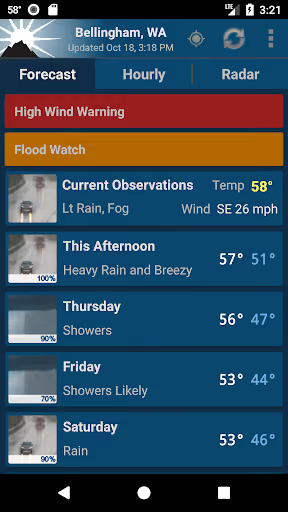
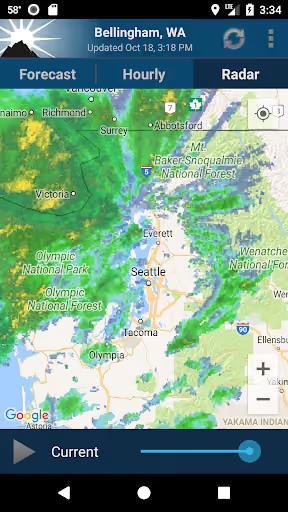
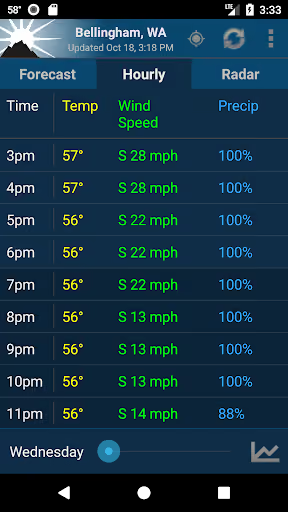
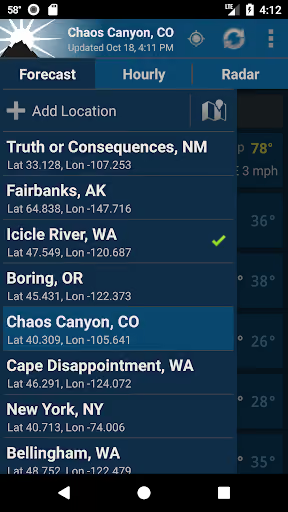
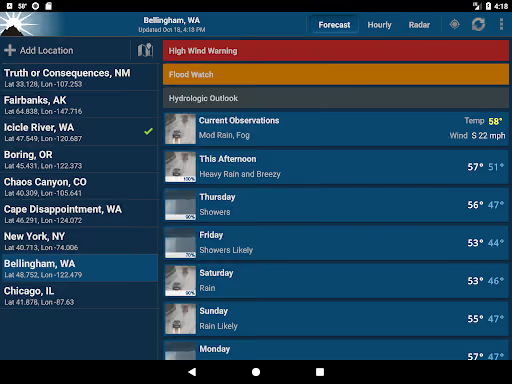
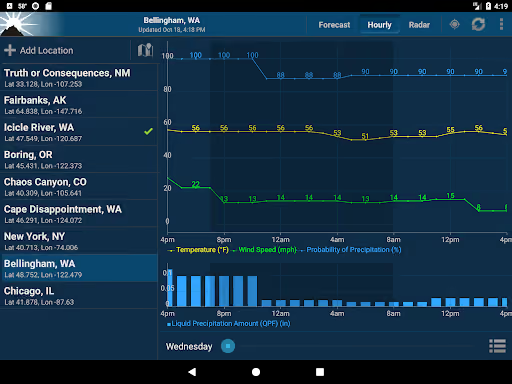
GPS-based hyper-local forecasts, animated radar, and widgets, sourced straight from NOAA's public API, ad-free.
What changed
Nothing about the app's philosophy — but reviewers increasingly report forecasts failing to load or going stale, traced by one reviewer directly to api.weather.gov's own instability.
Why it is soft
A weather app that goes blank exactly when severe weather makes NWS's servers busiest is failing at the one moment its no-frills, trustworthy positioning matters most.
Strengths
Direct-from-NOAA sourcing, an ad-free/no-tracking stance, and years of an actively engaged single developer are real, proven differentiators — reviewers explicitly contrast it favorably against bloated, ad-heavy competitors.
Market gap
The recurring complaints, grouped into clusters, most-common first.
Single point of failure
No fallback or cache when NOAA's own api.weather.gov endpoint is slow, rate-limited, or down — a named architectural gap, not a vague bug.
Widget reliability
A large, recurring cluster of "Update Error" and stale-widget complaints, separate from the core app.
Stale current conditions
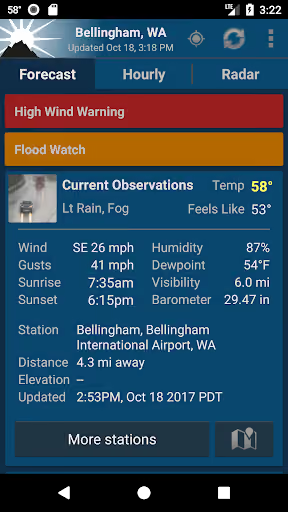
Current-observation data reported as 2+ hours old, undermining trust in the "live" numbers.
Clean UI without ads or bloat, but it relies entirely on the api.weather.gov endpoint with zero fallback. The NWS server is notoriously fragile, crashing not just during severe weather, but at random times when you just want a routine forecast. A weather app is nearly useless if it depends entirely on a single, unstable source of information.
This app is absolutely ridiculous, they couldn't get a forecast right to save their life, the predicted 2 to 4 inches of rain again today for us and all these big storms.. sun has never gone in.. hot sunny day.. what a joke this app is !!
- Add a cached-forecast fallback. Serve the last-known-good forecast with a clear "data is X minutes old" label instead of a blank screen when NOAA's API is unreachable.
- Blend a secondary data source for redundancy. A commercial or alternate government feed as backup directly answers the single-point-of-failure complaint.
- Fix the widget refresh pipeline first. It's the most-repeated specific complaint and is isolated enough to be a fast, high-visibility win.
Build complexity
Estimated for one developer, part-time, no funding. NOAA's point-forecast API is free and public, so this is primarily a reliability-engineering build (caching, fallback, retries) on top of a straightforward forecast UI.
| Workstream | Weeks |
|---|---|
| Forecast UI + GPS point forecasts (NOAA API) | 2 |
| Local cache + fallback data source | 2 |
| Widgets with reliable refresh | 1 |
| Listing + billing | 1 |
| Total | 6.0 |
Expected revenue
Assumes a $1.99 one-time price matching the incumbent, into a smaller but loyal US-only market (NOAA data is US-specific), explicitly marketed on reliability during outages.
| Month 12, monthly | ||
|---|---|---|
| Installs | 40,000 | |
| Activated | 18,000 | 45% |
| Paid | 750 | 4.2% |
| Revenue | $1,500 |
Biggest challenges
The incumbent is itself already a beloved, single-developer, decade-old project — competing here means displacing loyalty built over years, not exploiting negligence, which is a harder sell even with a real technical fix in hand.
AI angle
No strong angle. The core gap is data-pipeline reliability (caching, fallback sourcing), which AI doesn't meaningfully accelerate — this is an infrastructure fix, not a generation problem.
Conclusion
Build it — carefully. A real, specific, well-diagnosed architectural gap, but against an already-loved solo developer's decade-old app, which limits how much of that loyalty transfers.
6 weeks
Time to v1
$1.99
One-time
$1,500
Revenue at month 12
33
Helpful votes on the forecast-reliability complaint