Abstract
MegaNovel’s reviews show a real opening around honest pricing, non-expiring credits, and less abusive ads, but a solo builder is not competing with a reader UI — they are competing with a paid-content marketplace and a catalog habit, so the practical opportunity is narrow and modest.



Background
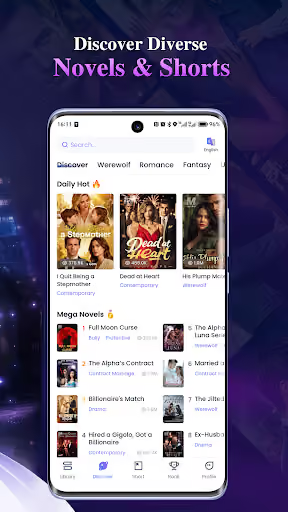
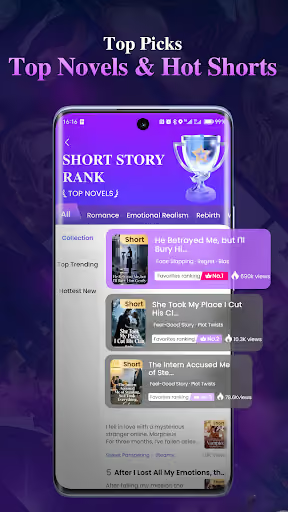
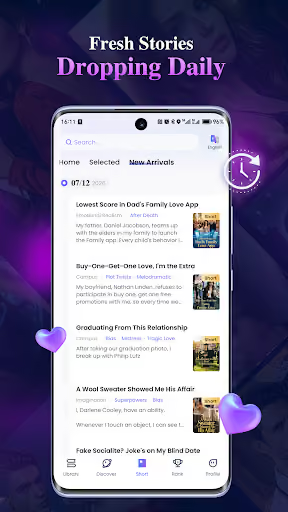
MegaNovel: Fictions & Webnovel is a free serial fiction app with a 4.2★ lifetime rating and 2,333,330 installs. It advertises fantasy, sci-fi, system, urban, mystery/thriller, paranormal stories, original writers, and author rewards; the review backlash is mainly about coins, subscriptions, ads, and trust rather than the basic idea of reading serialized web fiction.
What it does
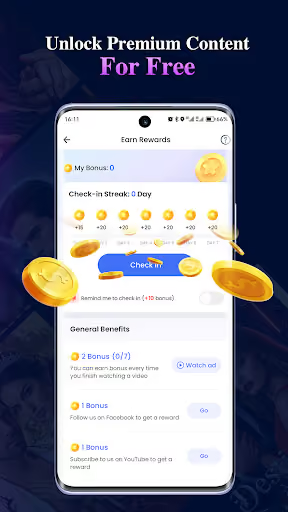
Hosts long serialized novels, locks later chapters, and monetizes through coins, bonus points, ads, and subscriptions.
What changed
Reviewers repeatedly say ads promise free reading, but the app then asks for coins, shows long ads, expires bonuses, or limits subscriptions in ways they did not expect.
Why it is soft
The frustration is not subtle: users ask for upfront whole-book cost, honest free claims, and a fairer unlock model.
Strengths
This is not a dead product. Several unhappy reviewers still say the stories are engaging, interesting, or good enough to hook them; some five-star reviewers praise the collection, storylines, and author opportunity. The incumbent also has 2,333,330 installs and a 4.2★ lifetime rating, which means a new entrant starts with no catalog, no reading history, no author network, and no store trust.
Stories still hook readers
Many complaints begin with some version of “I liked the story” before objecting to the cost, ads, or coin mechanics.
Habit already exists
Readers tolerate a lot because they want to finish a specific serial; that attachment is hard for a new app to reproduce.
Author-side promise
MegaNovel markets rewards, editorial support, and writer benefits, so a competitor must serve authors as well as readers.
Market gap
The market gap is large on trust but smaller as a solo opportunity because the most painful issues are tied to monetization and catalog control, not a missing feature a developer can clone in a weekend.
Hidden, escalating story cost
The most common complaint is that readers cannot tell what a full book will cost; reviewers compare the final spend unfavorably with Kindle, printed books, hardcovers, and ordinary ebooks.
“Free” ads feel deceptive
Reviewers say ads promised all chapters free, three free days, or a specific book, then the app locked chapters, required coins, or made the advertised book hard to find.
Ads and credits punish patience
The free path is described as long ads for tiny reading segments, low coin earnings, expiring bonus coins, and sometimes no ad-unlock option after topping up.
Quality and support trust
A smaller but important cluster cites AI-like writing, poor editing, incomplete books marked complete, subscriptions not applied, and poor refund or support response.
Don't even download or pay! You'll never know the cost of reading a chapter until your points are exhausted and they keep asking you to pay to read never ending - very short chapters. Total rip off and pathetic. Why not put the entire cost of a novel for those who want to pay once? I think the whole idea is just to rip People off. A hardcopy can't even be ⅛ of the cost of reading the book on this app. Spent over $150 reading and yet not enough. You'll soon start losing readers.
Still an extremely frustrating app. Watching dozens of ads with the intent to unlock new chapters yet they still take your bonus points and coins. The stories are engaging, but the method of delivery is not. It seemed they had the issue fixed for a while but started having books automatically open when you're opening the app before you have a chance to click on anything. They take your points when it opens as if you're buying the chapter. It needs to stop.
Absolute rip off. You have no idea how much a book is going to cost to read. I have spent £22.97 today over 3 purchases of coins and have not finished the book. I am on chapter 87 but I don't know how much it left. I don't spend that on a printed book. I won't be finishing the book or reading any more from this company. stick with Kindle. You know in advance the cost
- Show the full cost before chapter one. Offer a complete-story price and a true all-in subscription; no chapter-by-chapter coin math, no price jumps hidden mid-book.
- Make the free path honest. If ads unlock chapters, say how many; if credits expire, say when; ideally, do not expire earned credits at all.
- Ship only findable, completed, edited inventory. Deep-link ads to the exact title, label incomplete works clearly, and reject the sloppy AI-like writing that reviewers call out.
Build complexity
Estimated, not derived from review counts: one developer, part-time, no funding, and no paid acquisition. The reader app is straightforward; the hard part is seeding enough licensed, edited fiction to make a transparent alternative credible.
| Workstream | Weeks |
|---|---|
| Reader app, library, progress, account basics | 3 |
| Catalog CMS, author submission, rights metadata | 4 |
| Billing: all-in subscription, complete-story pricing, receipts | 3 |
| Free tier: ad unlocks or earned credits without hidden expiry | 2 |
| Seed catalog acquisition and light editorial workflow | 6 |
| QA, Play listing, support flows, launch content | 2 |
| Total | 20 |
Expected revenue
Estimated, not derived from reviews: with no paid acquisition, assume slow organic discovery and a simple $5.99/month all-in catalog subscription with no coins. This is revenue, not take-home profit; store fees, author payouts, and editing costs still come out of it.
| Month 12, monthly funnel | Estimate | Assumption |
|---|---|---|
| Installs | 2,500 | Organic Play search, social posts, author referrals |
| Activated readers | 1,000 | 40% start a story |
| Retained readers | 350 | 35% of activated return after trial reading |
| Paid subscribers | 200 | At $5.99/month |
| Revenue | $1,200 | Rounded monthly recurring revenue |
Biggest challenges
The solo-builder risk is not building a reading screen; it is earning trust in a category where users already feel scammed, while also convincing authors to bring completed work to an app with no audience yet.
Catalog cold start
Without recognizable titles or enough completed serials, the fair pricing model has nothing addictive to sell.
Author economics
Transparent low pricing is attractive to readers, but authors still need a believable payout path before they supply content.
Store trust and policy risk
The app must avoid misleading ads, unclear subscriptions, and refund disputes from day one, because those are exactly the incumbent’s wounds.
AI angle
There is a genuine but limited AI angle: AI can make editorial triage cheaper by flagging grammar issues, repetition, character-name drift, and likely machine-written filler before a human approves a story. It should not be used as the main content engine, because several reviewers already use “AI written” as an insult.
Useful AI assist
Run submissions through proofreading, consistency checks, summaries, and chapter-quality warnings to reduce solo editorial workload.
Bad AI wedge
Do not market AI-generated novels as the differentiator; the review gap is trust and quality, not more synthetic content.
Conclusion
Skip it. Build a tiny transparent serial reader only if you already have authors or a niche audience; otherwise MegaNovel’s complaints are a strong product brief trapped inside a hard content-marketplace business.
20 weeks
Time to v1
$5.99/mo
All-in, no coins
$1,200
Revenue at month 12
Catalog
The deciding bottleneck