Abstract
KeyConnect has a large installed base and a strong 4.6★ lifetime rating, but the long recent reviews are dominated by one painful pattern: users say they are asked to pay before discovering their car, country, phone, or required manufacturer service will not work. The opportunity is real, but not in pretending to be a universal remote key. A solo builder should compete by making the compatibility check, prerequisite disclosure, trial, cancellation, and refund experience radically more trustworthy.
Background
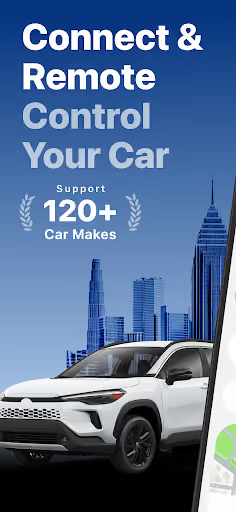
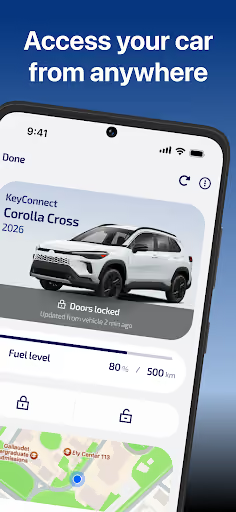
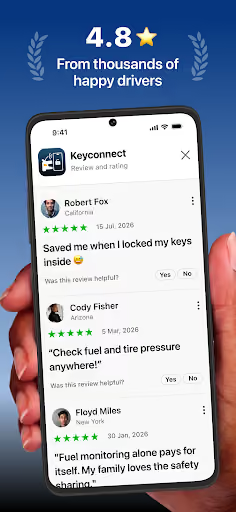
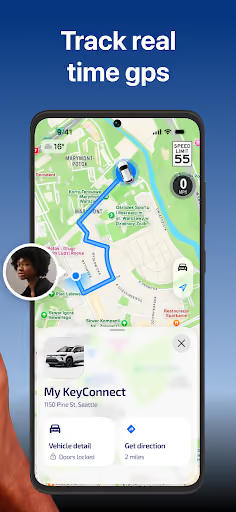
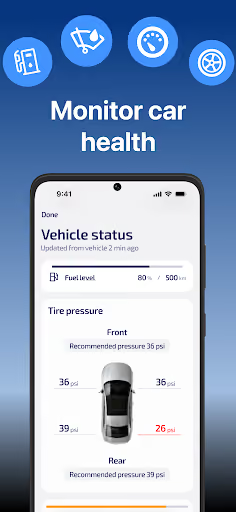
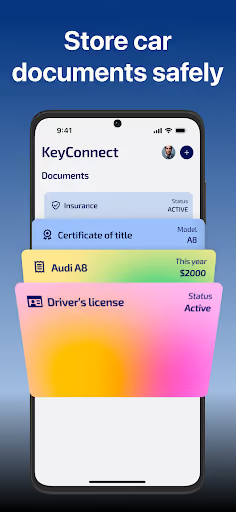
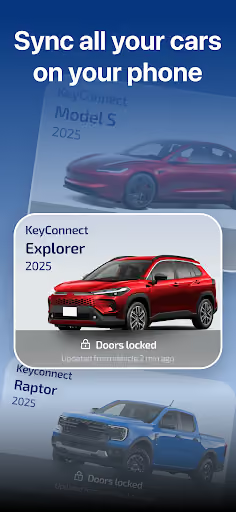
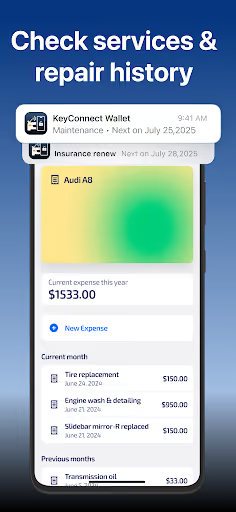
KeyConnect Digital Car Key is listed as a free Android app for remote lock and unlock, live vehicle status, multi-vehicle management, GPS location, document storage, expense tracking, history reports, roadside help, and key sharing across 40+ car makes. Its Play Store page shows 2,803,529 installs and a 4.6★ lifetime average. The reviews supplied here show a recurring break in trust: users say compatibility, region limits, manufacturer-app requirements, and refund rules appear too late.
What it does
It promises to replace or augment a physical key fob with phone-based controls, plus a broader vehicle-management dashboard for parking, documents, expenses, history, and emergency support.
What changed
The complaint is not one broken release; it is the purchase flow. Reviewers repeatedly describe paying first, then learning that another OEM app, another subscription, a region restriction, or an unsupported vehicle blocks the core feature.
Why it is soft
Fixing this would mean being more conservative about the product promise and letting some users fail out before paying. That is exactly the opening for a trust-first competitor.
Strengths
This is not an empty category. KeyConnect’s store listing bundles several useful jobs around the car — remote access, status, documents, parking, expenses, history, and roadside help — and the install base shows broad demand for a phone-first car companion. A new entrant would still have to overcome the same hard truth KeyConnect faces: many remote functions depend on the vehicle, region, phone, and manufacturer ecosystem, not just the app UI.
Market gap
The reviews point to a big trust gap, grouped here into recurring complaint clusters from the sample rather than a precise tally.
Compatibility before payment
The most common complaint is that the app says or implies a vehicle is compatible, takes payment, and only later reveals that the car cannot actually connect or use the desired feature.
Hidden prerequisites
A recurring cluster says KeyConnect depends on another manufacturer app, an OEM subscription, regional availability, Bluetooth or Wi-Fi equipment, or specific vehicle trims — but users say those conditions are not clear upfront.
Refund and support distrust
Many reviews describe trying to cancel immediately, ask for refunds, or reach support, then receiving slow, automated, or unhelpful responses.
Manufacturer-app confusion
A smaller but serious cluster says users mistook it for an official Kia, Ford, Hyundai, Nissan, Jeep, or other manufacturer app, or later discovered the manufacturer app already does the same job.
The app needs to be updated or be able to give accurate information about the compatibility with a certain vehicles especially if they're older vehicles. it said that my vehicle was compatible however after going through all of the steps and speaking to the connected activity app that's needed which is OnStar it turns out my vehicle is not compatible. before this app takes money it should have a way to make sure that it's actually going to work
you cannot even look at anything in this app without paying first. this is subscription only if you want any functionality there's no test drive there's nothing every time you try and look at something else it pops up that mandatory buy it now for a year screen I'm not giving you a dime until I know it works and you know like try it out I'm not buying it to get some other fool in here
- Make compatibility the product’s first screen. Ask for make, model, year, country, phone platform, and required OEM account before any paywall, then clearly say what will and will not work.
- Ship a narrow, verified v1 instead of a universal promise. If remote unlock cannot be verified for a vehicle, fall back to honest companion features such as parking location, documents, expenses, service history, and manufacturer-app guidance.
- Do not charge until a connection succeeds. The reviews are asking for a test drive, responsive support, easy cancellation, and refunds when the app cannot perform the promised job.
Build complexity
Estimated, not derived: one developer, part-time, no funding, and no paid acquisition. This assumes a trust-first competitor that starts with compatibility checking, prerequisite disclosure, manufacturer-app routing, and car companion features; it does not assume a solo builder can magically unlock every unsupported vehicle.
| Workstream | Weeks |
|---|---|
| Vehicle compatibility questionnaire + rules engine | 3 |
| Manufacturer-app prerequisite pages and routing | 2 |
| Car companion dashboard: documents, expenses, parking, history | 3 |
| Account, trial gate, cancellation, and refund-safe billing | 2 |
| QA, Play listing, support templates, launch polish | 2 |
| Total | 12 |
Expected revenue
Estimated, not derived: price the competitor at $5/month only after the user passes compatibility checks and confirms the app’s useful mode for their vehicle. The funnel assumes demand comes from searchers who are already looking for digital key or manufacturer-connect alternatives, with conversion lowered by the honest fail-fast compatibility gate.
| Month 12, monthly | ||
|---|---|---|
| Installs | 12,000 | |
| Activated | 4,800 | 40% |
| Retained | 2,400 | 20% |
| Paid | 960 | 8% |
| Revenue | $4,800 |
Biggest challenges
Compatibility truth source
The hardest part is not the companion dashboard; it is maintaining honest make, model, year, country, phone, OEM-account, and hardware rules when reviewers show that a wrong compatibility answer immediately creates refund anger.
Cold-start trust
A solo app with zero reviews has to convince users to trust it against an incumbent showing 2,803,529 installs and a 4.6★ lifetime rating, while also asking for sensitive vehicle and account information.
OEM dependency
Remote lock, unlock, status, and start claims may depend on manufacturer apps, subscriptions, regions, Wi-Fi, Bluetooth, or vehicle trims, so a part-time builder can get stuck verifying edge cases they cannot personally test.
Support burden
The competitor’s promise is trust, which means fast cancellation, refunds, and clear answers; that is operationally hard for one person if confused or unsupported users arrive expecting an official manufacturer app.
AI angle
The compatibility rules engine named as the hardest solo-builder problem below is largely a knowledge-extraction task — matching make/model/year/region/OEM-account requirements against manufacturer documentation — which a model can draft and keep current far faster than manual research, as long as a human verifies before anything reaches a paying user.
Without AI
Compatibility rules are researched and entered by hand per make/model/year/region, slow to build and slower to keep current — the same 'compatibility truth source' problem named below.
With AI
A model drafts and updates compatibility rules from manufacturer documentation, cutting the questionnaire/rules-engine research time — but every answer still needs a human check before the no-payment-until-confirmed promise holds.
Conclusion
Build it carefully. The market gap is obvious, but the right product is not a grand claim that every phone can become every car key. Build the anti-KeyConnect: prove compatibility first, disclose every prerequisite, charge only after value is confirmed, and turn unsupported users away before they become angry reviewers.
12 weeks
Time to v1
$5/month
After compatibility test
$4,800
Revenue at month 12
2,803,529
Installs prove demand