Abstract
A Better Routeplanner (ABRP) is the default trip-planning app for EV owners — set your vehicle and destination and it maps charge stops. Reviewers describe the underlying idea working well when it works, but a run of updates since Rivian's acquisition of the app has broken core navigation for many users, while basic in-car features like Android Auto and CarPlay sit behind a premium subscription. The gap is reliability and pricing fairness, not the routing concept itself.
Background
For years A Better Routeplanner (ABRP) has been the app EV owners reach for before a long trip — 1.68M+ installs and a 4.6★ lifetime rating. Several reviewers report it was acquired by Rivian, and describe both a new, broader data-collection agreement tied to that ownership and a wave of update-driven breakage that followed.
What it does
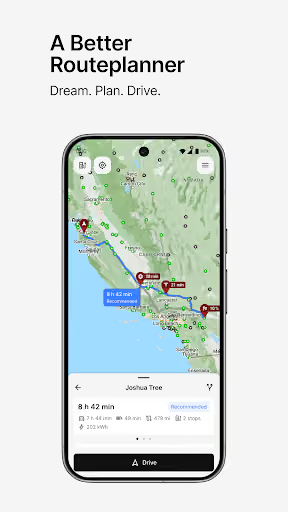
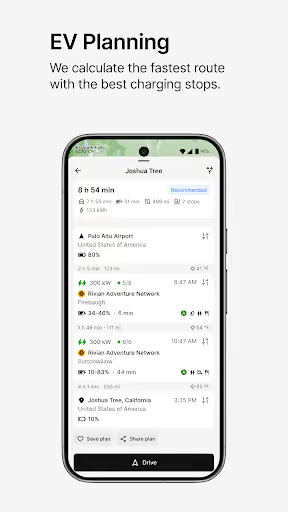
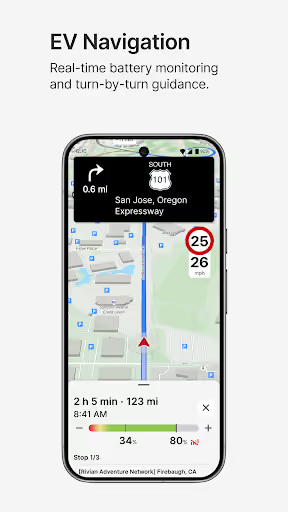
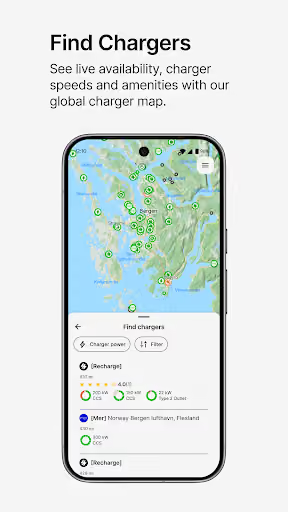
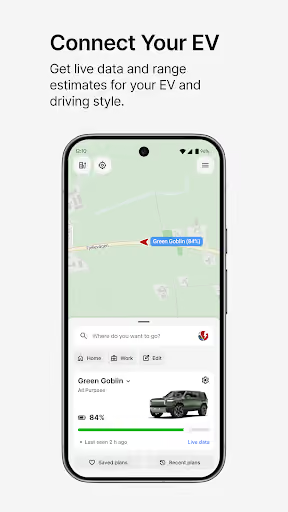
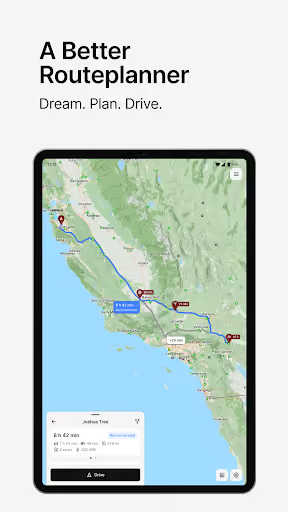
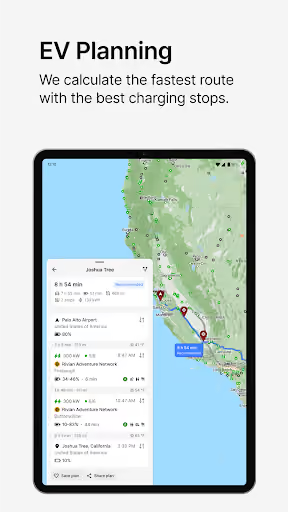
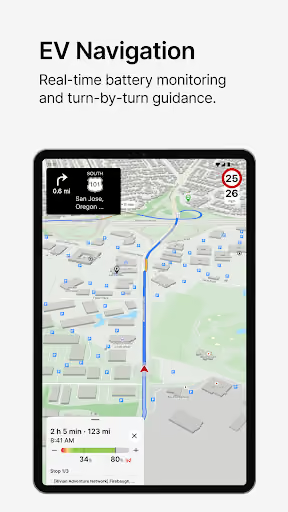
Plans EV road trips: charge-stop locations, state-of-charge at each stop, and turn-by-turn or Android Auto/CarPlay follow-along, optionally reading live vehicle data over OBD2/BLE.
What changed
Multiple reviewers say a recent update — one names it explicitly as the point ABRP "is no longer even functional" — broke saving a selected vehicle, address entry, and route calculation outright, and that Android Auto/CarPlay now requires Premium.
Why it is soft
The complaints are almost entirely execution — login loops, lost vehicle selection, charge-time estimates reviewers call several times slower than real-world charging — not gaps in the underlying routing concept, which a leaner competitor doesn't need to out-invent, just out-execute.
Strengths
When it functions, reviewers still trust the core idea: one long-time user ran ABRP's suggested route against a trip they'd planned by hand and found it "near identical." The OBD2/live-data integration and elevation-aware routing are repeatedly called out as the reason people keep coming back despite the bugs.
Proven demand
A 1.68M-install base of EV owners already pays for trip planning — this isn't an unproven category, it's an underserved one.
Loyal-but-frustrated base
Reviewers describe years of habitual use ("couldn't imagine having my car without this app") — a natural first audience for a more reliable alternative, not a cold start.
Market gap
Complaints cluster into four groups. Routing/range accuracy: charge-time estimates reviewers call several times slower than reality, roads misjudged as closed, and at least one report of being stranded on a bad estimate. Reliability regressions: address entry, saved vehicles, and route calculation breaking after updates, with several reviewers tying the breakage to the Rivian acquisition specifically. Paywalled essentials: Android Auto and CarPlay — table-stakes for an in-car navigation app — gated behind Premium, which one reviewer called having "no justification... outside of pure greed." Vehicle coverage: plug-in hybrids are excluded entirely, and the in-app form to request a missing vehicle model doesn't work.
- Ship in-car navigation (Android Auto/CarPlay) free, and charge instead for the live-data/OBD integration and expanded charger-network features — the opposite of ABRP's current gate.
- Support plug-in hybrids and a wider vehicle catalog from day one, since ABRP explicitly excludes PHEVs and reviewers ask for this repeatedly.
- Treat in-car reliability as the core product, not a feature — position drift, crashes, and lockups while driving are the complaints costing ABRP the most trust.
Build complexity
Estimate for one part-time solo developer with no funding and no team. Unlike a typical single-feature clone, this needs a working consumption/routing model and a charger-network data feed before it's usable at all — the build is genuinely more than a UI wrapper.
| Workstream | Weeks |
|---|---|
| Vehicle consumption model + charger-network data ingestion | 4 |
| Route/charge-stop planning algorithm | 4 |
| Mobile app UI + trip mode | 3 |
| Android Auto / CarPlay integration | 2 |
| OBD2/BLE live vehicle data (optional) | 1 |
| Total | 14 |
Expected revenue
Assumes a free tier that covers full trip planning (undercutting ABRP's paywall) with a $12/month premium tier for live vehicle data and expanded charger detail, distributed mainly through EV owner communities rather than paid acquisition. Figures below are month-12 estimates, not a forecast.
| Stage | Users |
|---|---|
| Installs (month 12) | 40,000 |
| Activated (completed a route plan) | 18,000 |
| Retained (trip in last 60 days) | 4,500 |
| Paid | 540 |
| Revenue | $6,480/mo |
Biggest challenges
Charger-network data goes stale fast, and ABRP's crowdsourced-correction workflow (edits only accepted from someone physically at the charger) hints at how hard that data is to keep fresh without a community already in place. This is also a safety-adjacent app — reviewers describe being stranded on bad range estimates — so trust and support burden are real costs a solo builder has to absorb, not just an engineering line item. Distribution is narrow and community-based (EV forums, owner groups), which is slower to build than a paid-ads funnel.
AI angle
There's a genuine angle here, not a bolted-on one: hand-building and maintaining a per-vehicle consumption profile for every EV/trim on the market is exactly the kind of structured-data task an AI pipeline can do far faster than manual engineering, and the same approach can triage community charger reports (flagging chargers repeatedly reported broken) more cheaply than a custom ML system built from scratch. It speeds up building the data layer; it doesn't change the routing engine itself or the numbers above.
Conclusion
Skip it. The complaint pattern is real and the underlying idea is proven, but ABRP is now backed by an automaker's resources rather than a scrappy indie team, and this is a safety-adjacent category where a wrong estimate strands a real driver — a heavier liability and trust burden than a typical solo clone. The honest opportunity here is a wedge (PHEV support, an unbundled free navigation tier) rather than a straight rebuild.
14 weeks
time to v1
$12/mo
freemium, premium data tier
$6,480/mo
month-12 revenue estimate
Rivian-backed
the fact that decided it