Abstract
HelloTalk still has the winning core idea — real conversations with native speakers — but recent reviews show frustration around voice-room limits, aggressive monetization, dating-like behavior, safety, and opaque moderation; a solo builder should not try to clone the whole network, but can build a narrower, trust-first voice-room exchange for serious learners.


Background
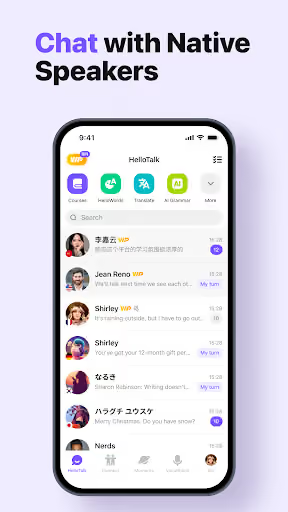
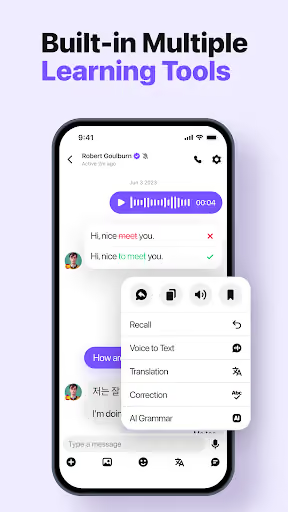
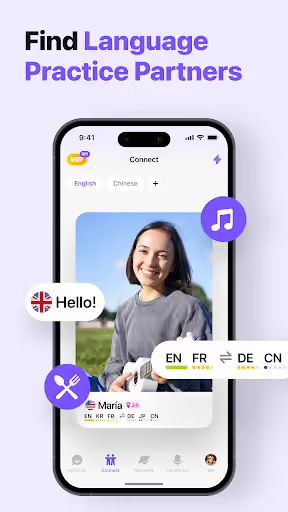
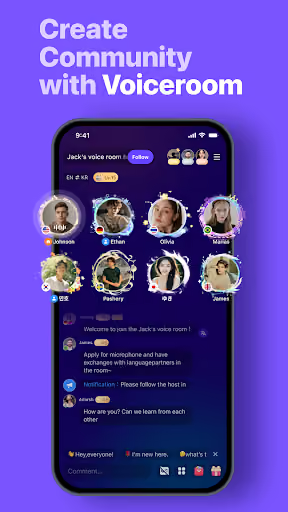
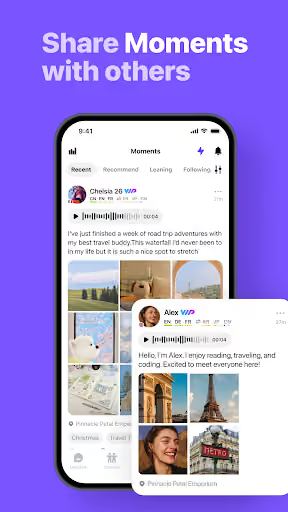
HelloTalk - Learn Languages is a free language-exchange app with chat, corrections, translation, voice rooms, livestreams, Moments, and support for 260+ languages. It has a 3.4★ Play rating and 44,129,797 installs as of 2026-08-05.
What it does
Connects learners with native speakers through text, voice messages, video calls, voice rooms, livestreams, posts, corrections, and translation tools.
What changed
Recent reviewers repeatedly complain that free voice-room and live-room access became much shorter, with the free VIP experience pass described as dropping from 24 hours to 30 minutes.
Why it is soft
The dissatisfaction is not with language exchange itself; users still want conversation partners, but they want clearer limits, safer matching, fewer dating dynamics, and fairer moderation.
Strengths
This is not a dead product. Positive reviewers still praise real native-speaker practice, friendships, voice messages, text correction, cultural exchange, and the ability to connect across countries. HelloTalk also has massive habit and network liquidity: a new entrant starts with zero rooms, zero partners, and no proof that conversations will actually happen.
Core loop still works
Several five-star reviews say users met friends, practiced real language, asked native speakers what sounds natural, and gained confidence.
Voice rooms are sticky
The backlash exists because voice rooms matter: reviewers describe study groups, long catch-ups, hosted rooms, and friendships built around them.
Incumbent has reach
With 44,129,797 installs listed, HelloTalk can recover some angry users simply because their friends and target-language partners are already there.
Market gap
The opportunity is a smaller, safer alternative for learners who primarily want voice practice, not a full global social network. The complaint clusters below are based only on the listed reviews, with the voice-room limit change being the clearest recent break.
Voice-room access got worse
Reviewers say the free VIP pass or room access used to support much longer sessions and now cuts off too quickly for real study groups.
Paywalls and ads feel hostile
Many users describe the free version as increasingly restricted, with subscription prompts, long ads, and baseline learning features feeling locked away.
Dating, harassment, and scams
A recurring theme is that too many people use the app like dating, while women and other users report screenshots, creepy behavior, catfish, scammers, bullying, and identity misuse.
Opaque bans and broken delivery
Several reviewers say they cannot send messages, join voice rooms, create accounts, or appeal restrictions clearly; one also flags a misleading fake “Sent” status.
Really disappointed. The voiceroom feature was the main reason I kept this app because it was 24 hours before. Now it’s limited to just 30 minutes and it ruins the whole experience. We use voiceroom for study sessions and long catch-ups, and 30 minutes is way too short. I hope the developers reconsider this change and bring back the 24-hour option.
Well intended app, but too limited. The standard use should be achieveable without VIP. VIP should only be for something that is extra, not the baseline. Also, this app is for learning languages and making friends, so why would you make the algorithm to prioritize opposite gender instead of making it completely random? Almost all of my list is female users, I'm not here for dating app. Lastly, pay more attention for female users, I've seen lot of predators.
Great app for language learning, but the moderation system needs improvement. I accepted a previous 3-day suspension and changed my behaviour. Days later, I received a 5-day Voice Room ban despite not making any abusive or offensive comments that day. I requested a manual review and asked for the evidence, but only received a generic template reply. False reports or automated moderation shouldn't result in penalties without proper human review. Transparency and fair appeals are needed.
- Make small voice rooms the free core. Do not compete on livestream spectacle; compete on dependable 60–90 minute study rooms with explicit rules that do not suddenly shrink after users build routines.
- Design against dating by default. Match by target language, native language, level, topic, and availability first; give users gender, age-range, and location controls without making the app feel like a dating funnel.
- Ship transparent trust tooling early. Users need clear delivery states, clear account limits, screenshot/privacy controls, evidence-backed moderation, and an appeal path that does not feel automated or arbitrary.
Build complexity
Estimated, not derived: one developer, part-time, no funding, and no paid acquisition. This is not a full HelloTalk clone; it is a narrow Android-first v1 for serious language learners: profiles, matching, small voice rooms, basic chat, corrections, reporting, and payments.
| Workstream | Weeks |
|---|---|
| Product scope, UX, room rules | 1.5 |
| Auth, profiles, language levels, preferences | 3.0 |
| Text chat, corrections, partner list | 3.0 |
| Small-group voice rooms | 4.0 |
| Safety, reporting, appeals, privacy controls | 3.0 |
| Billing, limits, Play listing | 2.0 |
| Testing, reliability, moderation admin | 1.5 |
| Total | 18.0 |
Expected revenue
Estimated, not derived: keep the baseline useful for free, then charge an optional $4/month Pro plan for convenience features such as advanced discovery, saved room templates, extra partner organization, and supporter badges. With no paid acquisition and a cold-start network, month-12 revenue should be modeled as small.
| Month 12 funnel | Users | Assumption |
|---|---|---|
| Installs | 2,500 | Organic only |
| Activated | 900 | Create profile + join or book a room |
| Retained | 350 | Still active after first month |
| Paid | 200 | $4/month optional Pro |
| Revenue | $800 | Month-12 MRR |
Biggest challenges
The hardest part is not building chat screens; it is creating enough marketplace liquidity and trust that a learner can join and actually find a serious partner. A part-time solo builder also becomes the support, moderation, anti-abuse, and community team.
Cold-start rooms
Voice rooms feel empty until both sides of a language pair show up at the same time; this requires focused niches, scheduled events, or founder-led community work.
Safety burden
Reviews mention predators, catfish, screenshots, bullying, false reports, and account bans; a competitor wins only if it handles these better from day one.
Voice infrastructure risk
Live audio adds cost, latency, device bugs, and abuse cases that a simple vocabulary or flashcard app would avoid.
AI angle
There is a real but limited AI angle: AI can make moderation triage, level-matched conversation prompts, and post-room summaries cheaper to build than hand-written curricula or fully manual review queues. It should not replace human appeals, especially because one review specifically says HelloTalk’s AI learning behavior ignored the chosen language level and another says translation changed meaning.
Useful AI
Generate beginner/intermediate room prompts, suggest corrections after a session, flag likely harassment for review, and summarize why a report was escalated.
Dangerous AI
Automatic bans, unchecked translation, or AI that ignores language level would recreate the exact trust complaints users are already raising.
Conclusion
Build it. But only as a narrow, serious-learner voice-room wedge, not as a full HelloTalk replacement. The market gap is obvious, but the network and safety work cap the realistic solo-builder upside.
18 weeks
Time to v1
$4/mo
Optional Pro, useful free core
$800
Month-12 MRR
24h→30m
Break users cite