Abstract
DramaStream has real demand for short-form drama, but the backlash is about trust: users say the app changes their home screen, is hard to remove, overloads them with ads, and often fails to show the story that brought them in. The gap is obvious, but a solo builder cannot easily replicate the most important asset: a licensed drama catalog.






Background
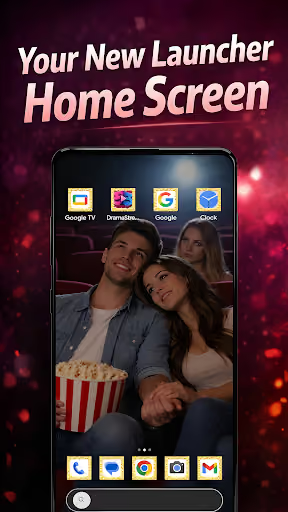
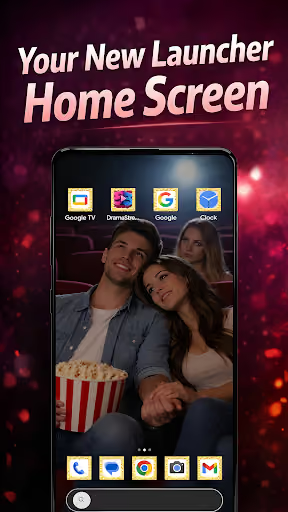
DramaStream Launcher is a free Android app with a 4.8★ lifetime rating and 3,859,216 installs as of 2026-08-03. Its store listing says it replaces the user’s home screen while providing quick access to short-form drama content, wallpapers, and icon frames.
What it does
Combines a custom Android launcher with drama discovery, themed wallpapers, and icon frames.
What changed
The product asks users looking for videos to accept a home-screen replacement, which many reviewers experience as invasive rather than useful.
Why it is soft
The complaints are not about wanting fewer dramas; they are about safety, transparency, ads, and not finding the advertised story.
Strengths
This is not a dead category. Some users still praise the stories, picture clarity, variety, and entertainment value, and the install base shows that paid social-style drama clips can drive huge curiosity. A competitor would not need to prove that people want short dramas; it would need to prove that it is safer, clearer, and less bait-and-switch.
Content pull
Positive reviewers describe the dramas as addictive, touching, clear, and varied.
Distribution proof
The app has millions of installs, so demand exists even if the current packaging angers users.
Simple user promise
“Watch the drama I clicked” and “do not take over my phone” are easy messages for a rival to communicate.
Market gap
The review gap clusters around trust first, then ad load and content mismatch. The best competitor would be boring on purpose: no launcher, no hidden home-screen behavior, a searchable catalog, and a clear rule for how many episodes or ads a user will face.
Phone takeover fear
The most common complaint is that the app changes the home screen, hides or alters apps, shows ads over other apps, or feels difficult to uninstall.
Ad-to-story imbalance
Several reviewers say they spend too much time in commercials, rating prompts, or menus compared with actual story time.
Baited by missing dramas
A recurring frustration is downloading from an ad, then not finding the exact movie or ending that was promoted.
Episode continuity
Some users say stories stop after a few episodes, endings are hard to find, or there are no instructions for unlocking the rest.
WARNING ⚠️ I'd give it a 0 rating if I could, it's a Hack. I downloaded it from an add the show wasn't even on there. It changed my phone settings hid my apps and hijacked Facebook and browser, spammed me with adware I couldn't even delete it. I had to go on the app store to uninstall it. once I did everything went back to normal.
They're great stories for free but the number of ads you have to sit through is a bit much. Feels like you sit through a minute and a half of commercials just to watch 60 seconds of your stories. I understand there needs to be a few ads but at least you should try to make being able to watch the story for as equal time as you spend showing ads. in other words, right now it's maybe 70%=ads and 30%=story. That's a little much.
difficult to navigate if not paying very high subscription in comparison to other sites. Watching adds and being limited to only a small amount of viewing makes this site not worth the time.
- Do not build a launcher. Make the core promise that the app never becomes the default home screen, never changes icons, and can be uninstalled normally.
- Make every ad-click deep-link to the exact title. If the promoted drama is not available, do not run the ad; the missing-title complaint is too damaging for trust.
- Show the episode and ad rules up front. Users should know whether they can finish the story, how many ads are required, and what a paid plan removes before they start watching.
Build complexity
Estimated, not derived: one developer, part-time, no funding, no team, and no paid acquisition. The app shell is straightforward; the hard part is sourcing enough legitimate drama content to make the product worth opening.
| Workstream | Weeks |
|---|---|
| Android video app, search, title pages | 3.0 |
| Catalog admin, metadata, deep links | 2.0 |
| Ads, subscription unlock, entitlement rules | 2.0 |
| Content sourcing, rights checks, initial uploads | 4.0 |
| Trust UX, onboarding, uninstall-safe positioning | 1.0 |
| QA, Play listing, policy review buffer | 2.0 |
| Total | 14.0 |
Expected revenue
Estimated, not derived: a free app with ads and a $4.99/month ad-light subscription. With no paid acquisition and a thin starting catalog, month-12 revenue is likely modest even if the positioning is sharply better than DramaStream’s launcher bundle.
| Month 12, monthly | ||
|---|---|---|
| Installs | 2,000 | organic estimate |
| Activated | 900 | watch one episode |
| Retained | 320 | return in month |
| Paid | 160 | $4.99/month |
| Revenue | $1,200 | subscription plus light ads |
Biggest challenges
The solo-builder blocker is not coding a video app; it is getting enough legal, desirable dramas without a studio budget, then convincing users and Google Play that the app is safe in a category where the incumbent’s reviews repeatedly use words like virus, malware, and hack.
Content rights
The product only works if users can finish the stories they came for; that requires content access, not just better UX.
Store trust
A new listing starts with no review moat, while the category already has safety anxiety.
Acquisition mismatch
DramaStream appears to benefit from ad-driven curiosity; a no-budget builder cannot count on the same volume.
AI angle
There is a small genuine AI angle, but it does not solve the core business problem. AI can help create searchable summaries, detect whether an uploaded episode likely matches its title, generate multilingual metadata, and flag broken continuity, which directly supports the “find the advertised drama and its ending” gap. It cannot replace licensed content or user trust.
Useful
Auto-tag titles, summarize episodes, improve search, and catch obvious catalog mismatches before users hit them.
Not enough
AI does not make a solo builder competitive with apps that can buy or produce the actual short dramas.
Conclusion
Skip it. The market gap is real and user pain is unusually clear, but a solo, part-time builder is boxed in by content rights and acquisition. Build only if you already have access to drama inventory; otherwise the safer play is a smaller discovery or catalog tool, not a full DramaStream competitor.
14 weeks
Time to v1
$4.99/mo
Ad-light subscription
$1,200
Revenue at month 12
Content rights
Deciding constraint