Abstract
Olive markets itself as a free "Yuka alternative" that scans groceries for harmful ingredients, but its own reviewers describe a long onboarding questionnaire that ends in a mandatory subscription, followed by a wave of paying users getting locked out with a bare "developer error." The underlying idea — a more holistic ingredient scanner than Yuka's single score — still resonates; the execution around paying for it and trusting its verdicts is what's driving people back to the free incumbent.
Background
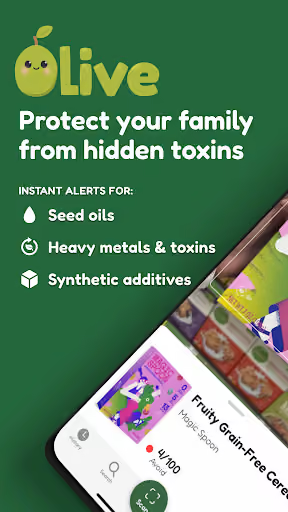
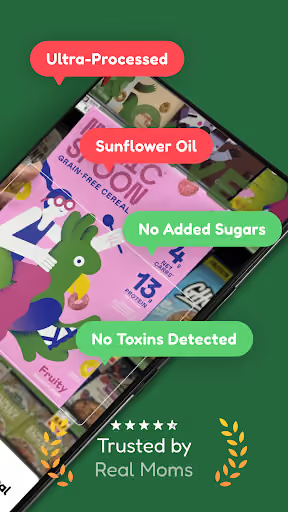
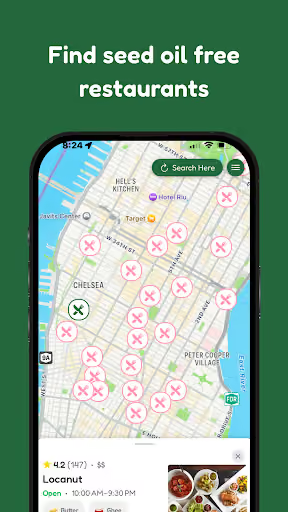
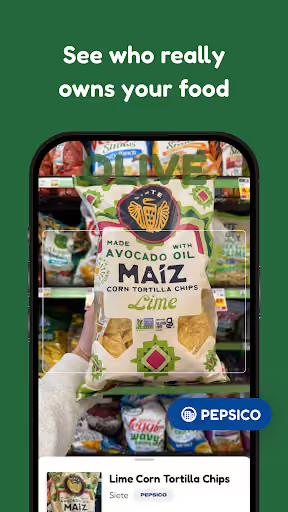
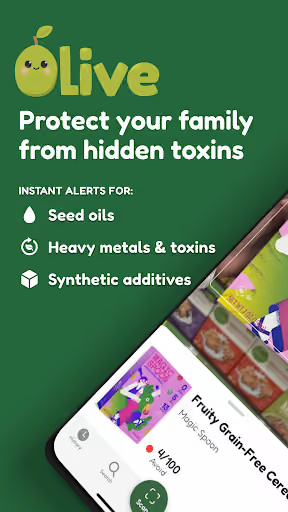
Olive (Olive - Holistic Food Scanner) positions itself against Yuka and similar barcode scanners, flagging seed oils, additives, and contaminants and promising a community-powered, lab-tested database of over a million products, plus a premium tier for unlimited scans and personalization.
What it does
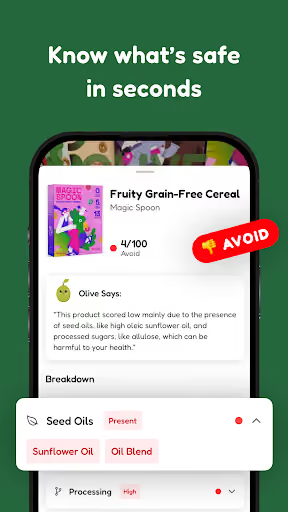
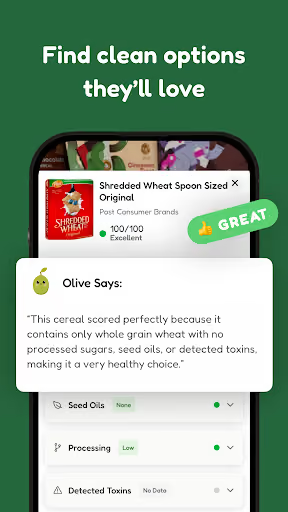
Scans a barcode and returns a holistic health score plus flagged ingredients, with personalized alternatives based on dietary preferences.
What broke
The store listing reads as free, but every account goes through a long personal questionnaire that ends in a required subscription — and even paying doesn't reliably unlock the app, with many subscribers reporting they're immediately logged out with a "developer error."
Why it is soft
There's no way in-app to dispute a score or reach support, and switching cost is close to zero — reviewers consistently say they're simply reopening Yuka instead.
Strengths
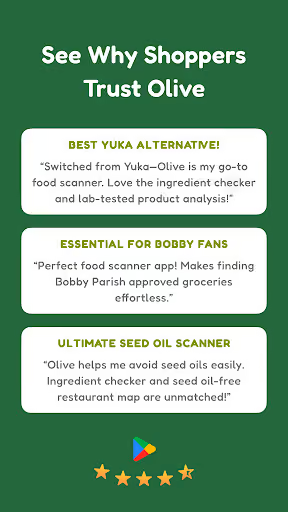
The core idea has real pull: several reviewers who never hit a technical issue call the onboarding "one of the best" they've experienced and ask for more categories (cosmetics, household items) rather than asking for a refund. That's an install base and a level of engagement a new entrant would otherwise have to build from zero.
I like the holistic approach, compared to Yuka. I think a great feature would be if I could choose specific ingredients to avoid. For example, I want to avoid sucralose. So for this feature, if anything I scanned had sucralose, a flag, or automatic red colored number regardless of score coming up, would be great!
Market gap
Paywall gate
The single most repeated complaint: a long personalized questionnaire ends in a subscription request with no free alternative at all — several reviewers call it deceptive given the listing shows the app as free.
Payment doesn't buy access
A recurring pattern of subscribers getting a bare "developer error" and being locked out entirely, sometimes immediately after being charged, with support unresponsive for weeks.
Frozen onboarding
A separate wave of reviewers say the "Start My Journey" button simply does nothing, blocking them from ever reaching the app they already paid to try.
Opaque scoring
Reviewers question why the AI-generated score treats similar products differently or varies across devices on the same account, with no way to see the reasoning or turn off a factor they don't weigh, like seed oils.
This app is honestly terrible. There isn't even a free version to try — everything is locked behind a paywall from the start. You can't test the features, see if it works, or even decide if it's worth it without paying first. That's a huge red flag for any app. It feels like the developers care more about squeezing money out of users than actually providing a good product. Forcing people to pay before they even know what they're getting is frustrating and shady.
Immediately after being charged $40 for the app the app stopped working and kicked me out, I only get "developer error", they haven't responded to any of my emails, they won't refund me. I'll be going to my bank and issuing a chargeback, I hope everyone follows suit and this company goes bankrupt and gets banned from credit card processing.
- Ship one visible free tier — even a capped number of scans per day — instead of a forced questionnaire-to-paywall flow.
- Make paid access unbreakable: a subscriber who has already been charged must never be locked out by a login error.
- Make the scoring legible — show why a product scored the way it did, and let users turn off factors they don't personally weigh, like seed oils.
Build complexity
Assumes one part-time solo developer, no funding, no team, and leaning on a free/open ingredient dataset (e.g. OpenFoodFacts) rather than building or licensing a lab-tested database from scratch. This is an estimate, not a guarantee.
| Workstream | Weeks |
|---|---|
| Barcode scan + open ingredient database integration | 2 |
| Transparent, rules-based scoring engine (user-auditable) | 3 |
| Onboarding, accounts, single honest paywall | 2 |
| Polish, QA, store submission | 2 |
| Total | 9 |
Expected revenue
Assumes a single $5/month tier with no forced trial-to-paywall flow, and organic/ASO-only acquisition with no paid ads. This is an estimate, not a promise.
| Installs | Activated | Retained (D30) | Paid | MRR |
|---|---|---|---|---|
| 50,000 | 25,000 | 4,500 | 540 | $2,700 |
Biggest challenges
The hardest part is data, not code. Olive's own listing claims over a million lab-tested items plus recall alerts — a solo builder starting from a free/open dataset will have visibly thinner, messier coverage for a chunk of scans on day one. Cold-start trust is the other hurdle: a health-adjacent app asking people to trust its verdict on what's "harmful" needs real credibility a brand-new indie app doesn't have yet, and earning it means being conservative about scoring claims rather than repeating Olive's "AI says so" trust problem.
AI angle
There's a narrow, genuine angle: use AI OCR to read an ingredient label directly when a barcode isn't in the database yet — turning today's dead-end (several Olive reviewers hit products the search simply can't find) into an instant analysis. The scoring verdict itself should stay rules-based and auditable rather than a black-box AI judgment, since an opaque "AI-generated" score is one of Olive's own recurring complaints — AI here should extract and categorize, not decide.
Conclusion
Skip it. Olive's specific fumbles — a deceptive-feeling paywall and payment that doesn't reliably buy access — are real and fixable, but the underlying category is a hard one for a solo, unfunded builder: Yuka already gives away for free what Olive charges for, ingredient data is a genuine ongoing maintenance burden, and nothing here suggests a thin-margin niche a single developer can defend.
9 weeks
solo build to v1
$5/mo, single tier
pricing & model
$2,700/mo
estimated MRR at month 12
Yuka is free
the incumbent already gives away what Olive charges for