Abstract
Duo Mobile has a real user-pain opening around phone changes, restore, older-device support, and broken approval flows, but a solo builder cannot realistically replace Duo’s enterprise push network; the only viable wedge is a safer, portable authenticator for standard passcodes.
Background
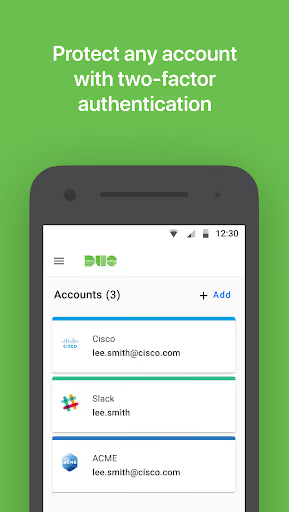
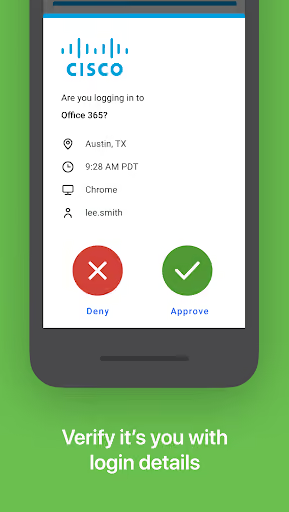
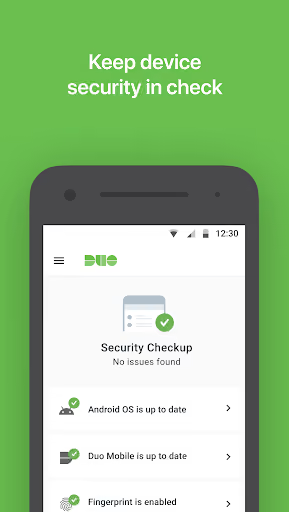
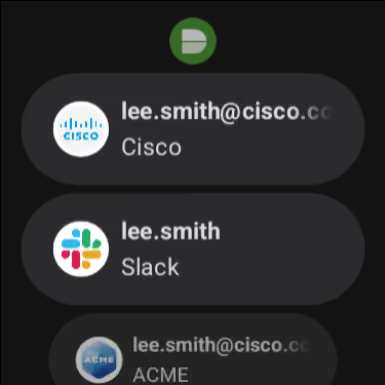
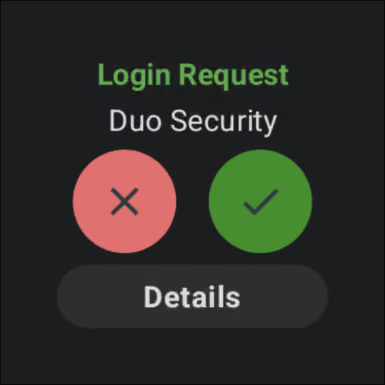
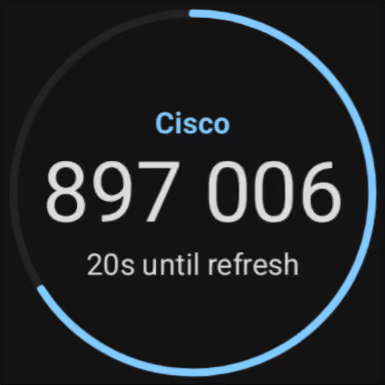
Duo Mobile is a free two-factor authentication app with a 4.2★ lifetime rating and 51,318,126 installs as of 2026-08-05. It handles Duo push approvals, passcode generation, third-party passcode accounts, and a Wear OS companion app.
What it does
Generates login passcodes, receives one-tap Duo push notifications, scans QR codes, and can store third-party authenticator accounts.
What changed
Recent reviews describe broken restore, failed phone transfers, notification approval failures, unsupported Android versions, and watch frustration.
Why it is soft
The pain is severe because authentication failure means lockout, but many users are forced by school or work and cannot simply switch away from Duo push.
Strengths
This is not a dead app. Duo still has massive distribution, is free, supports passcodes and push approvals, and some reviewers still call it reliable, fast, secure, and easy to use. Its biggest moat is not UI polish; it is institutional adoption by employers, schools, and services that require Duo enrollment.
Distribution
51,318,126 installs gives Duo trust and search gravity a new authenticator would not have on day one.
Mandated usage
Many complaints come from people using it for work, school, VPN, Canvas, Facebook, Instagram, or university access; that makes churn harder than normal app dissatisfaction.
Still useful
Positive reviews still praise the basic flow: ping, code, done, sometimes directly from the notification shade.
Market gap
The complaints cluster around reliability at the exact moment a 2FA app must be boring: restore, approval, device compatibility, and user control.
New phone and restore lockouts
The loudest pattern is users losing access after a new phone, reinstall, reset, stolen phone, changed number, or broken restore flow.
Push approval failures
Reviewers report notification approvals not opening, not approving, timing out, or demanding the full app even after tapping the notification.
Device and OS restrictions
Older Android support, custom ROMs, and Wear OS expectations show up as lockout risks, not cosmetic annoyances.
Opaque control and support
Users complain about hidden TOTP seeds, unclear permissions, no obvious help path, poor account naming, and no simple recovery route.
After I re-download the Duo mobile on a new phone, suddenly I couldn't sign into my account. Every time I tried, it said the app couldn't find my account. Thankfully, I didn't have much connected to Duo, and I was able to get access to everything that was connected again, but for a while, I thought I was completely locked out of those accounts.
Won't let me approve from notifications, complains about not being connected which is stupid considering I just received the notification to approve my connection.
Let's find out how to make a mandatory app the most difficult terrible experience ever! Now imagine something WORSE than that! Surprise! Cisco found a way to make it even worse than THAT! No longer supports Android 8. No longer works on watch. No longer approves through notification. Can't even perform it's most basic function. Need to get rid of this and use Google Auth which actually works.
- Do not build a Duo push clone. A solo app cannot approve Duo-backed enterprise logins without Duo account activation and service integration; focus on standard TOTP accounts instead.
- Make restore the product. Encrypted export, local backup, cloud backup, recovery key, device-transfer rehearsal, and visible seed ownership address the strongest pain.
- Be explicit about compatibility. Publish OS support, backup limits, custom-ROM behavior, and recovery tradeoffs before install so users are not surprised at login time.
Build complexity
Estimated, not derived: one developer, part-time, no funding, no team, and no paid acquisition. A solid TOTP authenticator is buildable; a secure, trustworthy authenticator that people trust with account access is slower.
| Workstream | Weeks |
|---|---|
| TOTP/HOTP core, QR parsing, token naming | 2 |
| Encrypted vault, export/import, backup formats | 3 |
| Restore, device transfer, recovery-key flows | 2 |
| Android UX, accessibility, search, icons, widgets | 2 |
| Security hardening, docs, Play listing, beta | 3 |
| Total | 12 |
Expected revenue
Estimated, not derived: free core passcodes, optional $2.99/month Pro for encrypted multi-device backup, restore rehearsal, and priority export tools. No paid acquisition means this is a small trust-led funnel, not a Duo-scale business.
| Month 12, monthly | ||
|---|---|---|
| Installs | 3,000 | |
| Activated | 1,800 | 60% |
| Still retained | 1,000 | 33% |
| Paid Pro | 400 | 13% |
| Revenue | $1,200 |
Biggest challenges
The hardest part is not generating six-digit codes; it is being trusted as a security app while clearly explaining that you cannot replace Duo push for institutions that require Duo enrollment.
Cold-start security trust
A new authenticator with zero reputation asks users to store keys that protect Instagram, school, work, and financial access.
No Duo push API
Duo accounts must be activated and linked to Duo’s service, so a competitor cannot simply approve those push requests.
Recovery liability
If restore fails once, your app creates the same catastrophic lockout story users are already angry about.
OS support tradeoff
Supporting older devices wins angry users, but a security app must avoid promising safety it cannot maintain.
AI angle
There is no strong AI angle here. QR parsing, TOTP generation, encrypted backup, and restore verification are deterministic security work; adding AI would mostly increase privacy and reliability concerns rather than create a defensible feature.
Where AI might help
Support docs, migration checklists, and plain-English explanations of recovery options.
Where AI should not matter
Generating codes, storing secrets, validating backups, and restoring accounts must be boring, testable, and auditable.
Conclusion
Skip it. There is real pain, but not a clean solo-builder opening: the users most angry at Duo are often trapped by a school, employer, or service that specifically requires Duo. Build the portable TOTP version only as a narrow side bet, not as a direct Duo competitor.
12 weeks
Time to v1
$2.99/mo
Free core plus Pro backup
$1,200
Month-12 revenue
Duo-linked accounts
Deciding constraint