Abstract
NovelQ has demand for short, ad-driven romance and genre fiction, but its reviews are dominated by billing panic: surprise charges, PayPal-only payment, hard-to-find cancellation, and a paywall that arrives before readers trust the app.
Background
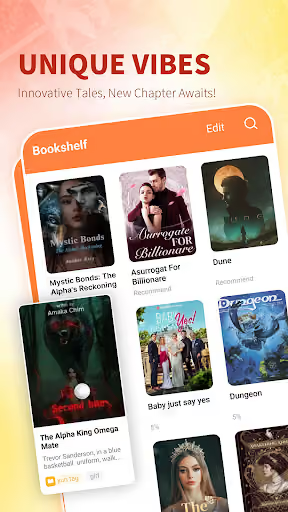
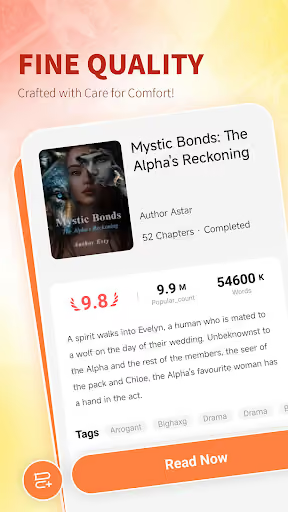
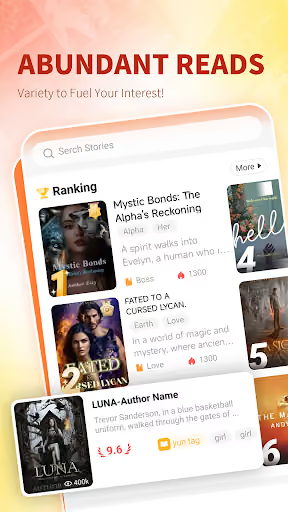
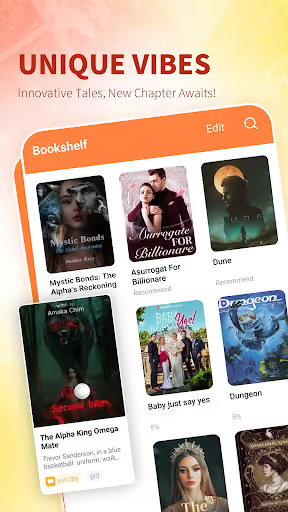
NovelQ is a free Google Play app for long-form mobile novels, with 179,235 installs and a current lifetime average rating of 3.4★. The store pitch is broad — romance, suspense, fantasy, sci-fi and curated collections — but recent reviewers describe a very different first-run experience.
What it does
It hooks readers from ads into serialized novels, then asks them to pay after the opening chapters.
What changed
The backlash is not one broken release; it is the payment flow itself: trial pricing, surprise larger charges, PayPal billing, and cancellation confusion.
Why it is soft
A rival does not need to beat NovelQ on every story. It can win the low bar of clear pricing, Google Play billing, visible cancellation, and readable free options.
Strengths
This is not a market with no demand. Several angry reviewers still say the ad story was interesting, the story looked interesting, or they loved reading until payment blocked them. NovelQ also has 179,235 installs, so the habit is proven; the weak point is trust and execution, not whether people tap on dramatic mobile fiction.
Ad hook works
Many installs came from ads for a specific story, and reviewers often complain only after they hit the third-chapter paywall.
Some content appeal
A few users describe good or interesting stories, even while criticizing payment, limited features, or cancellation.
Low UX expectations
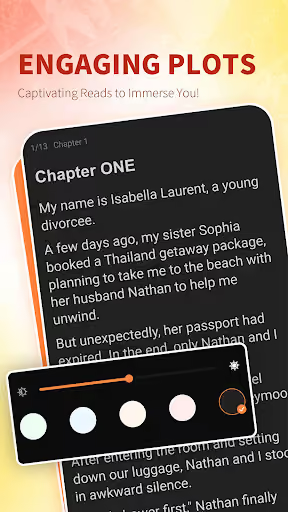
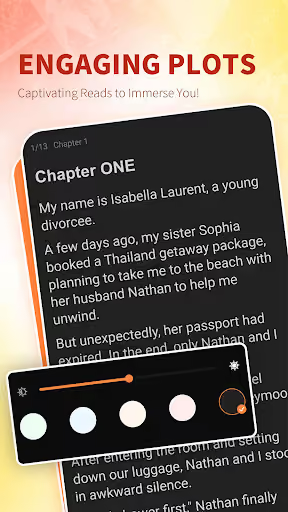
Font size, dark mode, language filtering, navigation, and payment options are all basic product fixes rather than deep technology moats.
Market gap
The market gap is unusually clear: readers are not asking for a radically new reading format. They are asking for a novel app that does not make payment feel like a trap.
Surprise billing and cancellation
The most common complaint is the trial-to-charge experience: users say they paid a small trial price, then saw larger charges early or repeatedly, with cancellation hidden or outside Google Play.
Payment choice and trust
Reviewers object to PayPal-only or web-based payment, failed card flows, and the subscription not appearing where they expect to manage it.
Hard paywall too early
Readers repeatedly mention getting only a few chapters before a locked prompt, with no ads, coins, login rewards, or affordable alternative path.
Content and reader basics
A smaller but important cluster cites unfinished books, poor editing, repeated genres, language mismatch, tiny fonts, no dark mode, and limited reading settings.
I signed up for the trial period of one week for 99 cents. then they charged me $30 three days later. I couldn't figure out how to cancel (you have to send a message to customer support before a cancel button magically appears), and they charged me $30 AGAIN a few days later, not even a whole week. I FINALLY found the cancel button, but $60 in the span of ONE WEEK is ridiculous!
A clunky app. You are unable to earn points, so after the first few free chapters, there's no way of moving forward other than paying. You are unable to adjust the font size and the font in the app is tiny. Sometimes when browsing for books, the language changes from English to Spanish or French, so it would be good if you could actually choose the language that you should always be offered through the site. I uninstalled it.
- Use Google Play Billing only. Make subscription status, renewal date, and cancellation visible from Settings on day one; the trust gap is the wedge.
- Offer a free path. Rewarded ads, daily coins, or chapter unlocks directly answer the complaint that the app becomes useless after a few chapters.
- Start narrower than NovelQ. Do not promise every genre; launch with a small edited English catalog, complete books, dark mode, font controls, and language filters.
Build complexity
Estimated, not derived: one part-time developer, no funding, no team, and no paid acquisition. The app shell is straightforward; the expensive part is enough legitimate, readable content to avoid looking empty.
| Workstream | Weeks |
|---|---|
| Reader app: library, chapters, bookmarks, font size, dark mode | 3.0 |
| Backend CMS for books, chapters, languages, and moderation | 3.0 |
| Google Play Billing, subscription status, cancellation UX | 2.0 |
| Coins, rewarded ads, free unlock rules | 2.0 |
| Seed catalog sourcing, formatting, QA, and policy review | 3.0 |
| Store listing, analytics, crash fixes, launch polish | 1.0 |
| Total | 14.0 |
Expected revenue
Estimated, not derived: assume a transparent $4.99/month subscription, plus free chapter unlocks through ads or coins. With no paid acquisition, month-12 revenue is modest because store trust, catalog depth, and organic discovery all start from zero.
| Month 12, monthly | ||
|---|---|---|
| Installs | 3,000 | organic estimate |
| Activated readers | 1,350 | open and read |
| Retained readers | 450 | return after first session |
| Paid subscribers | 240 | $4.99/month |
| Revenue | $1,200 | month 12 |
Biggest challenges
The solo-builder risk is not the chapter reader; it is proving legitimacy in a category where users already suspect scams, while also sourcing enough non-infringing fiction to make the app worth opening.
Cold-start trust
A new app with no reviews must convince readers it is safer than the incumbent before asking for any payment.
Content rights
You need complete, edited, licensed or public-domain-compatible stories; scraping or copying would create legal and store-policy risk.
Store policy risk
Adult or explicit ads and stories are mentioned in reviews, so age rating, moderation, metadata, and ad creatives need care.
AI angle
There is a real but limited AI angle: AI can reduce catalog-prep friction, not replace content rights. It can help summarize books, tag genre, flag language mismatch, detect abrupt chapter endings, and surface likely spelling issues before publishing.
Useful AI
Auto-tagging, content QA, chapter summaries, language detection, and moderation checks make the CMS and catalog QA cheaper for one person.
Not a moat
AI does not solve licensing, author relationships, organic distribution, or the trust problem created by bad billing experiences.
Conclusion
Build a narrow version, not a full clone. NovelQ has exposed a strong trust gap, but a solo developer cannot cheaply clone a broad paid-fiction library. The best bet is a smaller, safer reader with transparent billing, free unlocks, and a curated English catalog.
14 weeks
Time to v1
$4.99/mo
Transparent subscription plus free unlocks
$1,200
Revenue at month 12
Billing trust
The deciding gap