Abstract
FlexJobs has a clear trust problem: job seekers repeatedly object to being asked to subscribe before applying or seeing company names, but a solo competitor still has to solve the much harder problem of sourcing legitimate remote jobs without charging the unemployed.
Background
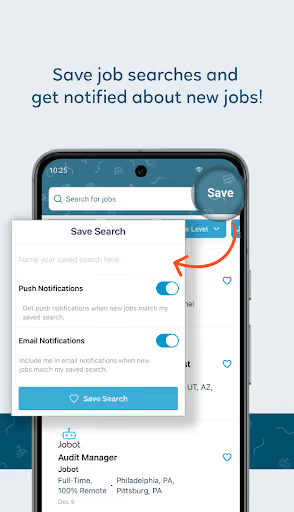
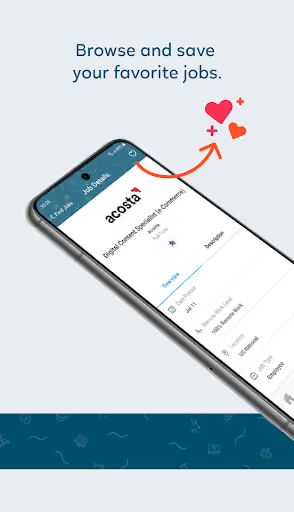
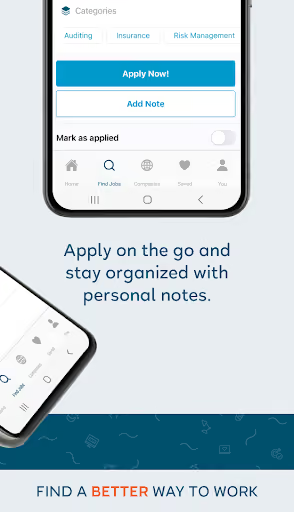
Remote Jobs Search - FlexJobs is a free-to-download Android app for remote, work-from-home, hybrid, freelance, part-time, and full-time jobs. The listing says FlexJobs vets every job and company, has over 50 categories, and offers subscriptions after limited free access.
What it does
Remote job search, saved jobs, saved companies, notes, alerts, recommendations, employer research, and career webinars.
What changed
Recent reviewers say core actions are effectively locked: applying, seeing the company, and sometimes full job details require an upgrade.
Why it is soft
The app has 511,382 installs and a 4.0★ lifetime rating, but the current review stream gives a competitor unusually plain positioning: free applications, visible companies, honest filters.
Strengths
This is not a weak incumbent. FlexJobs’ promise is valuable: vetted listings, scam reduction, direct company-site applications, many categories, and career support. A few positive reviewers still praise the clean interface, easy navigation, real work-from-home listings, and the feeling that the price can be fair when the listings are good.
Trust asset
Vetting jobs is the product’s strongest differentiator; users do want fewer scams and less job-board spam.
Installed base
More than half a million installs means the category has demand a new entrant would otherwise have to prove from zero.
Workflow habit
Saved jobs, alerts, company research, and direct apply redirects are sticky if the listings remain credible.
Market gap
The complaints cluster around trust, not lack of demand. The strongest opening is not “another remote jobs app”; it is a transparent job board that never charges users merely to see or apply to jobs.
Paywall before value
The most common complaint is emotional and direct: people looking for work do not want to pay before seeing the company or applying.
Disclosure and billing trust
Several reviewers say the cost or renewal was not clear enough, and some describe cancellation or unauthorized-charge problems.
Filters and relevance
A recurring product complaint is that remote, location, entry-level, and experience filters return jobs that do not match the user’s stated needs.
Listing freshness
A smaller but serious cluster says jobs are outdated, missing at company sites, fake-looking, or indistinguishable from results on free boards.
Never even got started. First thing it asks you for is a review or if you're liking the app. The one you haven't used yet. The second thing is to "upgrade". Considering downloading it is the only thing you can do free and that you can't even see the companies posting ads unless you spend money. This should not be even allowed to be listed as free. As for how it works I couldn't tell you but I will say to stay away and look on LinkedIn or any other actually free service. DO NOT WASTE YOUR TIME
I like how the jobs are screened to limit scams and false job postings, however there are definitely some things that could be better in the app itself. For one, even if you filter 100% remote or give a certain state/location, many of the jobs then that show up aren't actually 100% remote or require travel half way across the country. Additionally, setting a filter to entry level you still get mid+ level jobs. there are a few other things I dont like about the app and its lack of tailoring
This app is AWFUL. I signed up for a 7 day ONLY trial at a discount. It said NOTHING about trying to charge me on an auto basis right after. I hate when companies do that; very sneaky! Thankfully, the charge didn't go through, but neither the website nor the app provide ANY way of cancelling the subscription. I had to call to cancel. The young lady who helped me was very kind and sweet. She's the ONE decent person to do with this horrid app/ website. I definitely won't be using it anymore!
- Make all jobs and company names free to view and apply. Do not repeat the exact trigger: job seekers will tolerate paid extras more than a paywall on the core job-search action.
- Monetize only optional tools or employers. A small paid layer for alerts, tracking, or resume help is safer than charging to reveal listings; employer revenue is better aligned but harder for a solo builder to sell.
- Start narrow and verify freshness manually. Pick a few remote-friendly categories, show the source company, check whether jobs still exist, and be stricter on “remote,” “entry level,” and location filters.
Build complexity
Estimated, not derived: one part-time developer, no funding, no team, and no paid acquisition. The app itself is straightforward; the hard part is collecting and validating enough legitimate remote jobs to be useful without FlexJobs’ researcher operation.
| Workstream | Weeks |
|---|---|
| Android search app, auth-lite, saved jobs | 2.0 |
| Job ingestion and source normalization | 2.5 |
| Manual vetting/admin review queue | 2.0 |
| Remote/location/level filters and alerts | 2.0 |
| Optional paid tools and billing | 1.0 |
| QA, Play listing, policy, support setup | 2.5 |
| Total | 12.0 |
Expected revenue
Estimated, not derived: the honest solo-builder model is free job access, with an optional $8/month job-search toolkit for power users. That avoids the disliked pay-to-apply model, but it also caps revenue because many job seekers are cash-constrained and organic Play traffic is slow.
| Month 12, monthly funnel | Assumption | |
|---|---|---|
| Installs | 2,400 | organic only |
| Activated | 900 | 38% |
| Still active at 30d | 420 | 18% |
| Paid toolkit subscribers | 100 | $8/month |
| Revenue | $800 | MRR |
Biggest challenges
The biggest solo-builder risk is not coding the app; it is earning trust in a scam-heavy category while maintaining a fresh, vetted job database without a research team, employer sales motion, or official integrations into every company career site.
Cold-start trust
A new app with no review history is asking users to trust it in a category where reviewers already suspect scams.
No clean job source
Company career pages vary, expire quickly, and may not expose a stable API; manual QA becomes part of the product.
Revenue mismatch
The clearest market demand is “do not charge applicants,” but the easiest app-store monetization is charging applicants.
AI angle
There is a real but limited AI angle: AI can cheaply classify listings, flag likely hybrid roles mislabeled as remote, summarize requirements, and detect missing pay or experience signals. It does not solve the moat: legitimate job supply and trust still require sourcing, verification, and support.
Useful AI
Parse job descriptions into remote type, location constraints, seniority, pay visibility, and resume keywords faster than hand-tagging every listing.
Not a moat
AI cannot guarantee that a posting is live, that an employer will respond, or that users will trust a new job board.
Conclusion
Skip it. There is a real gap, but not a great solo-business opportunity: the winning product must be free where users are most angry, while the expensive part is continuously vetting fresh jobs. Build only if you already own an audience in a narrow remote-work niche.
12 weeks
Time to v1
$8/mo
Optional toolkit, jobs free
$800
Month-12 revenue
paywall
Fact that decides it