Abstract
AppClose has 1,248,581 installs, a 4.3★ lifetime rating, and a product category with unusually high switching pain because many families use it under court order. Recent reviewers describe a trust break: communication that used to be free is now behind a subscription, while paid users also report locked messaging, billing failures, poor support, broken search, and unreliable exports. A solo builder should not try to clone the whole platform; the wedge is a reliable, court-ready messenger with free basic contact and paid documentation tools.
Background
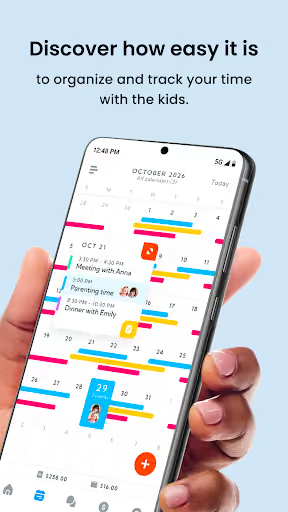
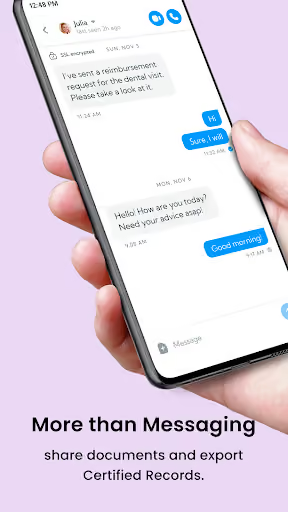
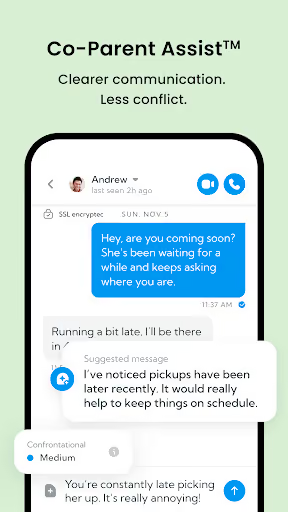
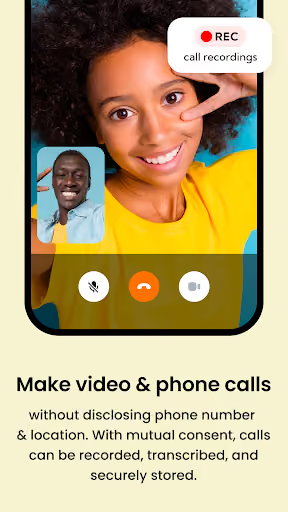
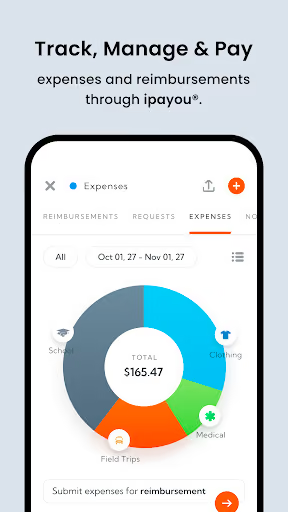
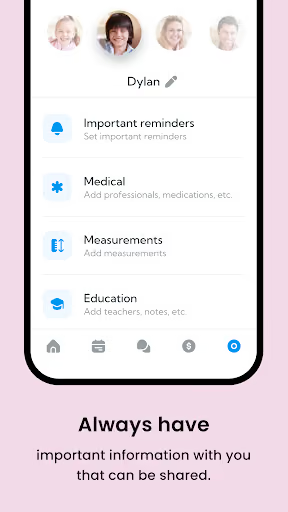
AppClose: Co-Parent Essentials is a co-parenting platform for secure messages, shared calendars, calls, expense tracking, payments, check-ins, child information, file storage, and court-ready record exports. The store listing is Free, but recent reviews repeatedly say basic communication now requires a subscription.
What it does
It gives separated parents a single place for unalterable communication, schedules, expenses, calls, files, and exportable records for court or professionals.
What changed
Reviewers who had used the app for years say messaging, reading messages, calls, or continued access are now blocked unless they pay, and some say payment still does not activate access.
Why it is soft
The pain is not just price; it is trust. Court-ordered users cannot casually ignore missed messages, broken exports, or support silence, so a credible alternative can win by being narrower but more dependable.
Strengths
This is not a weak incumbent. AppClose already has broad awareness, 1,248,581 installs, a 4.3★ lifetime average, and a feature set that spans communication, scheduling, reimbursements, call recording, transcripts, storage, and exports.
Court and professional habit
The description says the platform is widely used and court-ordered, which means the incumbent benefits from institutional familiarity a new app will not have on day one.
All-in-one scope
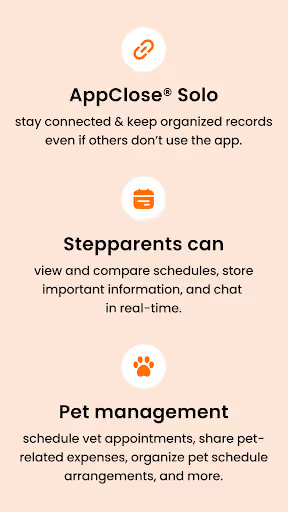
Expense tracking, payments, call logs, transcripts, records, and family-circle roles are real product depth; a competitor should pick a wedge instead of matching everything immediately.
Some users still see value
Even in the recent sample, a positive review praises user friendliness and unalterable messages, which confirms the category need is real even when the current implementation frustrates users.
Market gap
The complaints cluster around a broken bargain: parents accept accountability software when it helps them document and communicate, but they reject being charged for essential contact while reliability and support feel worse.
Paywalled communication
The most common complaint is moral and practical: users say they are court-ordered to communicate through the app, but basic messages, calls, or reading updates are blocked unless they subscribe.
Paid but still locked out
A recurring complaint is that payment does not reliably unlock service: reviewers describe active subscriptions, double charges, failed cancellations, refund loops, and slow or canned support while messaging remains unavailable.
Court records are hard to retrieve
Reviewers repeatedly ask for dependable history: search by date, usable scrolling, exports that work, and access to older messages needed for evidence.
Reliability and usability gaps
A smaller but important cluster names poor calls, crashing video, unreliable media, confusing calendars, notification issues, and a hard-to-navigate interface.
It No Longer Free to Call My Child. Although they offer financial assistance for people struggling, on paper I'm not struggling. In real life I am. I was court ordered to use this app and now I'm forced to paying for something that should be free. video, phone calls, and texts should be free. documentation should cost if there's going to be a cost. But to charge to make calls is ridiculous. Everything is high in this economy. It's evil to put a price on being able to contact your child.
to many bugs. can't search anything it just buffs,won't load. scrolling through, to find certain messages it buff won't load. this was on going before charging people. obersevation: shouldn't be charging till the app is stable. and also put on the app where someone can search by date as well.
- Make basic contact free. The strongest opening is not “cheaper AppClose”; it is “parents can always message, receive, and keep a basic calendar without a paywall.” Charge for court packets, advanced export, and professional sharing instead.
- Build evidence retrieval before breadth. Date search, stable message history, topic-friendly organization, and reliable PDF exports answer the court-record complaint more directly than adding payments, pets, or recorded video first.
- Treat billing and support as product features. Visible cancellation, clear waiver status, payment-state diagnostics, and human escalation matter here because a billing bug can become a missed-child-contact or court-compliance problem.
Build complexity
Estimated, not derived: one developer, part-time, no funding, and no paid acquisition. This v1 is a narrow competitor, not a full AppClose clone: secure messaging, shared calendar, immutable audit trail, search, exports, notifications, and billing/waiver plumbing.
| Workstream | Weeks |
|---|---|
| Secure accounts, circles, invites, and roles | 2 |
| Audit-logged messaging, attachments, and read state | 4 |
| Calendar, requests, and notifications | 2 |
| Search, date filters, history, and export packets | 2.5 |
| Billing, free core tier, waiver flow, and admin tools | 1.5 |
| Reliability, privacy, QA, and Play launch | 4 |
| Total | 16 |
Expected revenue
Estimated, not derived: assume basic messaging and calendar stay free, while paid users buy a $9/month records plan for advanced search, certified export packets, storage, and professional sharing. The month-12 funnel below assumes organic discovery from people searching for an AppClose alternative, not paid acquisition.
| Month 12, monthly | ||
|---|---|---|
| Installs | 8,000 | |
| Activated | 4,000 | 50% |
| Retained | 2,000 | 25% |
| Paid | 900 | $9/month |
| Revenue | $8,100 |
Biggest challenges
Court-market trust
The hardest part is credibility: a new app has to convince stressed parents, attorneys, and possibly court-facing professionals that its messages and exports are dependable enough for evidence, while AppClose already describes itself as widely used and court-ordered.
Reliability burden
A solo builder cannot treat outages, missing notifications, broken exports, or account lockouts as normal bugs; in this category they can become missed-child-contact or court-compliance problems.
Support load
The competitor’s wedge depends on doing billing, waivers, cancellation, refunds, and human escalation better, but those are exactly the tasks that become exhausting for one part-time builder with no support team.
AI angle
The court-record complaints ask for more than date search: AI can index message history semantically and pre-draft a chronologically organized export packet, a capability the incumbent's plain scrolling-and-buffering search doesn't offer at all.
Without AI
Parents scroll and search by exact keyword or date, and building a court packet means manually assembling a message history — exactly the retrieval pain in the market_gap complaints.
With AI
Semantic search finds relevant exchanges regardless of exact wording, and a summarization pass can pre-draft the export packet's chronology — inside the existing search/export workstream rather than adding a new one.
Conclusion
Build it. Do not build a bloated co-parenting suite; build the dependable communication-and-records layer AppClose users say they need when the current app blocks contact, loses history, or fails to export evidence. The distribution risk is real because court-ordered defaults are sticky, but the product wedge is unusually clear.
16 weeks
Time to v1
$9/month
Core contact free; records paid
$8,100
Revenue at month 12
1,248,581
Existing installs facing a trust break